Sleep


Yes, snoring can be unhealthy — it's often a warning sign of restricted airways, poor sleep quality, or underlying conditions like obstructive sleep apnea that increase your risk of heart disease, stroke, and daytime cognitive impairment.
Not all snoring signals a health emergency. Occasional, quiet snoring after a cold or a late-night drink is usually harmless. But habitual snoring — the kind that happens most nights and disrupts your sleep or your partner's — deserves attention. The vibration itself isn't the problem; it's what that vibration reveals about how well air is moving through your airway while you sleep.
Also Read: Snoring vs Sleep Apnea: Key Differences & When to Worry
Snoring occurs when air flows past relaxed tissues in your throat, causing them to vibrate and produce sound — and the louder or more frequent the snoring, the greater the airway obstruction.
During sleep, the muscles in your soft palate, tongue, and throat relax. In most people, this relaxation is mild and air passes freely. But when these tissues relax too much or when the airway is already narrowed (from anatomy, weight, or congestion), the airflow becomes turbulent. That turbulence makes the tissues flutter like a flag in the wind, producing the snoring sound.
The volume and pattern of snoring tells you something important. Soft, occasional snoring usually means minimal obstruction. Loud, rattling snoring with pauses or gasping suggests the airway is collapsing partially or completely — a hallmark of obstructive sleep apnea.
"Snoring is produced by vibration of the soft palate and other soft tissue in the upper airway. It is a sign of increased upper airway resistance." — American Academy of Sleep Medicine
Chronic snoring — especially when paired with breathing pauses — puts measurable strain on your cardiovascular system and can impair cognitive function over time.
Habitual snoring is independently associated with higher rates of hypertension, coronary artery disease, and stroke. The mechanism is straightforward: when your airway narrows or closes during sleep, your oxygen levels drop. Your body responds with a surge of stress hormones, your blood pressure spikes, and your heart works harder to compensate. Night after night, this pattern damages blood vessel walls and promotes inflammation.
A 2024 meta-analysis in the European Heart Journal found that people who snore regularly have a 26% higher risk of cardiovascular events compared to non-snorers, even after controlling for weight and age.
Fragmented sleep from snoring prevents your brain from completing full sleep cycles. Deep sleep and REM sleep are when memory consolidation happens — when your brain files away what you learned during the day. Snorers often spend less time in these restorative stages because micro-arousals (brief awakenings you don't remember) keep pulling them into lighter sleep.
The result: daytime fatigue, difficulty concentrating, slower reaction times, and over years, potentially accelerated cognitive decline. A 2023 study in Neurology linked chronic snoring in middle age to earlier onset of mild cognitive impairment.
Also Read: Does Snoring Mean Deep Sleep? The Truth About Sleep Quality
Snoring becomes a red flag for obstructive sleep apnea (OSA) when it's accompanied by breathing pauses, gasping or choking sounds, and excessive daytime sleepiness.
Simple snoring and sleep apnea exist on a spectrum. Not everyone who snores has apnea, but nearly everyone with apnea snores. The distinction matters because untreated sleep apnea carries serious health consequences — and it's often the bed partner, not the snorer, who notices the warning signs.
| Feature | Simple Snoring | Obstructive Sleep Apnea |
|---|---|---|
| Sound pattern | Steady, rhythmic | Interrupted by silences then gasps |
| Breathing pauses | None or rare | Frequent (5+ per hour) |
| Oxygen levels | Normal | Drop during apneas |
| Daytime sleepiness | Mild or none | Moderate to severe |
| Morning headaches | Uncommon | Common |
| Health risk | Low to moderate | High |
If your partner reports that you stop breathing, snort, or gasp during sleep — or if you wake up exhausted despite a full night in bed — a sleep study is the only way to know for certain whether you have apnea.
"Obstructive sleep apnea is a common and serious disorder in which breathing repeatedly stops for 10 seconds or more during sleep. The disorder results in decreased oxygen in the blood and can briefly awaken sleepers throughout the night." — National Heart, Lung, and Blood Institute
Also Read: Is Snoring Normal? When to Worry & When to Relax
Snoring risk increases with factors you can control (weight, alcohol, sleep position) and factors you can't (anatomy, age, sex).
Excess weight — especially around the neck — is one of the strongest predictors of snoring. Fat deposits narrow the airway and make tissues more likely to collapse during sleep. Studies show that a neck circumference over 17 inches in men or 16 inches in women significantly increases snoring frequency.
The good news: weight loss often reduces or eliminates snoring. Even a 10% reduction in body weight can meaningfully improve airway patency.
Alcohol relaxes throat muscles more than natural sleep does. Drinking within three hours of bedtime makes tissues floppier and more prone to vibration. Many people who don't normally snore will snore after a few drinks.
Sleeping on your back allows gravity to pull the tongue and soft palate backward, narrowing the airway. Side sleeping keeps the airway more open. A tennis ball sewn into the back of a sleep shirt is a classic (if uncomfortable) way to train yourself to stay on your side.
Men are about twice as likely to snore as women, partly due to anatomical differences in airway size and partly due to fat distribution patterns. Women's snoring rates increase after menopause when hormonal changes affect airway muscle tone.
Also Read: Does Weight Gain Cause Snoring? 6 Facts & How to Fix It
Beyond heart and brain impacts, chronic snoring can cause sore throats, headaches, relationship strain, and poor quality of life.
Mouth breathing and tissue vibration dry out and irritate the throat. Many habitual snorers wake up with a raw, scratchy throat that improves as the day goes on. Humidifying the bedroom and addressing nasal congestion can help.
Morning headaches are common in snorers, especially those with apnea. The likely culprit is a combination of oxygen desaturation during the night and sleep fragmentation, both of which can trigger vascular headaches.
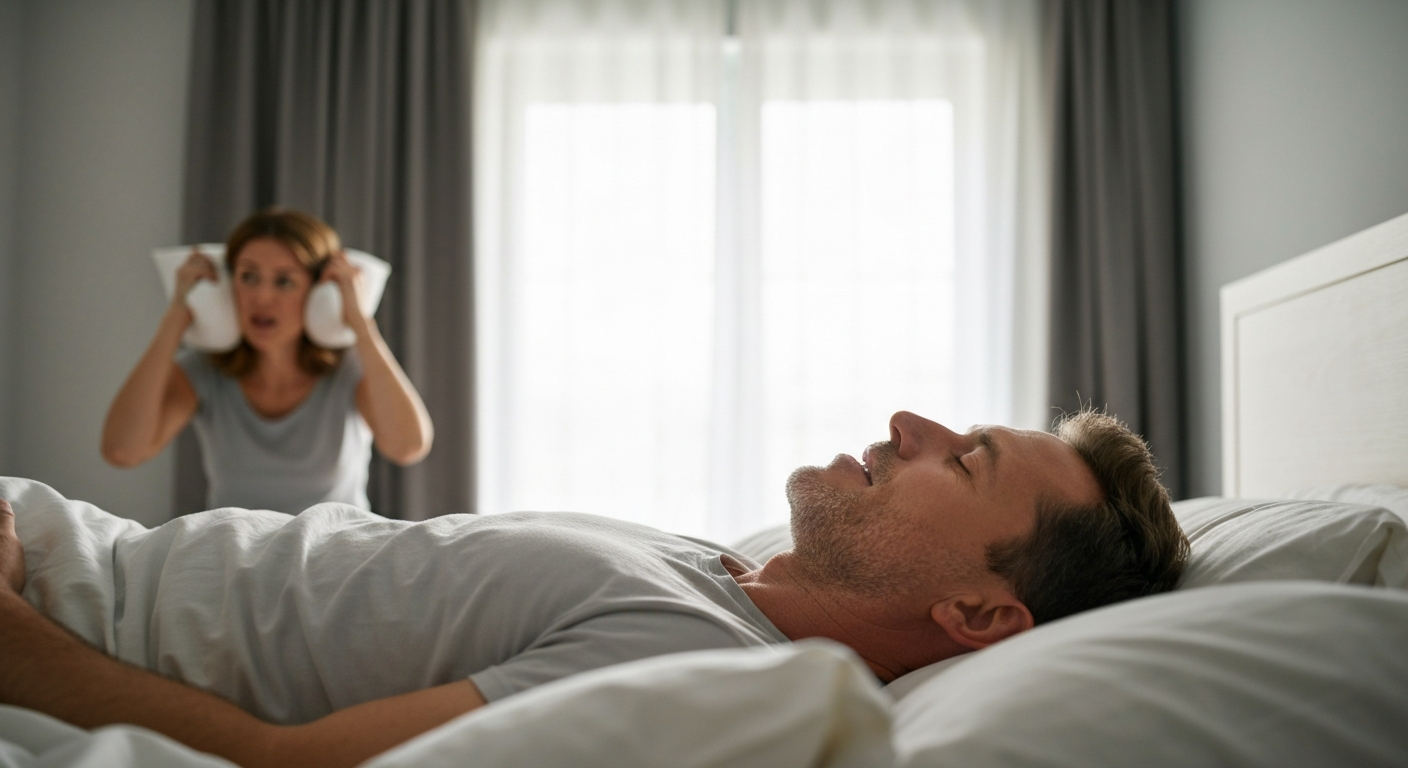
Bed partners of snorers lose an average of one hour of sleep per night. Over time, this sleep debt contributes to the partner's own health issues — irritability, impaired immune function, and relationship conflict. Studies show that treating one person's snoring improves both partners' sleep quality and relationship satisfaction.
Diagnosis starts with a sleep study (polysomnography or home sleep test), and treatment ranges from lifestyle changes to devices to surgery depending on severity.
A sleep study measures your brain waves, blood oxygen, heart rate, breathing patterns, and body movements overnight. It can distinguish simple snoring from sleep apnea and quantify how many times per hour your breathing is disrupted (the apnea-hypopnea index, or AHI).
| Treatment | Best For | How It Works |
|---|---|---|
| Weight loss | Overweight snorers | Reduces airway compression |
| Positional therapy | Back-sleeping snorers | Encourages side sleeping |
| Nasal strips/dilators | Nasal obstruction | Opens nasal passages |
| Oral appliances (MADs) | Mild-moderate snoring/apnea | Repositions jaw to open airway |
| CPAP | Moderate-severe apnea | Delivers pressurized air to keep airway open |
| Surgery | Anatomical obstruction | Removes or stiffens excess tissue |
Mandibular advancement devices (MADs) — custom-fitted mouthpieces that hold the lower jaw forward — are among the most effective non-surgical options for snoring and mild apnea. They work by preventing the tongue and soft tissues from collapsing backward.
| ✓Our Pick |
Custom-fit snore mouthpiece that repositions your jaw for quieter sleep This is what many people find solves the problem quickly, without a costly professional visit. Learn More → |
Snoring is often more than a nuisance — it's a signal that your airway is struggling during sleep. Habitual, loud snoring increases cardiovascular risk, fragments sleep quality, and may indicate obstructive sleep apnea. The healthiest response is to identify what's causing your snoring (weight, anatomy, sleep position, or apnea) and address it directly. A sleep study provides answers, and treatments ranging from weight loss to oral appliances to CPAP can resolve most cases.
Yes, especially if your snoring is loud enough to disturb a partner, happens most nights, or comes with gasping, choking, or excessive daytime tiredness. These patterns suggest your sleep quality is compromised and you may have obstructive sleep apnea. A doctor can order a sleep study to determine severity and recommend appropriate treatment.
Chronic snoring can irritate and inflame throat tissues, leading to recurring sore throats and a dry, scratchy feeling each morning. While it doesn't typically cause permanent throat damage in most people, the vibration and mouth breathing do stress the tissues. Addressing the underlying cause — whether nasal congestion, sleep position, or apnea — protects your throat.
Occasional snoring is common and usually harmless. Snoring every single night, however, suggests a consistent airway issue that deserves evaluation. Nightly snoring increases your risk of sleep apnea, cardiovascular problems, and cognitive impairment over time. If you or your partner notice that snoring happens without fail, schedule a medical evaluation.
Snoring often increases with age as muscle tone in the throat decreases and tissues become more prone to collapse. Weight gain, hormonal changes (especially in postmenopausal women), and medications that relax muscles can compound the effect. Addressing modifiable factors like weight and sleep position can offset some age-related worsening.
Yes. While some childhood snoring is normal, habitual snoring in children — especially with mouth breathing, restless sleep, or behavioral issues — can indicate enlarged tonsils, adenoids, or pediatric sleep apnea. Untreated, it can affect growth, learning, and behavior. A pediatrician or ENT specialist should evaluate children who snore regularly.
Reviewed and Updated on June 14, 2026 by George Wright