Sleep

Snoring during sleep can almost always be reduced — even when it cannot be fully eliminated — by combining a few targeted interventions. The most effective reduction methods address airway muscle tone (with a MAD), sleep position, bedroom air quality, and behavioral triggers like alcohol and late-heavy meals. Most people see measurable improvement within two to four nights of making these changes.
The environment your airway breathes in for eight hours every night directly affects how much your throat tissues vibrate and dry out during sleep.
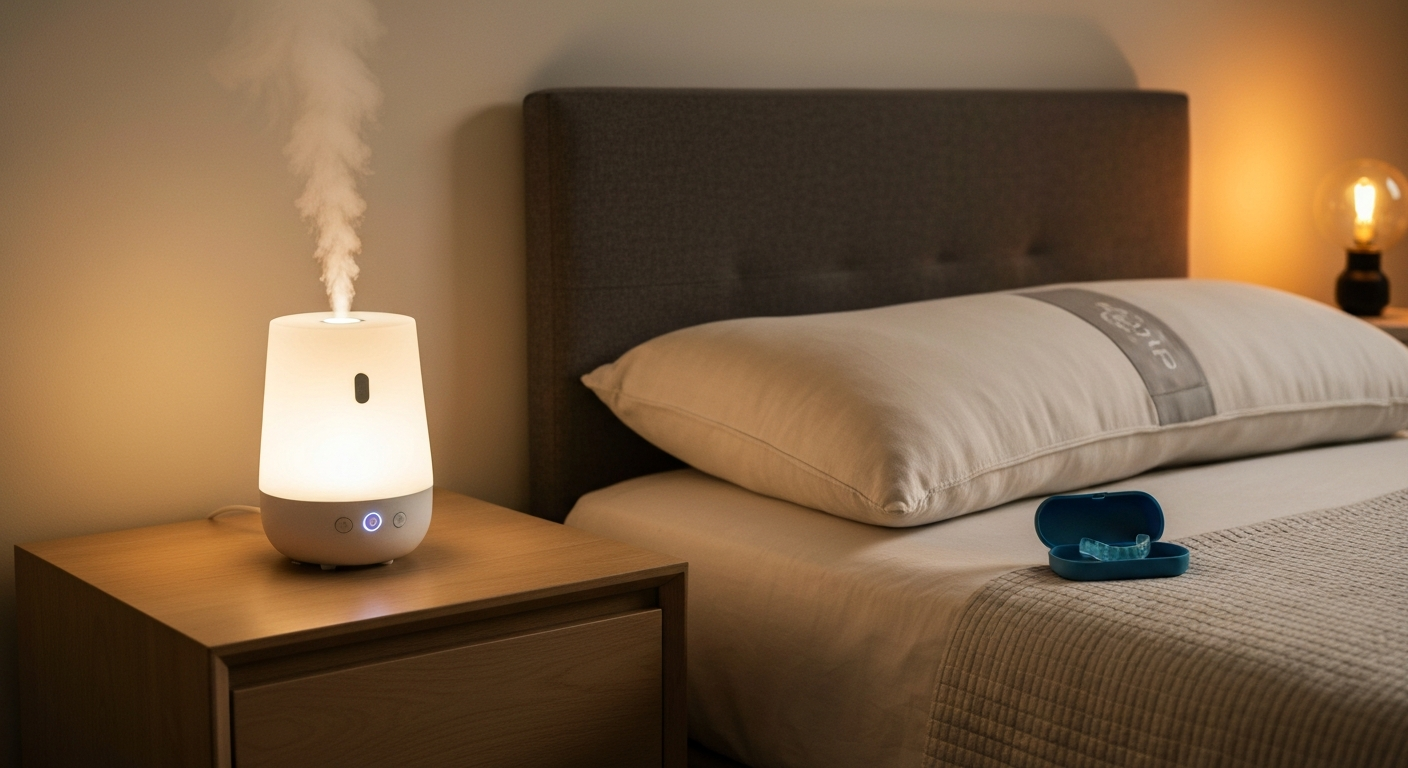
Dry indoor air desiccates the mucous membranes lining the throat and nasal passages. Dehydrated tissues swell slightly and become stickier, which increases vibration resistance and worsens snoring sound intensity. A bedroom humidifier maintaining 40–50% relative humidity reduces this desiccation.
"Upper airway mucosal hydration has a significant effect on airflow resistance. Humidification of inspired air reduces nasal and pharyngeal mucosal inflammation in patients with snoring and obstructive sleep apnea." — National Institutes of Health at nih.gov
A cool-mist ultrasonic humidifier placed 3–4 feet from the bed on the bedside table delivers humidity to the breathing zone without raising room temperature. In winter months — when heating systems drop indoor humidity to 20–30% — a humidifier can reduce snoring intensity noticeably on the first night.
Allergic inflammation of nasal passages forces mouth breathing, which compounds snoring. Dust mites — concentrated in pillowcases, mattresses, and duvets — are the most common night-time allergen source. Encasing the mattress and pillows in allergen-barrier covers and washing bedding weekly in hot water (at least 130°F / 54°C) reduces allergen exposure substantially.
Also Read: Why Snoring Causes Dry Mouth: 7 Causes & How to Fix It
Body position changes the geometry of the upper airway by changing the gravitational pull on the tongue, soft palate, and pharyngeal walls. Sleeping on your back is the position of maximum airway narrowing; sleeping on your side reduces it significantly.
When you sleep supine (on your back), the tongue and soft palate fall backward directly into the airway under gravity. This narrows the passage and dramatically increases airflow turbulence — producing louder, more frequent snoring. For tongue-base snorers in particular, the supine position is responsible for the majority of snoring events.
Rolling onto your side repositions the tongue laterally rather than rearward, widening the central airway channel. Side-sleeping alone can reduce snoring frequency by 50% or more in position-dependent snorers.
Practical tools for staying on your side:
| ✓Our Pick |
SnoreMeds custom moldable MAD — reduces snoring by repositioning the jaw forward during sleep A top-rated pick that works — readers who tried this reported noticeable improvement within days. Learn More → |
Mechanical devices that physically hold the airway open are the most reliably effective tools for snoring reduction during sleep.
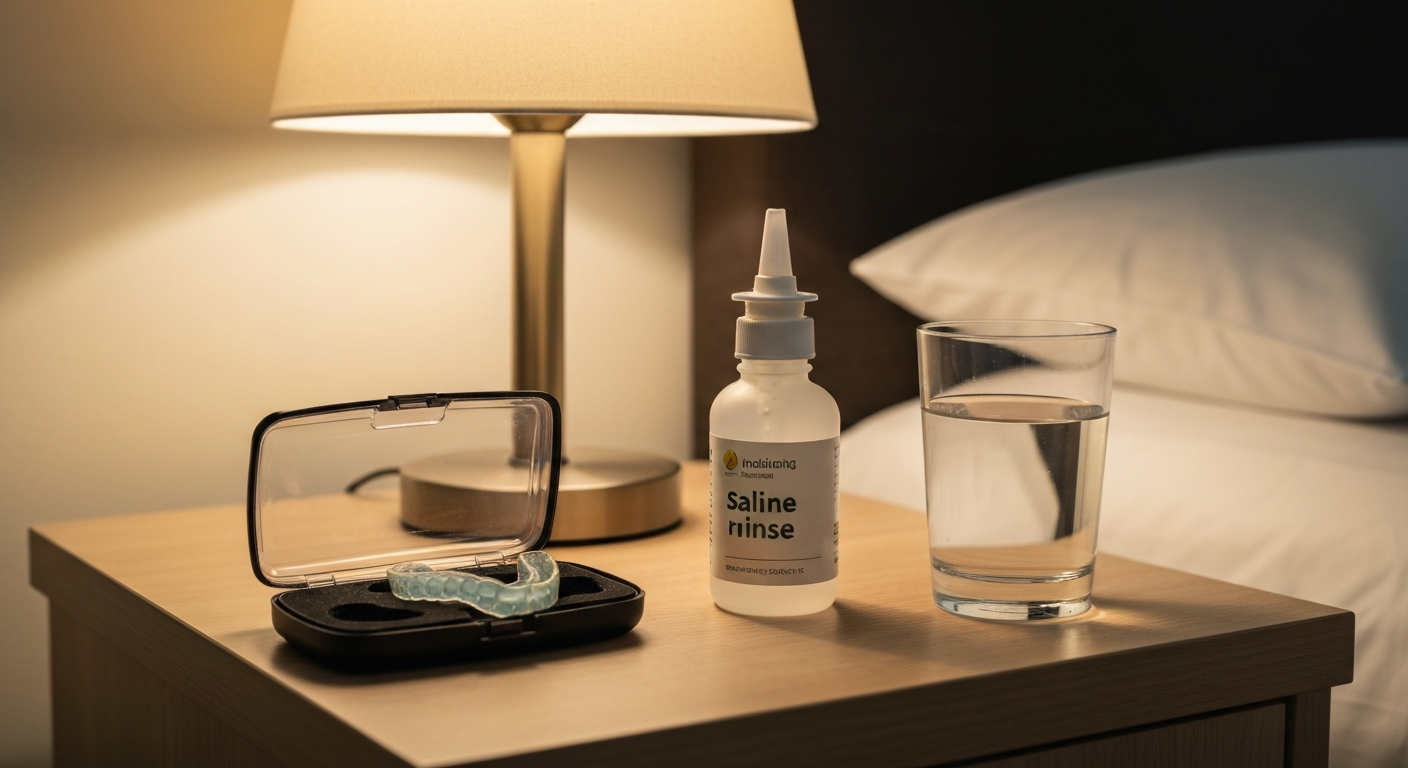
A MAD is a custom-moldable or dentist-fabricated mouthguard that holds the lower jaw slightly forward during sleep. This jaw repositioning pulls the tongue base forward, away from the posterior airway wall, and stiffens the soft palate by changing its resting angle. The net effect is a wider, more stable airway with less vibrational tendency.
Clinical studies consistently show MADs reduce snoring index (frequency and loudness combined) by 50–75% in compliant users. Unlike positional methods, MADs work in all sleep positions — including supine — making them the go-to device for people who cannot reliably maintain side-sleeping.
Boil-and-bite MADs like those from SnoreMeds allow the user to mold the device to their teeth at home. They cost significantly less than custom dental appliances while providing comparable functional benefit for most users.
Nasal strips (adhesive strips applied across the bridge of the nose) physically widen the nasal passage by pulling the nasal walls outward. Internal nasal dilators (soft plastic cones or Y-shaped inserts placed inside the nostrils) achieve the same effect from inside. Both work well when nasal congestion or narrow nasal passages are a major contributor to snoring.
Neither nasal strips nor dilators address tongue-base or palatal snoring — they specifically target nasal airflow resistance. For mixed-cause snorers, they work best in combination with a MAD.
Also Read: Mute Snore: How These Anti-Snoring Devices Work in 2026
Upper airway muscle tone at night is the underlying variable that determines how much the airway collapses during sleep. Exercises that strengthen these muscles can reduce snoring by improving their resting tone.
Myofunctional therapy involves deliberate exercises of the tongue, soft palate, and pharyngeal muscles, practiced for 8–15 minutes daily. A randomized controlled trial published in Sleep (2015) found that a 3-month myofunctional therapy program reduced snoring frequency by 36% and loudness by 59% compared to control.
"Oropharyngeal exercises significantly reduced the frequency and total power of snoring and were associated with improvements in sleep quality and sleepiness. This approach is a viable and beneficial treatment for primary snoring." — American Journal of Respiratory and Critical Care Medicine at atsjournals.org
Example exercises:
- Tongue push: Press the tongue flat against the roof of the mouth and hold for 3 seconds, 10 repetitions
- Soft palate lift: Repeatedly lift the soft palate by saying "ahh" and holding the raised position for 2 seconds
- Tongue slide: Slide the tip of the tongue backward along the roof of the mouth 20 times
- Jaw advancement hold: Push the lower jaw forward and hold for 30 seconds
Results from myofunctional therapy are cumulative — minimal in the first two weeks, meaningful after 6–8 weeks, and strongest after 3 months. It pairs well with other interventions rather than replacing them.
Snoring is worsened by any factor that further relaxes the pharyngeal muscles or increases tissue volume in the upper airway. Modifying these factors reduces snoring without devices.
Avoid alcohol within 3 hours of sleep: Alcohol relaxes pharyngeal muscles beyond their normal sleep-related relaxation, significantly increasing airway collapsibility. Studies show snoring duration and loudness are higher on alcohol nights regardless of the drinker's baseline snoring level.
Avoid heavy meals close to bedtime: A full stomach pushes the diaphragm upward, reducing lung volume and increasing respiratory effort during sleep. This increases the negative pressure that draws the pharyngeal walls inward. Allow 2–3 hours between your last large meal and sleep.
Hydrate consistently throughout the day: Systemic dehydration thickens mucus and dries throat tissues, increasing friction during airflow. Well-hydrated tissue vibrates less aggressively. Drinking 6–8 glasses of water daily supports mucous membrane health generally.
Also Read: Does Drinking Make You Snore? 6 Facts & Fixes
If snoring reduction strategies improve sleep quality for the bed partner and reduce your waking symptoms but do not eliminate snoring entirely, that is a reasonable outcome for primary snoring. Snoring that is accompanied by witnessed apneas, gasping, morning headaches, or extreme daytime fatigue despite adequate sleep time indicates obstructive sleep apnea — a condition requiring formal sleep study evaluation, not just snoring reduction.
Also Read: What Type of Snoring Is Dangerous? 5 Warning Signs
To reduce snoring during sleep: run a bedroom humidifier, sleep on your side, use a mandibular advancement device, and avoid alcohol within three hours of sleep. Adding myofunctional throat exercises produces cumulative improvement over 6–8 weeks. These methods address the four controllable variables in snoring severity — tissue hydration, airway geometry, airway muscle support, and pharyngeal muscle relaxation. Most people achieve a meaningful reduction within the first week by addressing two or more of these simultaneously.
Mandibular advancement devices and side-sleeping produce the greatest immediate reduction in snoring. MADs reduce snoring index by 50–75% in compliant users. Side-sleeping reduces snoring by roughly 50% in position-dependent snorers. Combined, they address both palatal vibration and tongue-base collapse — the two most common snoring mechanisms.
A humidifier reduces the desiccation of throat and nasal tissues that worsens snoring severity, particularly in dry bedroom air (common in winter). It does not address the mechanical causes of snoring — airway collapse and soft tissue vibration — so it is most effective as a complement to other interventions rather than a standalone treatment.
Yes — sleeping on your side, doing daily myofunctional throat exercises, avoiding alcohol, staying hydrated, and maintaining a healthy weight all reduce snoring through behavioral and physiological mechanisms. These approaches produce meaningful reduction over weeks to months. For immediate or more dramatic reduction, anti-snoring devices (MAD, nasal strips) provide faster results.
Position changes and nasal strips produce immediate results on the first night. A MAD typically shows its full effect within 2–4 nights as you adapt to wearing it. Myofunctional therapy takes 6–8 weeks to show meaningful results and is strongest at 3 months. Lifestyle changes (weight loss, stopping alcohol) produce gradual improvement over weeks to months.
Reviewed and Updated on June 16, 2026 by George Wright