Technology
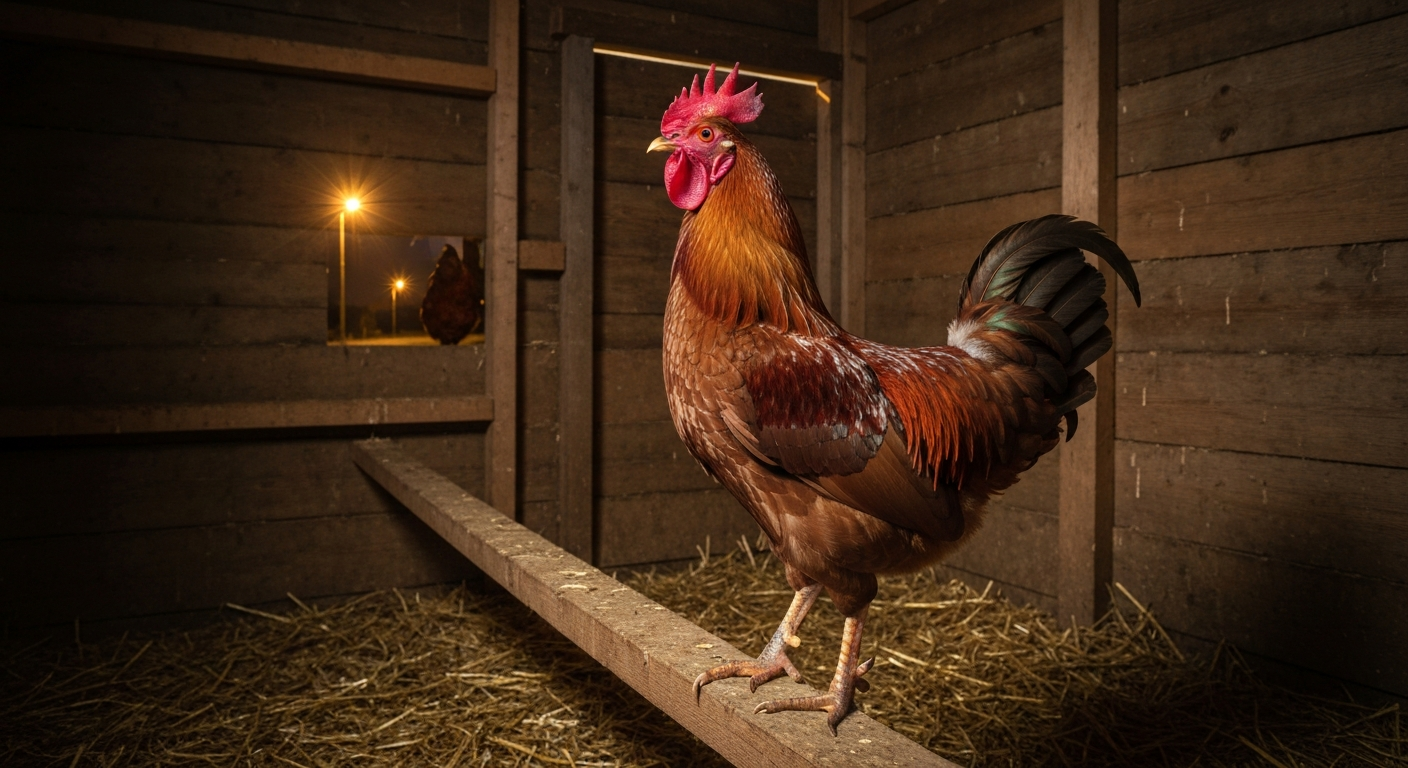

Roosters crow at night primarily because of artificial light pollution, perceived threats from predators, territorial disputes with other roosters, illness or discomfort, or disruptions in their internal circadian rhythm—not simply because they're confused about the time.
| ✓Our Pick |
Motion-activated predator deterrent light for coops Great value for money — this product tackles the root cause rather than just masking the symptoms. See on Amazon → |
Crowing is a rooster's primary communication tool—it announces his presence, establishes territory, and signals to hens that he's on guard.
Many people assume roosters only crow at dawn, but that's a misconception. Roosters crow throughout the day and night in response to various stimuli. The iconic sunrise crow is simply the most noticeable because it happens when everything else is quiet.
A rooster's crow serves several biological purposes. It warns other roosters to stay away from his territory. It reassures hens in his flock that a protector is nearby. It also responds to perceived threats, changes in the environment, or even excitement.
"Roosters have an internal circadian clock that causes them to crow at dawn, but they will also crow in response to external stimuli at any time of day or night." — Dr. Tsuyoshi Shimmura at Nagoya University
Understanding why roosters crow at all helps explain why yours might be sounding off at 2 AM. Something is triggering his instinct to vocalize—your job is to identify what.
| ✓Quick Fix |
See What Solves This in Minutes A fast first step before anything more expensive or time-consuming — worth a look right now. See on Amazon → |
Most nighttime crowing traces back to environmental triggers, health issues, or the rooster's natural instincts being activated at the wrong time.
Artificial light is the number one cause of unexpected nighttime crowing. Roosters rely heavily on light cues to regulate their internal clocks. When a streetlight, porch light, car headlight, or even a neighbor's security light reaches the coop, your rooster may interpret it as the approaching dawn.
Even brief flashes of light can trigger crowing. A passing car, someone checking their phone near the coop, or a motion-activated floodlight can all be enough to set off a vocal rooster.
Roosters are hardwired to alert their flock to danger. If a fox, raccoon, opossum, owl, or even a stray cat prowls near the coop at night, your rooster will sound the alarm. This protective crowing is loud, urgent, and often repeated.
Listen to the quality of the crow. An alarm crow typically sounds more frantic and is often accompanied by other birds stirring, clucking, or making distress sounds. If you hear this type of crowing, investigate immediately—something may be threatening your flock.
Roosters are competitive. If your rooster hears another rooster crow—whether from a neighboring property or even a distant farm—he may feel compelled to respond. This territorial call-and-response can happen at any hour.
Sound travels farther at night when ambient noise is lower. Your rooster might be responding to a bird you can't even hear from inside your house.
A rooster in discomfort or pain may vocalize more than usual, including at night. Respiratory infections, mites, lice, intestinal parasites, or injuries can all cause restlessness and crowing.
Look for other symptoms: labored breathing, discharge from eyes or nostrils, weight loss, lethargy, pale comb, or visible parasites. A healthy rooster generally settles down at night once the coop is dark and secure.
"Behavioral changes in poultry, including increased vocalization, can be early indicators of illness or stress that warrant veterinary attention." — American Veterinary Medical Association
Insufficient space in the coop creates stress. When birds are packed too tightly, they jostle for position on the roost, step on each other, and generally stay more alert. This stress can manifest as nighttime crowing.
The general rule is 4 square feet of coop space per bird and 10 square feet of run space per bird. If you're below these minimums, consider expanding your setup.
Roosters are light sleepers. Loud noises—thunder, fireworks, a barking dog, a slamming door, or even a loud vehicle—can startle your rooster awake and prompt a crow.
If your coop is near a road, driveway, or area with frequent nighttime activity, your rooster may be responding to sounds you barely notice.
Some roosters have internal clocks that run slightly fast. They may genuinely perceive 3 or 4 AM as "close enough" to dawn and begin their morning routine early. This is especially common in summer when days are longer and dawn comes earlier.
Breed can also play a role. Some breeds are known for being more vocal than others. If you have a particularly chatty breed like a Leghorn or Rhode Island Red, you may simply have a more enthusiastic crower.
Also Read: Why Is My Lavender Dying? 7 Causes & How to Save It
Reducing nighttime crowing requires identifying the trigger and addressing it directly—there's no universal "off switch" for a vocal rooster.
Audit your coop's exposure to artificial light. Walk around your property after dark and note any light sources that might reach the coop windows or ventilation openings. Solutions include:
A predator-proof coop reduces alarm crowing and protects your flock. Essential security measures include:
| Vulnerability | Solution |
|---|---|
| Ground digging | Bury hardware cloth 12 inches deep around perimeter |
| Gaps in walls | Use 1/2-inch hardware cloth, not chicken wire |
| Door latches | Install two-step latches raccoons can't open |
| Overhead access | Cover runs with welded wire or netting |
| Night visibility | Add motion-activated lights or alarms outside the coop |
Consider a livestock guardian animal if predator pressure is high in your area.
If your rooster is responding to neighboring roosters, you have limited options. You can try insulating the coop with sound-absorbing materials, relocating the coop farther from property lines, or using white noise inside the coop to mask distant crowing.
If you have multiple roosters, ensure each has enough hens (ideally 8-10 per rooster) and enough space to establish separate territories. Otherwise, consider rehoming extra males.
Schedule a veterinary checkup if nighttime crowing is new or accompanied by other symptoms. Common issues to rule out include:
A healthy, comfortable rooster sleeps more soundly.
Create an environment that encourages rest:
Also Read: Why Is My Hibiscus Not Blooming? 7 Causes & Proven Fixes
No-crow collars don't silence roosters completely—they reduce the volume by restricting the air sac expansion needed for a full crow.
These collars wrap around the rooster's neck and limit how much air he can push through his vocal apparatus. The result is a quieter, shorter crow rather than the full-throated announcement.
Collars require careful fitting. Too loose and they're ineffective. Too tight and they can restrict breathing or cause injury. You'll need to check the fit regularly as feathers grow or compress.
Not all roosters tolerate collars well. Some become stressed, stop eating, or injure themselves trying to remove the collar. Others adapt within a few days. If you try a collar, monitor your rooster closely for the first week.
| Collar Consideration | What to Know |
|---|---|
| Volume reduction | Typically 50-70% quieter |
| Fitting period | Expect 3-7 days of adjustment |
| Daily checks | Required to prevent rubbing or tightening |
| Effectiveness | Varies by individual bird |
| Not a complete solution | Rooster will still crow, just more quietly |
Sudden changes in crowing behavior—especially when combined with other symptoms—warrant immediate attention.
Investigate right away if you notice:
A single night of unusual crowing might just be a passing car or a curious raccoon. Multiple nights of disrupted behavior suggest something in the environment—or in your rooster's health—needs addressing.
Also Read: Why Is My Bonsai Turning Brown? 7 Causes & How to Save It
You can reduce nighttime crowing, but you likely can't eliminate it entirely—crowing is fundamental to what makes a rooster a rooster.
Some crowing is inevitable. Roosters vocalize. It's their nature, their purpose, and their joy. The goal isn't to create a silent rooster but to minimize disruptive nighttime noise to a level you and your neighbors can live with.
If you've addressed light, predators, health, and coop conditions but your rooster still crows occasionally at night, that may simply be his baseline. Some roosters are more vocal than others, and some never fully settle into quiet nights.
For persistent issues that affect your relationship with neighbors, consider:
Roosters crow at night because something triggers their instinct to vocalize—most commonly artificial light, predators, competing roosters, health issues, or environmental disturbances. Address the root cause by eliminating light pollution, securing the coop against predators, reducing overcrowding, and ensuring your rooster is healthy and comfortable. No-crow collars can reduce volume but aren't a complete solution. Some crowing is normal and unavoidable; focus on minimizing disruption rather than expecting total silence.
A consistent 3 AM crow usually points to either a light source activating at that time (security light, streetlight, or passing traffic) or your rooster's internal clock running ahead of actual dawn. Check for any light reaching the coop around that hour. If the environment is truly dark, your rooster may simply be an early riser—some birds naturally wake before sunrise, especially during seasons with longer daylight hours.
Removing the rooster will eliminate his crowing, yes. However, if you have multiple males, another will likely step into the dominant role and begin crowing more. Hens can also make surprisingly loud vocalizations, especially when laying. If you keep chickens for eggs only and don't need fertile eggs, a rooster isn't strictly necessary—but many keepers appreciate the protection and flock dynamics a rooster provides.
Yes. Crowing often increases in spring and summer when daylight hours are longer, breeding instincts are heightened, and dawn arrives earlier. You may notice your rooster starting his morning routine earlier in June than in December. Some keepers find nighttime crowing decreases in winter when nights are longer and darker.
Not really. Crowing is instinctive, not learned behavior, so it can't be trained away like a dog's barking. You can reduce triggers (light, noise, predators) and create conditions that encourage sleep, but you can't teach a rooster to suppress his natural vocalizations. Attempts at punishment or negative reinforcement are ineffective and can harm your relationship with the bird.
It can be. A rooster who suddenly begins crowing excessively at night—especially if he was previously quiet—may be experiencing discomfort, respiratory distress, or parasitic infestation. Check for labored breathing, nasal discharge, weight loss, pale comb, or visible parasites. If environmental factors have been ruled out and the behavior persists, a veterinary exam is worthwhile to identify any underlying health issues.
Reviewed and Updated on June 20, 2026 by George Wright