Sleep
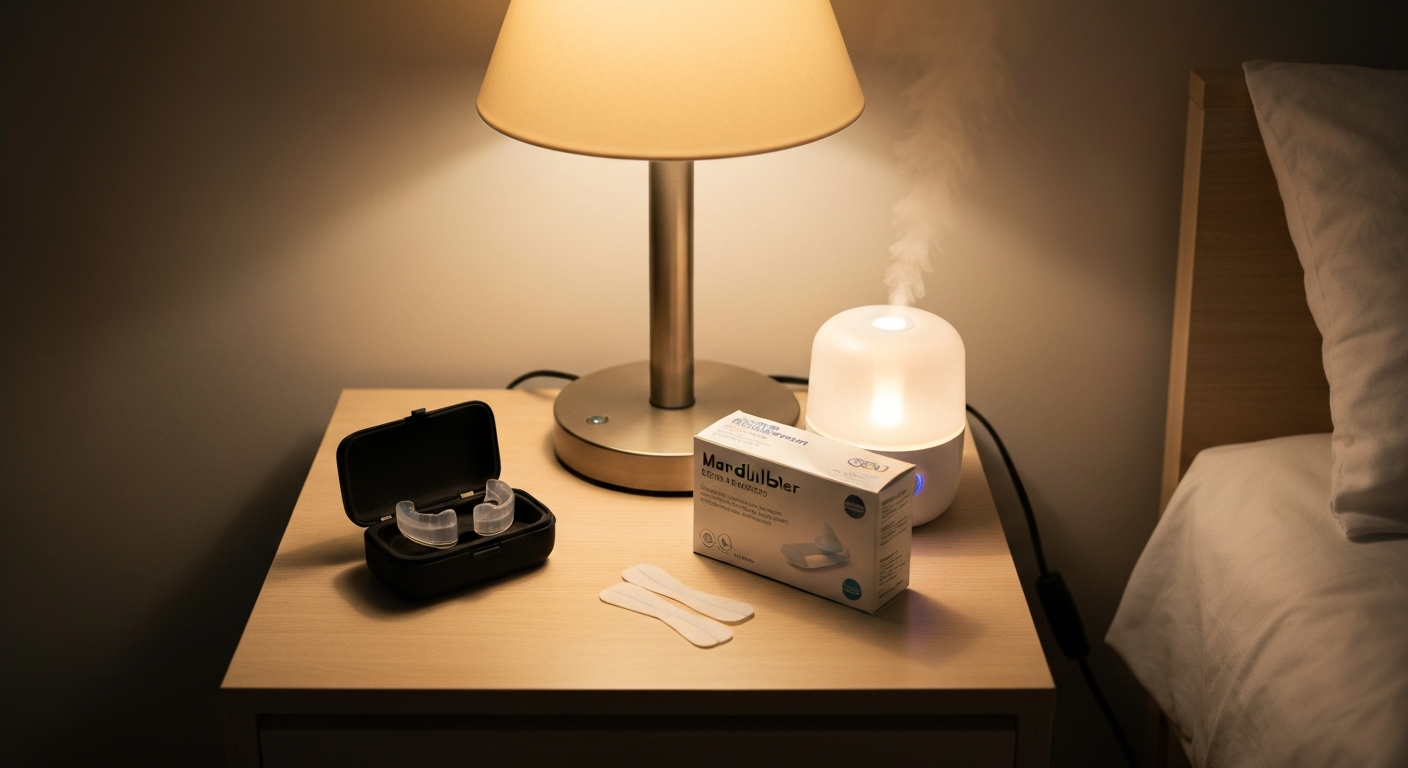

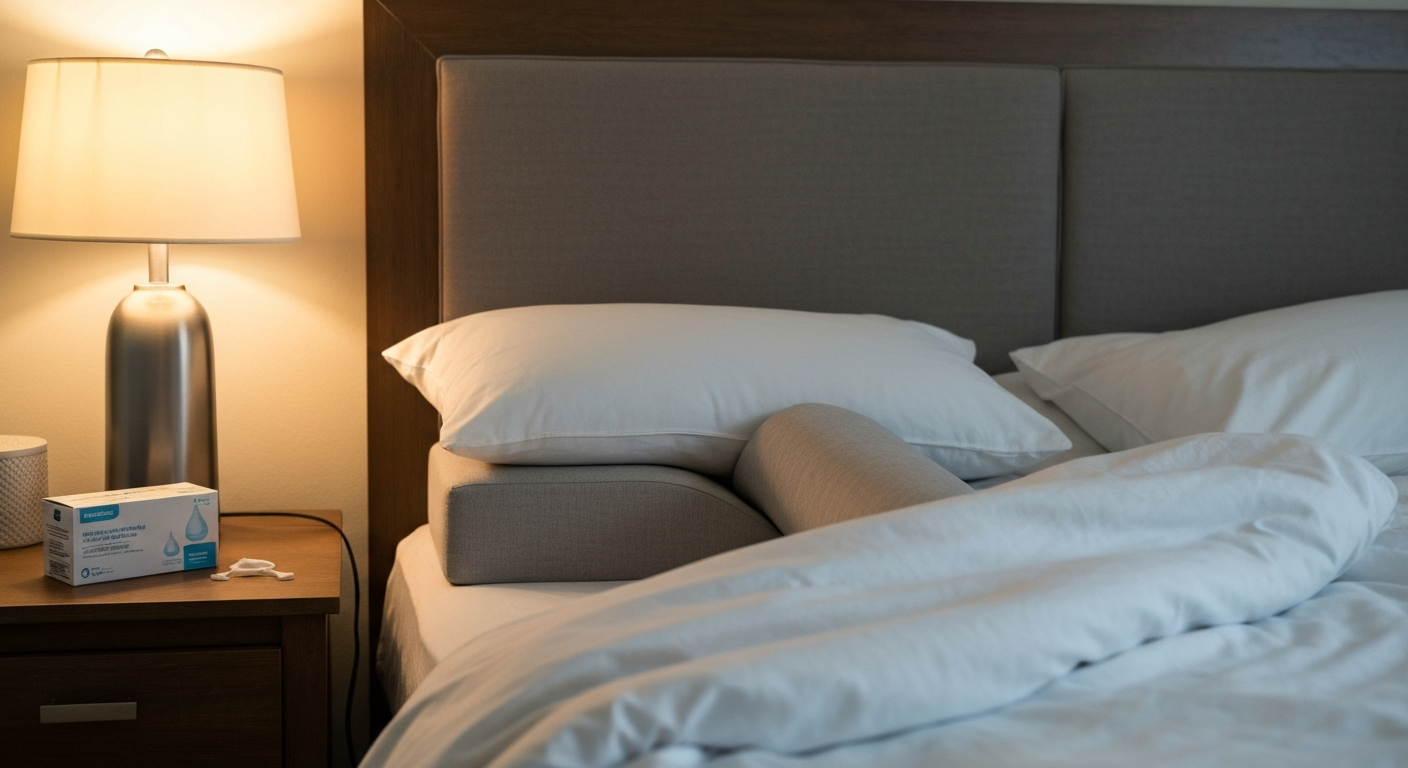
What helps with snoring at night comes down to four interventions that address the immediate mechanical causes: sleeping on your side, applying a nasal strip or dilator, wearing a mandibular advancement device, and running a bedroom humidifier. These work while you sleep — no daytime effort required.
Daytime behavioral changes (alcohol cutoff, weight loss, throat exercises) reduce snoring risk, but they don't directly address what happens during sleep. Nighttime interventions work mechanically — they change the physical conditions inside the airway while you're sleeping.
Snoring happens because the airway narrows, the surrounding tissue relaxes, and passing air causes vibration. Nighttime interventions act on one or more of these variables directly: they change airway geometry (MADs, pillows), reduce tissue dryness (humidifiers), or widen the nasal passage (nasal strips). Their effect begins when you lie down and continues all night.
This makes them the fastest path to reducing snoring — effective from the first night, without the weeks-to-months timeline of behavioral change.
| Intervention | Mechanism | First-Night Effect | Evidence Level |
|---|---|---|---|
| Mandibular advancement device | Jaw repositioning, widens airway | Yes | High |
| Side sleeping (body pillow) | Removes gravitational tongue-fall | Yes | High |
| Nasal strip / internal dilator | Widens nasal passage mechanically | Yes | Moderate |
| Bedroom humidifier | Hydrates throat tissue | Partial | Moderate |
| Head elevation (wedge pillow) | Reduces airway collapse | Yes | Moderate |
| Chin strap | Holds mouth closed | Yes | Low–Moderate |
| Throat lubricant spray | Reduces tissue vibration slightly | Partial | Low |
A MAD is the most reliably effective device for nighttime snoring reduction because it works regardless of sleep position, addresses both tongue-base and palatal snoring, and maintains its effect throughout the night.
By holding the lower jaw slightly forward, a MAD keeps the tongue base away from the posterior airway wall and stiffens the soft palate by changing its resting angle. Clinical trials consistently show MADs reduce snoring frequency and loudness by 50 to 75 percent. Unlike nasal strips, they work for both nasal-origin and throat-origin snoring.
Custom-fit MADs produce better compliance and effect than generic one-size models. SnoreMeds provides a self-impression kit that produces a personalized mouthpiece at home — no dentist appointment needed.
"Mandibular advancement devices are the most widely recommended intraoral device for the treatment of primary snoring, with strong evidence for reducing snoring index (frequency × loudness) in the majority of patients." — American Academy of Dental Sleep Medicine at aadsm.org
| ✓Our Pick |
Reduce snoring tonight with a custom-fit SnoreMeds mouthpiece — repositions your jaw while you sleep Backed by strong customer feedback — the most recommended solution in forums and Q&A communities. Learn More → |
The most effective positional intervention is not reactive (rolling over when snoring starts) but proactive — setting up the correct position before you fall asleep.
Snoring starts in the first sleep cycle, typically within 30 to 60 minutes of lying down. By the time snoring wakes a bed partner or the snorer, it has already been going on for a while. Proactive positioning means:
If you roll onto your back during the night and snore, a positional alarm — a small wearable device that vibrates when it detects supine position — can prompt a roll back to your side without fully waking you.
Also Read: Best Pillow for a Snorer: 4 Types That Actually Work
Nasal strips applied across the bridge of the nose before bed widen the nasal passage and reduce nasal resistance throughout the night.
For people whose snoring has a nasal component — where congestion or narrow nasal anatomy forces mouth breathing — nasal strips produce immediate, measurable results. They work best for:
- Snorers with congestion from allergies, colds, or deviated septum
- People whose snoring improves when they are congestion-free
- Mouth breathers who can breathe through the nose when it's mechanically dilated
Internal nasal dilators (soft inserts placed just inside each nostril) work similarly and are preferred by people who find adhesive strips irritating.
Note: nasal strips and dilators do not address throat-level snoring. If your snoring originates from the soft palate or tongue base, a MAD is more appropriate.
Dry bedroom air — especially common in winter during heating season — desiccates the mucous membranes in the throat and nose. Drier tissue is stickier and vibrates more aggressively, amplifying snoring.
A cool-mist ultrasonic humidifier running at 40 to 50 percent relative humidity reduces this tissue drying throughout the night. The effect is gradual rather than immediate — the humidifier needs about 30 to 60 minutes to bring room humidity to target level. Start it before you go to bed.
Humidifiers don't fix the structural causes of snoring, but they consistently reduce the amplitude (loudness) of snoring in environments with dry air.
Also Read: Why Snoring Causes Dry Mouth: 7 Causes & How to Fix It
Head and upper-body elevation changes airway geometry by using gravity to pull loose throat tissue forward rather than backward into the airway.
A wedge pillow that elevates the upper body at 30 to 45 degrees reduces airway collapse for both back sleepers and side sleepers. It is particularly useful for snorers with acid reflux, which can worsen snoring by causing throat inflammation.
Standard pillow stacking achieves similar elevation but is less stable — pillows compress and shift during the night. A purpose-made wedge pillow maintains its elevation reliably.
The most effective approach combines multiple interventions into a consistent nighttime routine. Each one addresses a different snoring variable, and their effects compound.
Recommended nighttime stack:
1. No alcohol in the 3 hours before bed (reduces muscle relaxation)
2. Saline nasal rinse (clears nasal passages)
3. Nasal strip applied (widens nasal passage mechanically)
4. MAD in place (holds jaw forward, widens throat)
5. Side sleeping position set up with body pillow
6. Humidifier running at 40–50% humidity
The combination of a MAD plus side sleeping addresses both throat-level and positional snoring simultaneously — the two highest-impact interventions — while the nasal strip and humidifier reduce compounding factors.
What helps with snoring at night is a combination of mechanical interventions that work while you sleep: a mandibular advancement device (highest impact), side sleeping with a body pillow (second highest), a nasal strip for nasal-origin snoring, and a bedroom humidifier for dry-air amplification. Stack multiple interventions for compounding benefit. If snoring persists despite all of these, particularly with gasping or daytime fatigue, a sleep study is the right next step.
Side sleeping with a body pillow and applying a nasal strip both produce immediate results on the first night. A mandibular advancement device typically shows its full effect within two to four nights as your jaw adapts to the forward position. The combination of all three produces the most consistent overnight reduction.
Nasal decongestants like oxymetazoline (Afrin) clear nasal congestion immediately before sleep — helpful for congestion-driven snoring. Use for no more than three consecutive nights. Some people find a small magnesium supplement before bed helpful for muscle relaxation quality, though evidence is indirect. Avoid alcohol, sedatives, and antihistamines (especially diphenhydramine) which worsen throat muscle relaxation.
A firmer, lower-loft pillow tends to keep the head and neck in better alignment, reducing the chin-to-chest positioning that narrows the throat. Very thick, soft pillows push the head forward and can collapse the airway. An anti-snoring pillow or a medium-firm pillow at the right height for your shoulder width is more important than firmness alone.
Yes — if you have been prescribed a CPAP machine for diagnosed sleep apnea, it eliminates both apnea events and the snoring that accompanies them. CPAP is the gold standard for apnea-associated snoring and is more effective than any other intervention for this indication. If you have a machine and are not using it, that is the highest-impact change you can make.
Reviewed and Updated on June 17, 2026 by George Wright