Sleep
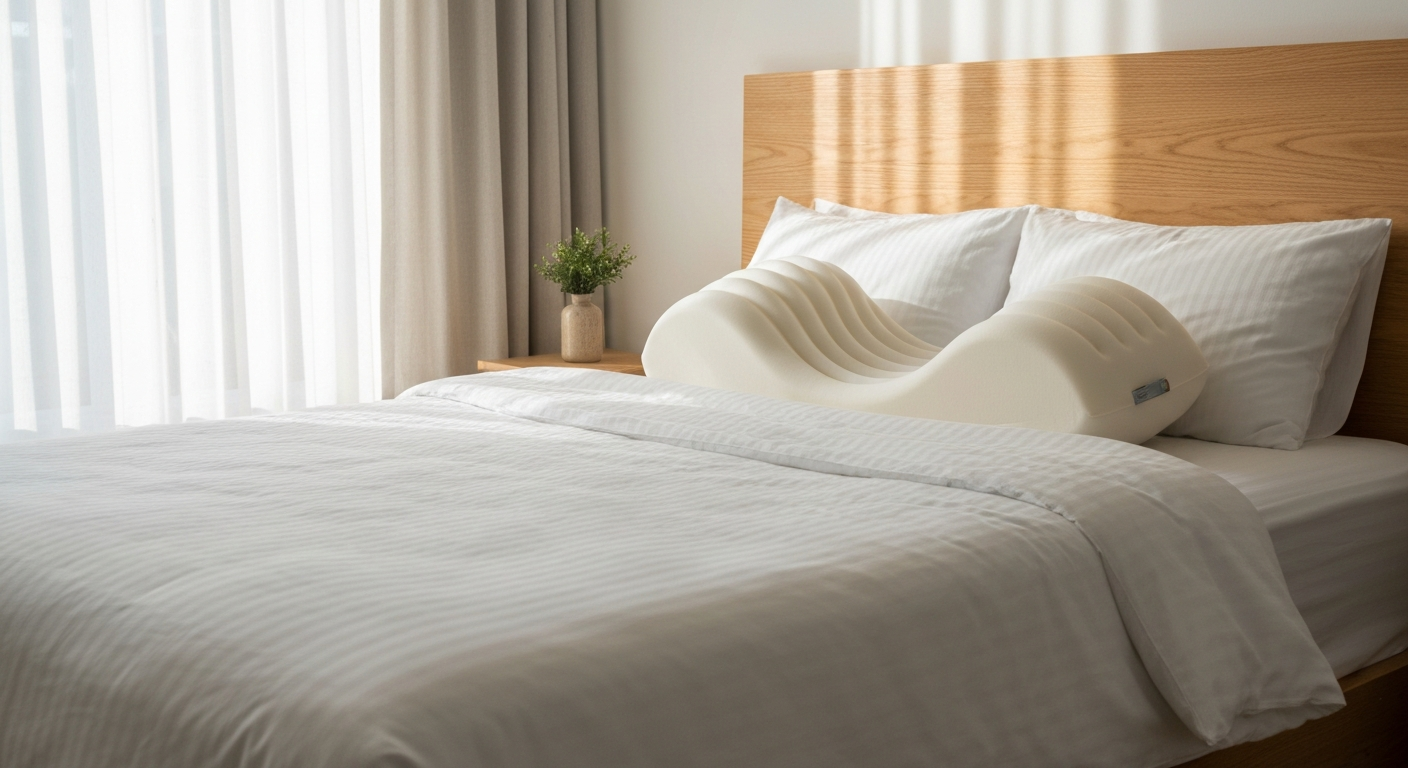

The best pillow for a snorer is one that keeps the airway open by supporting a neutral head and neck position — elevated enough to prevent the tongue from falling back, but not so high that the chin is pressed toward the chest. Wedge pillows, anti-snore pillows with a contoured center channel, and side-sleeping support pillows are the three designs with the most evidence behind them.
Snoring occurs when the upper airway narrows during sleep, causing the soft tissues at the back of the throat to vibrate. Pillow position directly influences how open or restricted that airway is throughout the night.
A pillow that is too flat lets the head fall back, causing the jaw to drop and the tongue to slide toward the throat — the position that causes the most airway narrowing. A pillow that is too thick bends the neck forward, compressing the airway from the other direction.
The ideal position is a slightly elevated, neutral neck alignment — chin slightly raised, neck neither craned back nor bent forward. This position is most easily maintained on your side rather than your back.
"Sleep position is one of the most modifiable factors in snoring severity. Lateral (side) sleep position consistently reduces snoring intensity compared to supine position in both primary snorers and those with mild obstructive sleep apnea." — American Academy of Sleep Medicine (AASM) at aasm.org
The four pillow types used by snorers — wedge pillows, contoured anti-snore pillows, body pillows, and positional pillows — each work through a different mechanism. Matching the type to your snoring pattern gives the best result.
Wedge pillows elevate the upper body at a 30–45 degree angle. This incline uses gravity to keep the tongue and soft tissues from collapsing into the airway. They are the most effective single-pillow solution for back sleepers who cannot easily switch to side sleeping.
A quality foam wedge (4–7 inches at the high end) is more effective than stacking regular pillows, which shift position during the night. Wedge pillows are also helpful for acid reflux, which itself worsens snoring.
Contoured pillows have a raised edge on one side and a lower center. The design keeps the head slightly elevated and encourages side sleeping by making the shoulder recess into the pillow correctly. Many snorers find these significantly reduce noise within the first week of use.
Look for a pillow that supports the gap between your shoulder and ear when lying on your side — this gap varies by shoulder width and should be measured before selecting fill firmness.
Many snorers only snore when they roll onto their back at night. A body pillow placed lengthwise prevents rolling and keeps you on your side. This is the simplest positional intervention and is often recommended before trying specialty pillows.
If you use a CPAP machine for sleep apnea, standard pillows cause mask leaks by pressing against the face seal. CPAP pillows have cutouts for the mask, allowing side sleeping without breaking the seal. These are an underappreciated subcategory with significant impact on CPAP compliance.
| ✓Our Pick |
 |
SnoreMeds custom anti-snoring mouthpiece — repositions the jaw to eliminate snoring at the source You'll wonder why you didn't try this sooner — practical, well-reviewed, and easy to get started. Learn More → |
| Feature | Why It Matters for Snoring |
|---|---|
| Loft (thickness) 4–6 inches for side sleepers | Keeps neck in neutral alignment |
| Memory foam or latex fill | Maintains consistent support without collapsing overnight |
| Washable cover | Allergens (dust mites) worsen snoring by increasing nasal congestion |
| Contoured or cervical shape | Designed to maintain neutral head position in a specific sleep position |
| Hypoallergenic fill | Reduces inflammation from allergen exposure during sleep |
Pillow loft should match your sleep position and shoulder width. Side sleepers generally need a higher loft (5–6 inches) than back sleepers (3–4 inches). Stomach sleeping is not recommended for snorers — it forces the neck into extreme rotation.
Anti-snore pillows reduce snoring for some people by improving head position — but they do not treat the underlying cause. If snoring is severe or accompanied by gasping, witnessed apneas, or daytime fatigue, an evaluation for obstructive sleep apnea is more important than pillow choice.
A small randomized study published in the Journal of Clinical Sleep Medicine found that positional therapy devices — including specialized pillows — reduced apnea events by approximately 50% in patients with positional obstructive sleep apnea (the subtype where events occur primarily on the back). However, they were less effective for non-positional apnea.
"Positional therapy is an evidence-based option for position-dependent sleep apnea. For patients whose breathing events primarily occur in the supine position, positional devices significantly reduce AHI." — American Academy of Sleep Medicine at aasm.org
For primary snoring (without apnea), pillow improvements consistently reduce noise volume in studies, though complete elimination is uncommon without addressing the root anatomical cause.
Also Read: What Type of Snoring Is Dangerous? 5 Warning Signs
The best pillow for a snorer keeps the airway open through neutral head and neck alignment. Wedge pillows work best for back sleepers; contoured cervical pillows work best for side sleepers; body pillows help prevent rolling onto the back. For snorers who need more than a position change, a mandibular advancement device like SnoreMeds works at the source — the jaw position — rather than relying on pillow geometry alone.
Side sleepers typically benefit from a pillow 5–6 inches high at the center to fill the gap between shoulder and head. Back sleepers benefit from 3–4 inches. The key metric is whether your nose points straight forward (neutral) when lying in position — not tilted up or down.
Yes. A pillow that is too low allows the head to fall back, narrowing the airway. A pillow that is too thick pushes the chin toward the chest, also narrowing the airway. Flattened, worn-out pillows that no longer hold their shape are a common overlooked snoring trigger.
Yes, for back sleepers. Elevating the upper body 30–45 degrees uses gravity to keep the tongue and soft palate from collapsing into the airway. Wedge pillows are more reliable than stacking regular pillows, which compress and shift during the night.
Side sleeping consistently produces less snoring and fewer apnea events than back sleeping. If you typically sleep on your back, using a body pillow or a positional sleep device to prevent rolling can reduce snoring significantly without changing your natural preferred position.
Reviewed and Updated on June 16, 2026 by George Wright