
Sleep
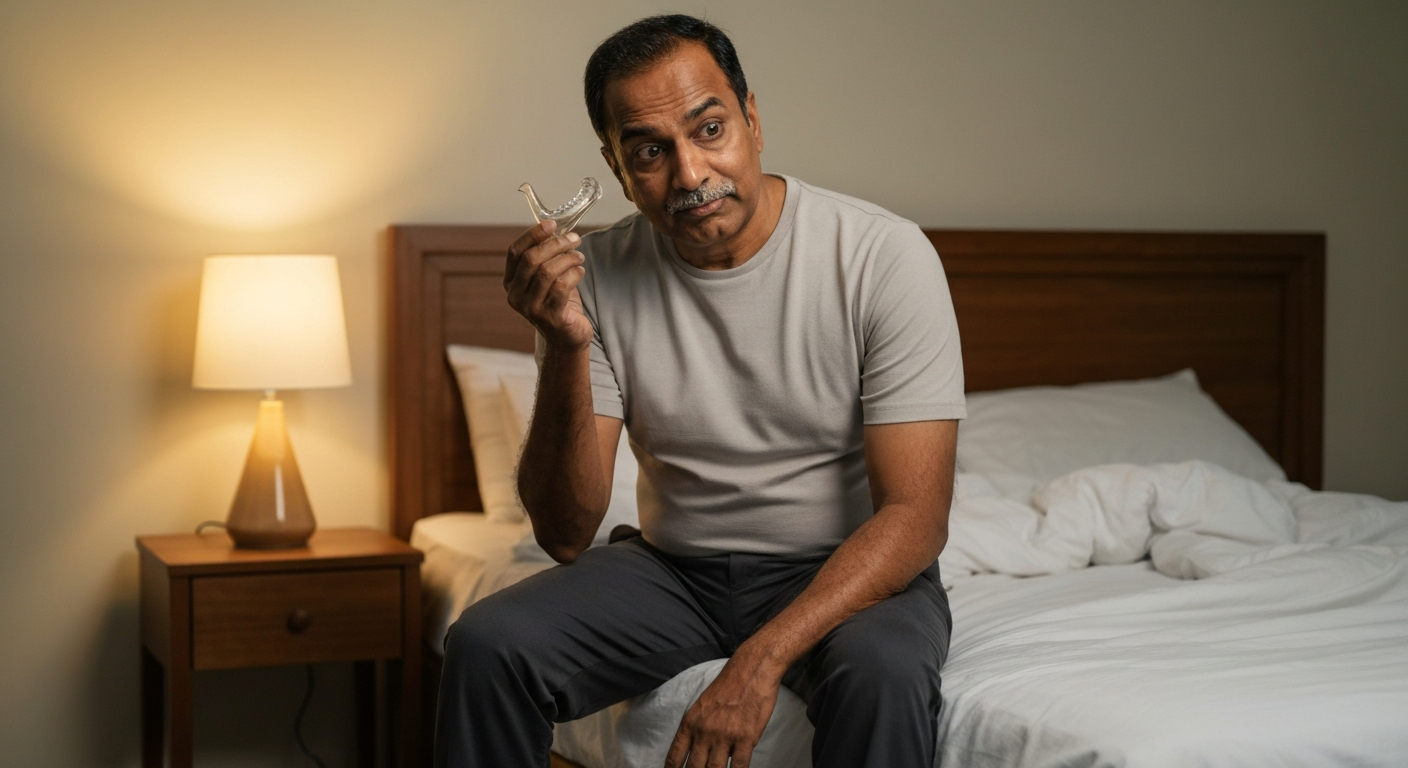

"Snore Dr" refers to a category of anti-snoring products — most commonly mandibular advancement devices (MADs) that hold the lower jaw slightly forward during sleep to keep the airway open and reduce or eliminate snoring.
The name appears across several brands and product types, from over-the-counter boil-and-bite mouthpieces to smartphone apps that claim to track and treat snoring. If you've searched for "Snore Dr" hoping to find a single miracle cure, here's what you need to know: these devices work on a specific mechanism, and whether one helps you depends entirely on why you snore in the first place.
Also Read: Do Skinny People Snore? 6 Causes & What Actually Helps
Snore Dr products are typically mandibular advancement devices (MADs) — mouthpieces that push your lower jaw forward by a few millimeters, which tightens the soft tissue at the back of your throat and prevents it from vibrating during sleep.
The science behind this approach is straightforward. When you fall asleep, the muscles in your throat relax. For some people, this relaxation allows the tongue and soft palate to collapse backward, narrowing the airway. Air passing through this constricted space creates turbulence — and that turbulence is what you hear as snoring.
By advancing the mandible (the lower jaw), MADs like Snore Dr mechanically widen the airway at its most vulnerable point. This is the same principle behind prescription oral appliances fitted by dentists, just in a more accessible over-the-counter form.
"Mandibular advancement devices have been shown to reduce the apnea-hypopnea index and improve subjective snoring in patients with mild to moderate obstructive sleep apnea." — American Academy of Sleep Medicine
The key phrase there is "mild to moderate." If your snoring is caused by severe sleep apnea or anatomical issues like enlarged tonsils, a generic mouthpiece isn't going to solve the underlying problem.
The "Snore Dr" name covers several distinct product types, from physical mouthpieces to digital tracking apps — and they work in completely different ways.
| Product Type | How It Works | Best For | Limitations |
|---|---|---|---|
| Boil-and-bite MAD | Heat-molded mouthpiece advances jaw | Mild snoring from throat relaxation | One-size approach; may cause jaw discomfort |
| Adjustable MAD | Incremental jaw advancement settings | Users who need fine-tuned positioning | Higher cost; requires adjustment period |
| Tongue retaining device (TRD) | Suction cup holds tongue forward | Snorers who can't tolerate jaw devices | Uncomfortable for many users |
| Snore tracking app | Records and analyzes snoring sounds | Monitoring and awareness | Does not treat snoring directly |
| Chin strap | Keeps mouth closed during sleep | Mouth breathers who snore | Ineffective for nasal or throat-based snoring |
Most products marketed under variations of "Snore Dr" fall into the boil-and-bite MAD category. You heat the device in hot water, bite down to create a custom impression of your teeth, and wear it nightly. The process takes about 10 minutes, and the device typically lasts 6–12 months with regular use.
Also Read: 7 Best Anti-Snore Devices That Actually Work in 2026
Clinical studies show that mandibular advancement devices reduce snoring in 50–80% of users, but effectiveness varies significantly based on the cause of snoring and the quality of the device fit.
Here's the reality: no anti-snoring product works for everyone. The success rate depends on several factors:
"Oral appliances are effective in reducing the respiratory disturbance index in patients with obstructive sleep apnea, though adherence remains a significant challenge in long-term management." — Journal of Clinical Sleep Medicine
The research also shows that custom-fitted devices from dentists tend to outperform generic over-the-counter options — but they also cost $500–$2,000 compared to $30–$100 for store-bought alternatives.
Snore Dr-type MADs are best suited for adults with primary snoring or mild sleep apnea who don't have significant dental issues, TMJ disorders, or severe nasal obstruction.
You're likely a good candidate if:
You should avoid over-the-counter MADs and consult a sleep specialist instead if:
Also Read: Snoring vs Sleep Apnea
Most users experience some jaw discomfort, excessive salivation, or tooth tenderness during the first 1–2 weeks of using an MAD — these effects usually diminish with consistent use.
| Side Effect | Why It Happens | How to Manage It |
|---|---|---|
| Jaw soreness | Muscles adjusting to new position | Start with shorter wear times; use device with adjustable advancement |
| Excess saliva | Foreign object triggers salivation reflex | Usually resolves within 2 weeks |
| Tooth tenderness | Pressure from the device | Ensure proper fit; consider professional fitting |
| Dry mouth | Mouth breathing around device | Use nasal strips; check for proper lip seal |
| Temporary bite changes | Jaw position shift | Brief morning exercises; bite should normalize within 30 minutes of removal |
If jaw pain persists beyond two weeks or you notice lasting changes in your bite alignment, stop using the device and consult a dentist. Long-term MAD use can occasionally cause permanent bite changes, though this is more common with poorly fitted devices.
MADs like Snore Dr offer a middle ground between simple positional therapy and medical interventions like CPAP — more effective than nasal strips for throat-based snoring, but less powerful than prescription treatments for sleep apnea.
| Solution | Effectiveness for Snoring | Cost | Comfort | Best For |
|---|---|---|---|---|
| Nasal strips | Low (20–30%) | $10–15/month | High | Nasal congestion only |
| MAD (Snore Dr type) | Moderate–High (50–80%) | $30–100 one-time | Moderate | Primary snoring, mild apnea |
| Custom dental appliance | High (70–90%) | $500–2,000 | High | Mild–moderate apnea, long-term use |
| CPAP machine | Very High (90%+) | $500–3,000 + supplies | Low–Moderate | Moderate–severe sleep apnea |
| Positional therapy | Variable (30–50%) | Free–$50 | High | Positional snoring only |
| Surgical intervention | Variable | $5,000–30,000 | N/A (recovery period) | Anatomical causes |
For many people with simple snoring, an over-the-counter MAD is a reasonable first step before investing in more expensive or invasive options. However, if you suspect sleep apnea — characterized by breathing pauses, gasping, and daytime exhaustion — start with a sleep study rather than self-treating with OTC devices.
Proper fitting, gradual adjustment, and consistent nightly use are the three factors that most determine whether a mouthpiece will work for you.
Follow these steps for the best outcome:
Choose an adjustable device when possible — Products that allow incremental advancement let you find the minimum effective position, reducing jaw strain.
Follow fitting instructions exactly — For boil-and-bite devices, water temperature and bite timing matter. Rushing the process creates a poor impression that won't hold your jaw properly.
Start with minimal advancement — Begin at the lowest setting and increase gradually over 1–2 weeks until snoring improves. More isn't always better — excessive advancement causes pain without additional benefit.
Wear it every night — Occasional use doesn't train your muscles or allow proper adaptation. Commit to nightly use for at least 30 days before judging effectiveness.
Maintain the device — Clean with mild soap or denture cleaner daily. Store dry. Replace when the material shows wear or the fit loosens.
Address nasal issues separately — MADs don't help nasal obstruction. If you're congested, treat that with saline rinse, nasal strips, or antihistamines alongside your mouthpiece.
| ✓Our Pick |
Custom-fit anti-snoring mouthpiece — repositions jaw to stop snoring Trusted by professionals and everyday users alike — a smart investment that pays for itself. Learn More → |
If you experience symptoms beyond simple snoring — gasping, choking, observed breathing pauses, or severe daytime fatigue — skip the OTC devices and get a sleep study to rule out obstructive sleep apnea.
Sleep apnea is a serious condition linked to increased risk of hypertension, heart disease, stroke, and diabetes. Treating it with an inadequate device delays proper care and can worsen long-term outcomes.
Red flags that warrant medical evaluation:
A board-certified sleep medicine physician can order a home sleep test or in-lab polysomnography to determine whether you have sleep apnea and how severe it is. Based on those results, they'll recommend appropriate treatment — which might include a prescription oral appliance, CPAP therapy, or other interventions.
Also Read: Is Snoring Unhealthy? 6 Risks & What Your Body Is Telling You
Snore Dr products — typically mandibular advancement mouthpieces — work by holding the lower jaw forward to prevent airway collapse during sleep. They're effective for 50–80% of users with simple snoring or mild sleep apnea, but they're not appropriate for everyone. The best results come from proper fitting, gradual adjustment, and consistent nightly use. If your snoring is accompanied by breathing pauses, gasping, or severe daytime fatigue, consult a sleep specialist rather than relying on over-the-counter devices — you may need a sleep study to rule out obstructive sleep apnea.
Many over-the-counter mandibular advancement devices sold as "Snore Dr" or similar names are FDA-cleared as Class II medical devices for snoring reduction. However, clearance status varies by specific manufacturer and product. Check the packaging or manufacturer's website for FDA clearance information before purchasing. FDA clearance means the device meets basic safety standards — it doesn't guarantee effectiveness for your particular situation.
Most boil-and-bite MADs last 6–12 months with nightly use before the material degrades, loses its shape, or no longer fits securely. Signs you need a replacement include visible cracks, a loose fit, reduced effectiveness, or persistent odor that cleaning doesn't remove. Higher-quality adjustable devices may last 12–18 months. Budget for replacement costs when comparing to other anti-snoring solutions.
Most over-the-counter MADs require a full set of healthy teeth to anchor properly. If you wear partial or full dentures, have multiple missing teeth, or have loose teeth, standard mouthpieces won't fit securely and may cause damage. Tongue retaining devices (TRDs) are an alternative that doesn't rely on teeth, though they're less comfortable for most users. Consult a dentist for custom options if you have significant dental work.
MADs can reduce mild to moderate sleep apnea symptoms, but they're not a substitute for CPAP in severe cases. If you've been diagnosed with obstructive sleep apnea, work with a sleep specialist to determine appropriate treatment. Using an OTC device without proper evaluation may mask symptoms while the underlying condition continues to damage your cardiovascular system.
Common reasons include improper initial fitting, material degradation over time, or excessive jaw relaxation during deep sleep. Try re-molding the device following the instructions carefully. If the problem persists with a new device, you may need a custom-fitted appliance from a dentist that provides a more secure anchor.
Reviewed and Updated on June 14, 2026 by George Wright