


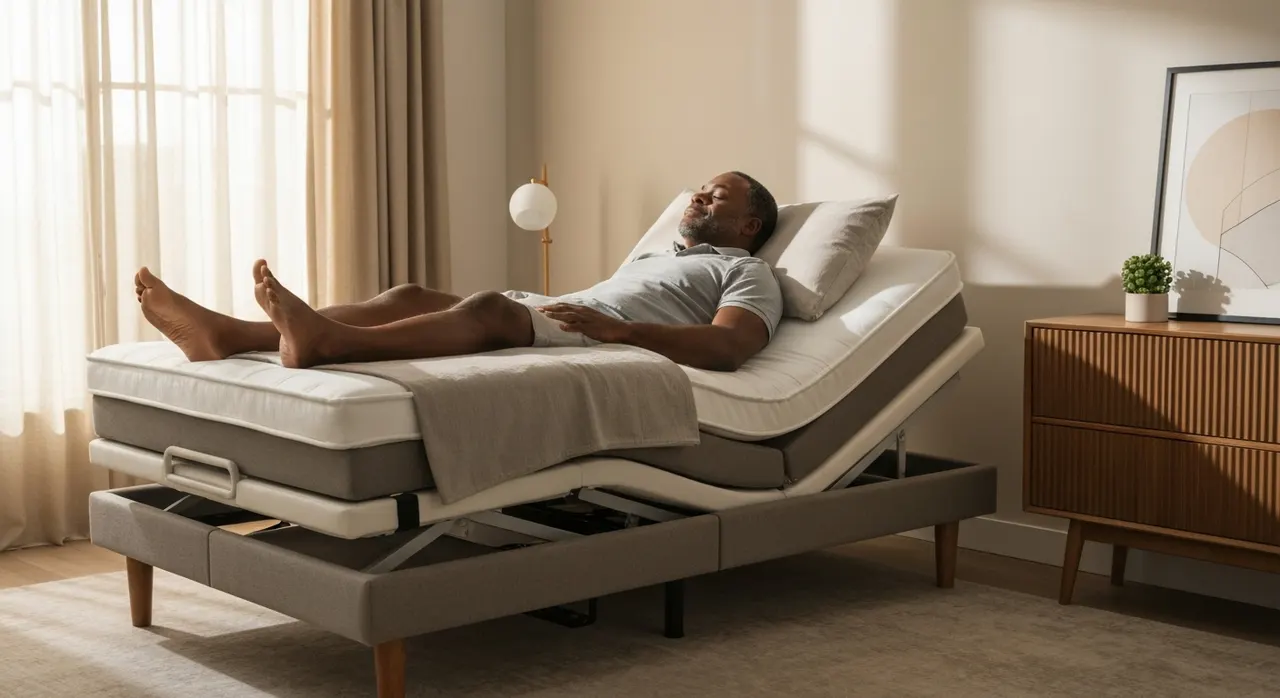
An anti snore bed uses adjustable elevation, smart sensors, or positional features to reduce snoring by keeping your airway open while you sleep. These beds typically raise the head 15–30 degrees or gently nudge you off your back — the position where gravity collapses soft throat tissues and causes the vibration we hear as snoring. While no bed eliminates snoring completely, the right adjustable base can reduce frequency and volume by 50% or more for positional snorers.
How Does an Anti Snore Bed Actually Work?
Anti snore beds work through one primary mechanism: they change your sleeping position to prevent airway collapse.
When you lie flat on your back, gravity pulls your tongue, soft palate, and throat tissues backward. These relaxed tissues partially block your airway, and as air squeezes past, they vibrate — producing the snoring sound. An anti snore bed counters this by elevating your upper body or encouraging side sleeping.
Most anti snore beds fall into two categories:
| Bed Type | Mechanism | Best For |
|---|---|---|
| Adjustable base with head elevation | Raises head 15–45 degrees to keep airway open | Back sleepers, acid reflux snorers |
| Smart bed with auto-adjustment | Detects snoring and raises head automatically | Light sleepers who don't want manual controls |
| Positional bed/mattress | Inflatable zones or wedges encourage side sleeping | Exclusively back-sleeping snorers |
The head elevation approach works similarly to how doctors elevate hospital patients with breathing difficulties. At a 30-degree incline, your tongue and soft palate shift forward, opening the pharyngeal airway by several millimeters. This seemingly small change can dramatically reduce or eliminate snoring.
"Elevating the head of the bed can be an effective intervention for patients with positional obstructive sleep apnea, reducing the apnea-hypopnea index significantly." — Dr. Atul Malhotra at UC San Diego Health
| ✓Our Pick |
Anti-snoring mouthpiece — adjustable mandibular advancement device (MAD) One of the highest-rated products in its category — a reliable, widely used fix. See on Amazon → |
What Features Should You Look for in an Anti Snore Bed in 2026?
The most effective anti snore beds combine adjustable head elevation, quiet motors, and a snore-detection response feature.
Not every adjustable bed is designed with snoring in mind. Here's what separates a true anti snore bed from a basic adjustable base:
Does Head Elevation Range Matter?
Yes — significantly. Look for beds offering at least 45 degrees of head elevation. While 15–20 degrees helps mild snorers, moderate to severe snoring often requires 30 degrees or more. Some sleepers find the "zero gravity" preset (head and knees slightly raised) provides optimal airway positioning without feeling like they're sleeping sitting up.
How Important Is Snore Detection Technology?
Smart beds with built-in snore detection can automatically raise your head when sensors pick up snoring sounds or vibrations. This feature is genuinely useful if you don't want to wake up to adjust the bed manually. However, the technology varies in sensitivity — some systems respond to any noise, while better models use algorithms to distinguish snoring from other sounds.
What About Partner Comfort?
Split adjustable bases allow each side to move independently. This matters enormously if your partner doesn't want their head elevated when you start snoring at 2 AM. A split king configuration lets your anti snore features work without disturbing your partner's sleep position.
Which Motor Specifications Should You Check?
- Noise level under 50 decibels (quieter than a conversation)
- Weight capacity appropriate for your mattress plus sleepers
- Wireless remote or smartphone app control
- Battery backup for power outages
Also Read: Is Snoring Unhealthy? 6 Risks & What Your Body Is Telling You
Do Anti Snore Beds Work for Everyone?
Anti snore beds work best for positional snorers — people who primarily snore when sleeping on their back.
Not all snoring responds to positional changes. Understanding why you snore determines whether an anti snore bed will help:
| Snoring Cause | Will Anti Snore Bed Help? |
|---|---|
| Back sleeping (positional snoring) | Yes — highly effective |
| Nasal congestion | Partial — elevation helps drainage |
| Alcohol before bed | Partial — reduces but doesn't eliminate |
| Obstructive sleep apnea | Moderate — often used alongside CPAP |
| Anatomical issues (deviated septum, large tonsils) | Limited — may need medical intervention |
| Excess weight around neck | Moderate — works better combined with weight loss |
If you only snore when on your back and sleep quietly on your side, an anti snore bed is likely your best non-invasive solution. If you snore in every position, the bed will probably reduce intensity but won't solve the problem entirely.
"Positional therapy is effective for approximately 50% of patients with obstructive sleep apnea, particularly those with mild to moderate disease." — American Academy of Sleep Medicine via Journal of Clinical Sleep Medicine
| ✓Quick Fix |
The Quick Fix Most People Reach for First One of the simplest things to try immediately — no appointment, no waiting. See on Amazon → |
Anti Snore Bed vs Other Snoring Solutions: Which Works Best?
An anti snore bed is most effective when combined with other interventions rather than used alone.
Here's how anti snore beds compare to other common solutions:
| Solution | Effectiveness | Comfort | Cost | Best Combined With |
|---|---|---|---|---|
| Anti snore bed (adjustable base) | 50–70% reduction for positional snorers | High — sleep normally | $500–$3,000+ | Mouthpiece, pillows |
| Mandibular advancement device (mouthpiece) | 70–90% reduction | Medium — takes adjustment | $30–$200 | Adjustable bed, nose strips |
| CPAP machine | 95%+ reduction | Low initially — improves | $500–$3,000 | Adjustable bed for comfort |
| Positional pillow | 30–50% reduction | Medium | $30–$100 | Adjustable bed, mouthpiece |
| Nasal strips/dilators | 20–40% reduction | High | $10–$30/month | Any other solution |
The advantage of an anti snore bed is passive effectiveness — you don't have to wear anything or change your routine. The disadvantage is cost and the fact that it only addresses positional factors.
For many couples, combining an adjustable base with a mandibular advancement device produces the best results. The bed keeps you elevated and reduces snoring intensity, while the mouthpiece holds your jaw forward to keep the airway fully open.
Also Read: Free sleep stories and calming audiobooks to quiet a racing mind
How to Set Up Your Anti Snore Bed for Best Results
Start at a modest 15-degree head elevation and increase gradually over several nights until snoring stops or you find your comfort limit.
Getting the most from your anti snore bed requires some experimentation:
- Begin with the lowest comfortable elevation — usually 10–15 degrees
- Sleep at this angle for 3–4 nights to adjust
- Have your partner monitor whether snoring persists
- Increase by 5-degree increments until snoring stops or diminishes
- If you experience neck pain or discomfort, try adding the knee elevation feature
- Consider using a pillow designed for inclined sleeping to prevent sliding down
Most people find their optimal angle between 20–35 degrees. Going beyond 45 degrees rarely provides additional benefit and often causes neck strain or sliding.
If your bed has a snore-response feature, calibrate the sensitivity settings. Start with lower sensitivity to avoid unnecessary adjustments, then increase if snoring continues undetected.
Also Read: Snore Guard Guide: MAD vs TRD & How to Choose in 2026
When Should You See a Doctor Instead of Buying an Anti Snore Bed?
If you experience gasping, choking, or breathing pauses during sleep, see a doctor before investing in an anti snore bed.
An anti snore bed treats symptoms, not underlying conditions. These warning signs indicate you need professional evaluation:
- Witnessed breathing pauses during sleep
- Waking up gasping or choking
- Excessive daytime sleepiness despite adequate sleep hours
- Morning headaches that improve throughout the day
- Blood pressure that's difficult to control
These symptoms suggest obstructive sleep apnea, which requires diagnosis and may need CPAP therapy. An anti snore bed can complement CPAP treatment by making the mask more comfortable, but it shouldn't replace medical care.
For simple snoring without these red flags, an anti snore bed is a reasonable first-line solution that many sleep physicians recommend trying before more invasive interventions.
Also Read: How to Stop Snoring While Sleeping: 6 Proven Methods
In Short
An anti snore bed works by elevating your head to keep your airway open, and it's most effective for people who snore primarily when sleeping on their back. Look for adjustable bases with at least 45 degrees of elevation range, quiet motors, and snore-detection features if budget allows. These beds work best when combined with other solutions like mandibular advancement mouthpieces. If you experience breathing pauses or excessive daytime sleepiness, see a doctor first — an anti snore bed treats positional snoring, not sleep apnea.
Also Read: Snoring vs Sleep Apnea: Key Differences & When to Worry
What You Also May Want To Know
Can an anti snore bed help with sleep apnea?
An anti snore bed can reduce mild obstructive sleep apnea symptoms by keeping your airway more open through elevation. However, it's not a replacement for CPAP therapy in moderate to severe cases. Many people use adjustable beds alongside their CPAP machines for improved comfort and effectiveness. Always get a proper sleep study diagnosis before relying solely on positional therapy.
How much does a good anti snore bed cost?
Quality adjustable bases with anti snore features range from $500 for basic models to $3,000 or more for smart beds with automatic snore detection. Split king configurations cost more but allow independent adjustment for partners. Budget models work fine for manual elevation, but smart features that auto-adjust when you snore require premium investment.
Will an anti snore bed stop my partner from hearing me snore?
An anti snore bed typically reduces snoring volume and frequency rather than eliminating it completely. Most positional snorers see 50–70% improvement, which often makes the difference between disturbing a partner and sleeping peacefully together. For complete silence, combining the bed with a mandibular advancement mouthpiece usually produces better results than either solution alone.
Do I need a special mattress for an anti snore bed?
Most memory foam and hybrid mattresses work well with adjustable bases. Avoid innerspring mattresses with rigid coil systems, as they don't flex properly. Check your mattress warranty — some manufacturers void coverage if used with adjustable bases. Mattresses specifically designed for adjustable frames flex more smoothly and maintain comfort at various angles.
How long does it take to get used to sleeping elevated?
Most people adjust to sleeping at a 15–20 degree incline within 3–5 nights. Higher angles of 30 degrees or more may take 1–2 weeks to feel natural. Start at a lower elevation and increase gradually. Using a contoured pillow designed for inclined sleeping can speed up the adjustment period and prevent neck strain.