
Sleep
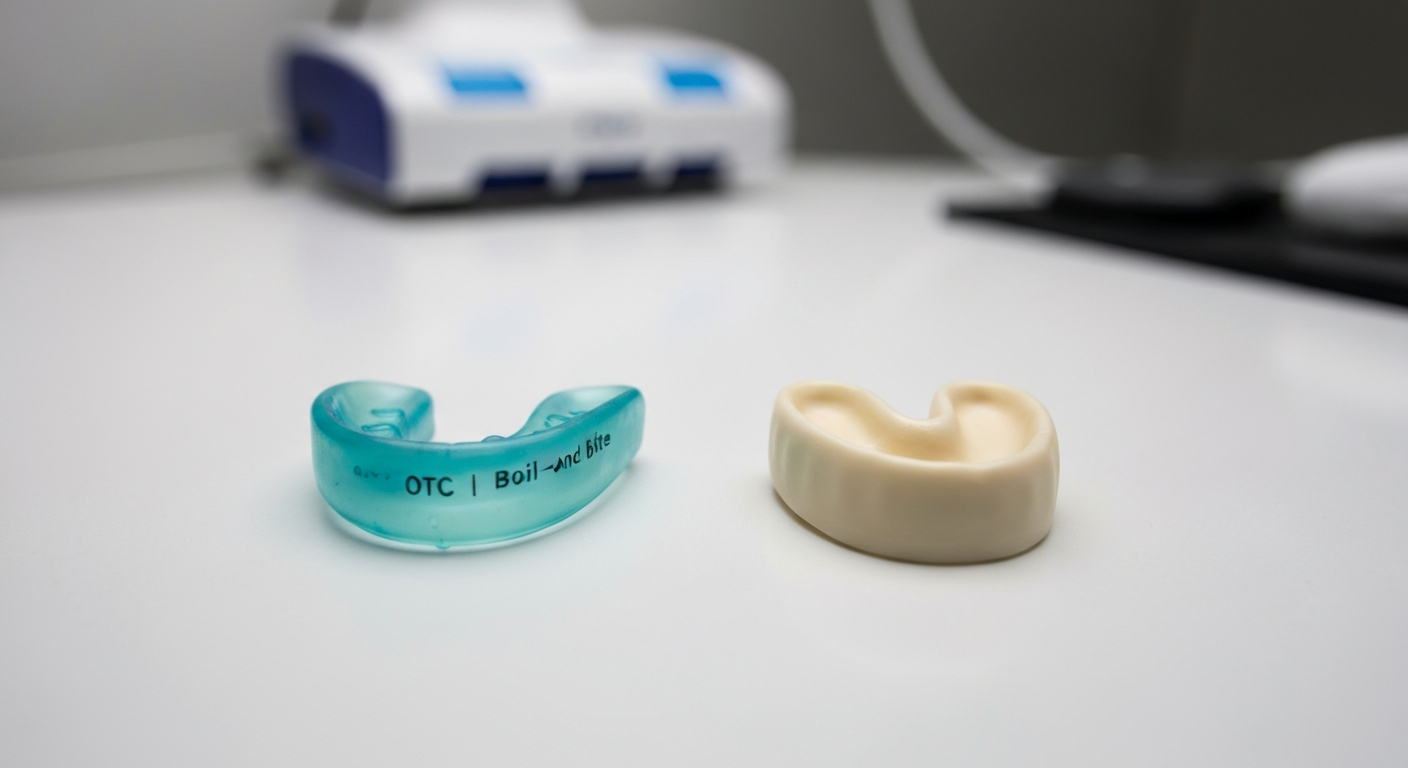

A snore guard is any device worn in the mouth or around the lower face during sleep to reduce or eliminate snoring. The two main types work through entirely different mechanisms — mandibular advancement devices (MADs) push the jaw forward to widen the airway, while tongue retaining devices (TRDs) hold the tongue forward directly. Choosing the right type depends on your anatomy, sleep habits, and how much fit precision matters to you.
Understanding the mechanism before you buy saves money and frustration. A snore guard that works via the wrong mechanism for your snoring type will produce no improvement.
The MAD — also called a jaw advancement device or anti-snoring mouthpiece — fits over both upper and lower teeth and holds the lower jaw in a slightly forward position. This forward jaw position has three effects on the airway:
The result is a wider, less collapsible airway. Less narrowing means lower air velocity, reduced tissue vibration, and quieter or absent snoring.
MADs are the most studied snore guard category. In clinical trials they reduce snoring in 80–90% of users and eliminate it entirely in roughly 50–60%.
Best for: Tongue-base snorers, mouth-breathing snorers, people with a recessed jaw, anyone who tested positive for tongue-base snoring on self-assessment.
Not ideal for: People with TMJ disorders, missing teeth, dentures (cannot anchor to teeth), severe nasal congestion (MADs increase mouth breathing in some users who can't breathe nasally).
A TRD works entirely differently. Instead of advancing the jaw, it holds the tongue forward using a small suction bulb that grips the tongue tip. By keeping the tongue pulled forward, it prevents the main alternative mechanism of snoring — the tongue falling back and obstructing the airway at a level below where the jaw would reach.
TRDs don't touch the teeth or jaw. They're valuable for people who can't wear a MAD (no teeth, TMJ problems) or whose snoring comes specifically from tongue-base collapse rather than jaw position.
Best for: People with TMJ disorders, those who can't wear dental appliances, tongue-base snorers whose jaw is already in a reasonable position.
Downside: Less comfortable for most users than MADs; takes more adjustment time; not suitable for mouth breathers (TRDs require nasal breathing to be worn comfortably).
"Both mandibular advancement devices and tongue retaining devices are effective for snoring reduction. MADs have more supporting evidence and generally better patient acceptance and compliance." — American Academy of Sleep Medicine, Position Statement on Oral Appliance Therapy
Within the MAD category, the biggest decision is between over-the-counter boil-and-bite devices and professionally fitted custom appliances.
| Feature | Boil-and-Bite OTC | Custom-Fit (Professional or Self-impression) |
|---|---|---|
| Cost | $20–60 | $150–600 (self-impression kit) or $500–2,000 (dental lab via dentist) |
| Fit precision | Variable — depends on impression quality | High |
| Adjustability | Fixed or very limited | Many custom devices are adjustable (5–10mm advancement range) |
| Comfort | Moderate | High |
| Durability | 3–6 months typically | 2–4 years |
| Return policy | Usually good for OTC brands | Varies |
| Best for | Testing whether a MAD works for you; budget option | Long-term use; optimal results; when bite relationship matters |
For most people, starting with a quality boil-and-bite to confirm the approach works, then upgrading to a custom-fit device if it's effective, is the sensible sequence. The custom fit matters most for all-night comfort and for maintaining the precise jaw position that produces the best airway opening.
Also Read: Why Is My Snoring So Loud All of a Sudden?
If you don't know your snoring type, use this decision guide:
Step 1: Can you breathe comfortably through your nose with your mouth closed?
- No → Fix the nasal obstruction first (allergy treatment, nasal strips, decongestant). A MAD or TRD won't solve nasal-driven snoring. Once nasal breathing improves, reassess.
- Yes → Continue to Step 2.
Step 2: Stick your tongue out as far as possible and hold it between your teeth. Try making your snoring sound. Is it reduced?
- Yes → You're a tongue-base snorer. Both MAD and TRD will help; MAD typically gives better compliance.
- Not sure → Default to MAD (it addresses the broadest range of snoring types).
Step 3: Do you have TMJ disorder, dentures, or missing most back teeth?
- Yes → TRD or nasal airway approaches; consult a dentist about your MAD options.
- No → MAD is typically the better fit.
Step 4: Is this a trial purchase or a long-term solution investment?
- Trial → OTC boil-and-bite MAD from a brand with a good return window.
- Long-term → Custom-fit MAD, ideally with adjustability so you can fine-tune jaw position as needed.
A snore guard you don't wear is a snore guard that doesn't work. Compliance — actually putting it in every night — is the most important variable in effectiveness.
Most new users take 1–3 weeks to adjust to wearing a MAD. Side effects that typically resolve with adjustment time:
- Increased salivation (resolves in 1–2 weeks)
- Minor jaw soreness (usually resolves; if severe or persistent, check advancement setting — may need backing off 1–2mm)
- Teeth sensitivity (normal; improves)
Care routine:
- Rinse thoroughly with cool water after each use (hot water can warp the material)
- Brush with a soft toothbrush and mild soap or denture cleaning tablet weekly
- Store dry in the case to prevent bacterial growth
- Replace when fit loosens or visible wear appears (every 6–18 months for OTC; 2–4 years for custom)
| ✓Our Pick |
SnoreMeds adjustable anti-snoring mouthpiece — custom-impression MAD with global clinical use Trusted by professionals and everyday users alike — a smart investment that pays for itself. Learn More → |
A snore guard is either a mandibular advancement device (jaw-forward) or a tongue retaining device (tongue-forward). MADs are more effective for the widest range of snoring types, have stronger clinical evidence, and are better tolerated by most users. TRDs are the alternative for people with TMJ issues or dental problems. Within MADs, start with an OTC boil-and-bite to test effectiveness, then invest in a custom-fit device if you're committed to the approach long-term. Compliance — wearing it every night — is the biggest predictor of success.
Yes — both MADs and TRDs are designed for nightly use and are safe for most adults long-term. MADs used nightly may cause minor, temporary changes in bite alignment in some users over years of use. This is manageable with morning jaw exercises and bite re-alignment techniques. Custom-fit devices with adjustable advancement allow minimizing this risk by using the lowest effective advancement setting.
No device works for 100% of snorers. MADs have a 10–20% non-response rate — typically nasal snorers or people with severe sleep apnea requiring CPAP. If a well-fitted MAD doesn't reduce snoring after 3–4 weeks of nightly use, reassess whether nasal obstruction is the primary cause, or get a sleep study to rule out OSA.
Yes — MADs are a clinically approved treatment for mild-to-moderate obstructive sleep apnea (OSA) and are endorsed by the American Academy of Sleep Medicine as an alternative to CPAP for these cases. For severe OSA, CPAP remains the standard. If you suspect OSA (witnessed apneas, extreme daytime sleepiness, morning headaches), get a diagnosis before choosing a treatment approach.
Most users notice reduced snoring from the first or second night. Full benefits typically emerge over 1–3 weeks as you adjust the device to the optimal jaw position. For adjustable MADs, starting at minimum advancement and gradually increasing by 1mm every 3–5 nights gives the best balance of effectiveness and comfort.
Reviewed and Updated on June 13, 2026 by George Wright