Cooking
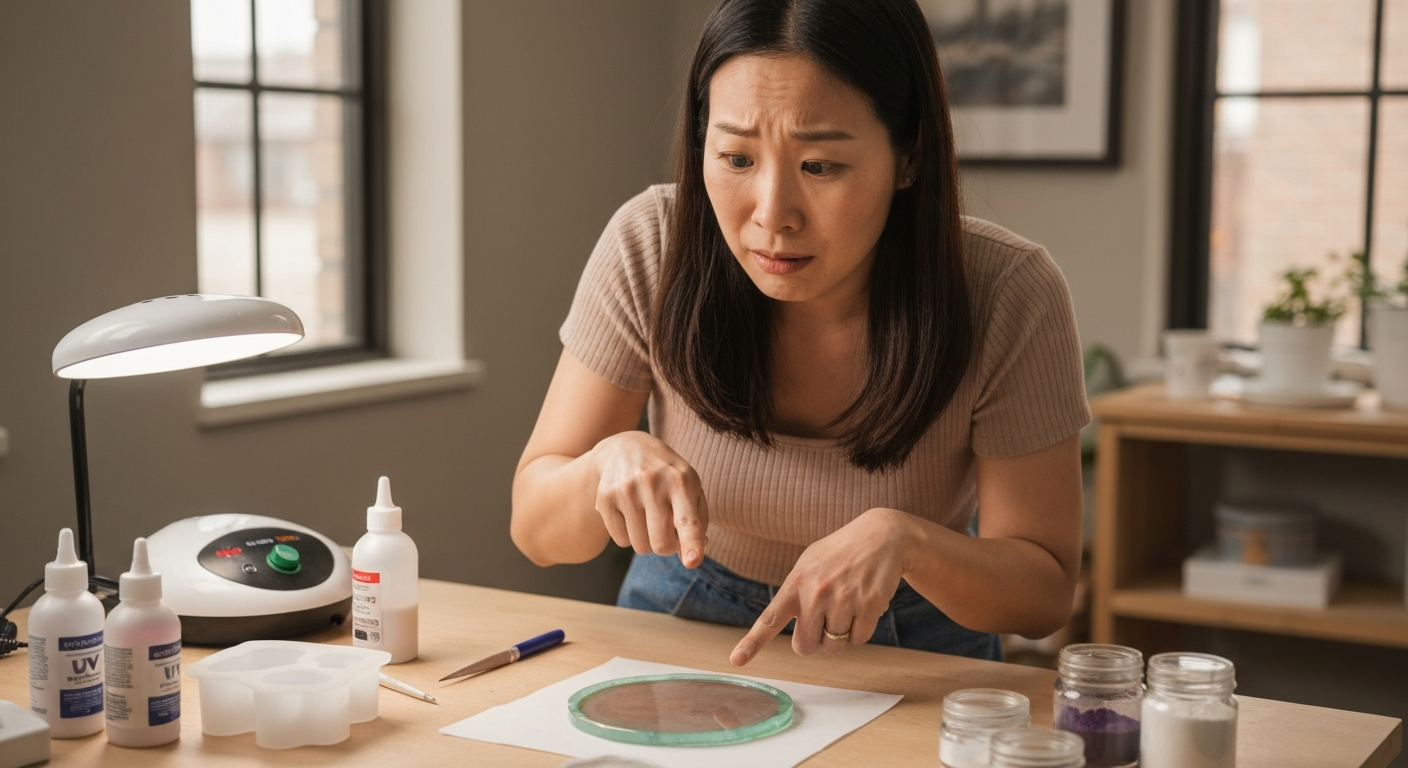

Your resin is sticky after drying because of an incorrect mixing ratio, insufficient curing time, low temperature, high humidity, or inhibited surfaces — and the fix depends on whether you're working with epoxy resin, UV resin, or builder gel.
Sticky resin is one of the most frustrating problems in crafting, and it doesn't mean your project is ruined. Whether your epoxy won't harden, your UV resin stays tacky after curing, or your builder gel has that annoying sticky layer, each type of resin has specific reasons for failing to cure properly — and specific solutions to rescue your work.
Epoxy resin stays sticky almost always because the resin and hardener weren't mixed in the correct ratio or weren't mixed thoroughly enough — this prevents the chemical reaction needed for full curing.
Epoxy is a two-part system. Part A (resin) and Part B (hardener) must combine in precise proportions — usually 1:1 or 2:1 by volume, depending on your brand. When you eyeball measurements or rush the mixing, you end up with unreacted components that never harden.
Some epoxy formulas specify mixing by weight, others by volume. These are not interchangeable. A 1:1 ratio by volume might actually be 100:83 by weight for certain brands. Always check your product's instructions and use the correct measuring method.
Most epoxies need 3–5 minutes of continuous stirring, scraping the sides and bottom of your container. Undermixing leaves streaks of unreacted resin or hardener throughout your piece. You'll notice these as soft spots or permanently tacky areas even after days of curing.
Epoxy cures through an exothermic reaction — it generates its own heat. But if your workspace is below 70°F (21°C), the reaction slows dramatically. Below 60°F, many epoxies won't cure at all. The resin remains soft, bendy, or outright sticky.
| Workspace Temperature | Cure Time Effect |
|---|---|
| Below 60°F (15°C) | May not cure at all |
| 60–70°F (15–21°C) | Extended cure time (48–72+ hours) |
| 70–80°F (21–27°C) | Standard cure time (24–48 hours) |
| Above 80°F (27°C) | Faster cure, risk of bubbles or yellowing |
High humidity introduces moisture into uncured epoxy. This can cause cloudiness, surface tackiness, or a condition called "amine blush" — a waxy, sticky film that forms on the surface. If your workspace humidity exceeds 85%, consider running a dehumidifier or waiting for drier conditions.
Also Read: Why Is My Honey Solid? The Science & How to Fix It
UV resin remains tacky after curing because the UV light didn't penetrate fully — caused by insufficient exposure time, weak UV output, thick pours, or pigments blocking the light.
UV resin works differently from epoxy. Instead of a chemical reaction between two parts, UV resin contains photoinitiators that harden when exposed to ultraviolet light. If that light doesn't reach every molecule, you get sticky patches.
Not all UV lights are created equal. Resin-specific UV lamps typically output 365–405nm wavelength at 36–48 watts. Cheap nail lamps or old bulbs may not deliver enough intensity. If your lamp is over a year old, the UV output has likely degraded even if it still lights up.
UV light can only penetrate so deep. Most UV resins cure reliably in layers of 2mm or less. Pour thicker than that, and the bottom stays liquid while the top hardens. Build up your piece in multiple thin layers, curing each one completely before adding the next.
Opaque pigments, glitter, and solid inclusions cast shadows. UV light can't cure what it can't reach. When working with colored UV resin, extend your curing time significantly — sometimes 2–3 times longer than clear resin requires.
"UV-curable resins require adequate light intensity and exposure time. Pigmented or filled resins may require extended cure times to ensure complete polymerization." — Radtech International
Here's something that surprises many crafters: UV resin is supposed to be slightly sticky on the surface right after curing. Oxygen in the air inhibits the very top layer from fully polymerizing. This tacky layer is called the "oxygen inhibition layer" and is completely normal.
To remove it: wipe the surface with isopropyl alcohol (91% or higher), apply a thin finishing coat and cure again, or use a UV resin specifically formulated to cure tack-free.
Builder gel has a sticky surface after curing because that's how it's designed — the tacky "inhibition layer" allows the next coat to bond, and you remove it only after your final layer.
If you're new to builder gel nails, this sticky residue feels like something went wrong. It didn't. Unlike regular nail polish that air-dries completely, builder gel maintains a tacky surface between layers so each coat chemically bonds to the one beneath it.
Only wipe the inhibition layer after your very last coat of builder gel and your final cure. Use a lint-free wipe soaked in 90%+ isopropyl alcohol or a brand-specific gel cleanser. Wiping between layers prevents proper adhesion and causes peeling.
If your builder gel feels soft or squishy beneath the surface tackiness, you have an actual curing problem:
Also Read: Why Is My Gel Polish Peeling? 8 Causes & How to Fix It
Sometimes — it depends on how sticky the resin is and what caused the problem.
If only the surface is tacky but the bulk feels hard:
The new layer will bond to the underlying resin and give you a smooth, hard finish.
Bad news: if the entire piece is soft, bendy, or gummy throughout, it cannot be saved by adding more resin. The chemical reaction failed, and no amount of additional curing time will fix it. You'll need to scrape off the uncured resin (it comes off more easily than you'd expect since it never hardened), clean the surface, and start over with correct measurements.
Try additional cure time under a stronger UV source. If you've been using a nail lamp, try direct sunlight on a clear day for 15–30 minutes. If it's still sticky after extended UV exposure, apply a tack-free topcoat designed for UV resin.
Preventing sticky resin is far easier than fixing it — these habits ensure a proper cure every time.
Measure precisely: Use digital scales for weight-based ratios and graduated mixing cups for volume. Never estimate.
Mix thoroughly: Stir for the full recommended time (usually 3–5 minutes), scraping sides and bottom. Consider mixing in one cup, then transferring to a fresh cup and mixing again.
Control your environment: Work in 70–80°F with humidity below 50%. Use a space heater or dehumidifier if needed.
Pour in thin layers: Keep epoxy pours under 1/4 inch and UV resin under 2mm per layer.
Use fresh materials: Check expiration dates. Old hardener absorbs moisture and won't react properly.
Cure in optimal conditions: Keep your project warm during the full cure period — don't move it to a cold garage overnight.
| ✓Our Pick |
Search resin craft supplies on Amazon Backed by strong customer feedback — the most recommended solution in forums and Q&A communities. See on Amazon → |
Sticky resin results from incorrect mixing ratios, insufficient cure time, cold temperatures, high humidity, or light that couldn't penetrate colored or thick layers. Epoxy needs precise measurement and thorough mixing. UV resin needs adequate light intensity and thin pours. Builder gel's surface tackiness is intentional and should only be wiped after the final cure. Slightly tacky surfaces can often be saved with sanding and a fresh coat, but fully soft resin must be removed and redone.
If your epoxy is still sticky after 24 hours, the most likely causes are incorrect mixing ratio, insufficient mixing time, or a workspace temperature below 70°F. Epoxy generates heat as it cures, and cold environments slow this reaction dramatically. Try moving your project to a warmer room (75–80°F) for another 24 hours before determining if it's a complete cure failure.
Nail lamps are designed for gel polish, not craft UV resin. Many nail lamps output 36W or less and may not cover the 365–405nm wavelength range that craft resins require. Additionally, if you're curing thick pours or pigmented resin, a nail lamp likely isn't powerful enough. Try a dedicated UV/LED resin curing lamp with 48W or higher output, or cure in direct sunlight.
No — paint will not adhere properly to uncured resin and the tackiness will transfer through the paint layer. You must resolve the cure issue first. If the resin is only surface-tacky, sand lightly and apply a fresh thin coat of properly-mixed epoxy. Once fully cured and smooth, you can then paint or coat as desired.
Partial stickiness indicates uneven mixing. When resin and hardener aren't combined thoroughly, you get pockets where the ratio is off. These areas cure improperly while the rest hardens fine. The solution is to mix longer and more deliberately in your next project — scrape the container walls and transfer to a second container for additional mixing if needed.
Yes — the tacky inhibition layer on builder gel is completely intentional. It allows successive layers to bond chemically. Only remove this layer with alcohol or gel cleanser after your final cure. If the gel beneath the tackiness is hard, everything worked correctly.
Reviewed and Updated on June 1, 2026 by George Wright