Health
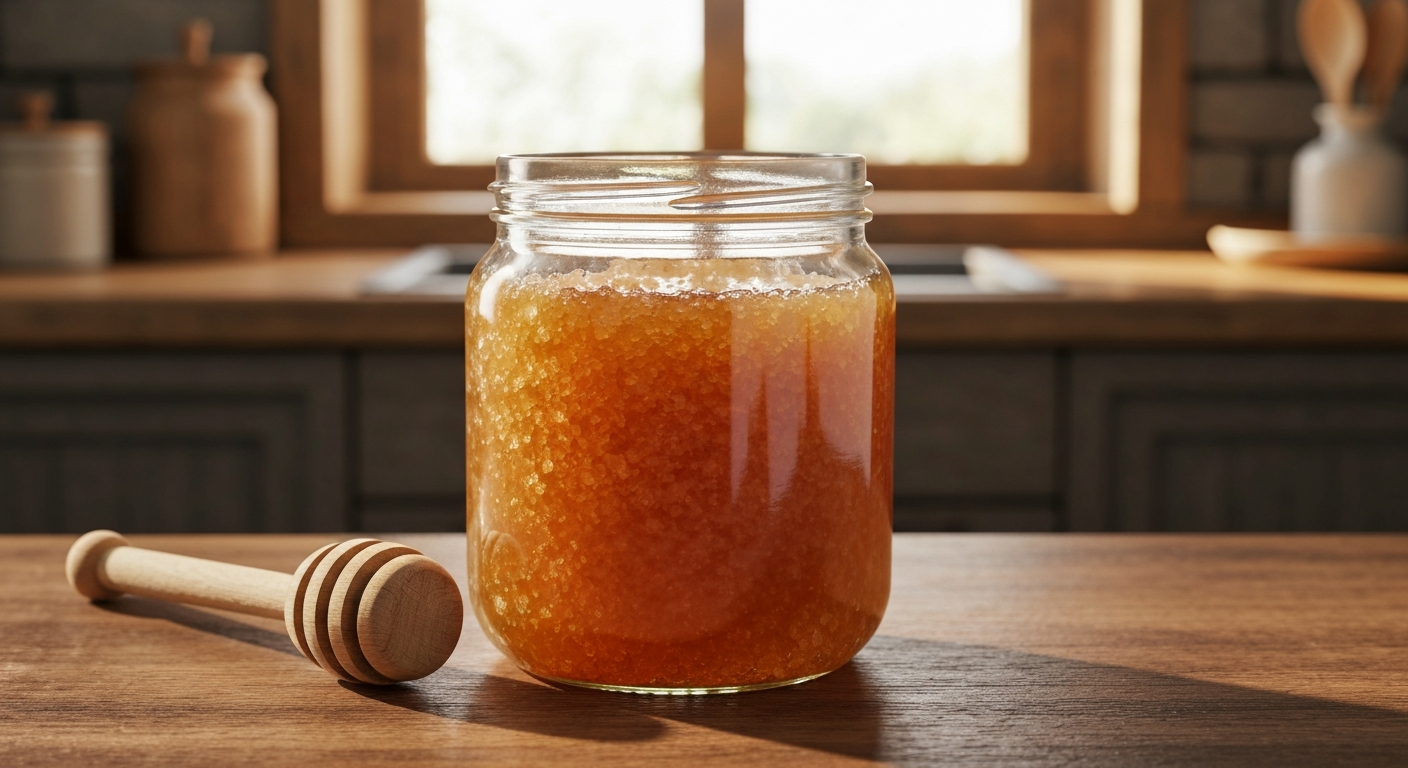

Your honey is solid because it has crystallized — a completely natural process that happens when glucose molecules in honey separate from the water and form tiny crystals, eventually turning the entire jar thick, grainy, or rock-hard.
Crystallized honey is not spoiled, expired, or fake. In fact, raw and unprocessed honey crystallizes faster than heavily filtered varieties, so a solid jar is often a sign of quality. The rate at which honey solidifies depends on its glucose-to-fructose ratio, storage temperature, and whether it contains tiny particles that act as crystallization "seeds." The good news: you can easily return solid honey to its liquid state without destroying its beneficial properties.
| ✓Our Pick |
Search raw honey varieties and honey accessories Used by over 10,000 satisfied customers — an easy, affordable option you can start using today. See on Amazon → |
Honey crystallizes because it is a supersaturated sugar solution — it contains more sugar than can stay dissolved in its water content, so the excess glucose eventually falls out of solution and forms crystals.
All honey contains two main sugars: glucose and fructose. Glucose is less soluble in water than fructose, which means it cannot stay dissolved indefinitely. When glucose molecules begin to separate from the liquid, they bond together and form solid crystals. These crystals then attract more glucose molecules, and the process spreads throughout the jar.
Think of it like salt in water. If you dissolve as much salt as possible in warm water and then let it cool, some of the salt will eventually settle out as solid crystals. Honey works the same way — it is inherently unstable and will naturally move toward a more stable, crystallized state over time.
"Crystallization is a natural process. Resistance to crystallization depends primarily on its original glucose and fructose content." — National Honey Board
The crystallization process does not change honey's nutritional value or safety. Crystallized honey contains the same sugars, enzymes, and antioxidants as liquid honey. Many people actually prefer crystallized honey because it spreads more easily on toast and does not drip off a spoon.
Honey crystallizes at different rates based on its floral source, processing method, storage temperature, and the presence of pollen or other particles that act as nucleation sites.
The flowers bees visit determine the glucose-to-fructose ratio in honey, which directly controls how quickly it solidifies. Honey with high glucose content crystallizes within weeks, while high-fructose varieties can stay liquid for years.
| Honey Type | Glucose Content | Crystallization Speed |
|---|---|---|
| Clover | High | Fast (weeks to months) |
| Alfalfa | High | Fast (weeks to months) |
| Canola/Rapeseed | Very high | Very fast (days to weeks) |
| Acacia | Low | Slow (1–3 years) |
| Tupelo | Very low | Very slow (may never crystallize) |
| Wildflower | Variable | Medium (months) |
If you bought clover honey and it turned solid within a month, that is completely normal. Clover is one of the most common honey sources in the United States, and its high glucose content makes rapid crystallization inevitable.
Storage temperature is the single biggest factor you can control. Honey crystallizes fastest between 50°F and 59°F (10°C to 15°C) — the temperature range of many pantries, basements, and garages. Below 50°F, honey becomes too thick for crystals to form easily. Above 77°F (25°C), the glucose stays dissolved longer.
If you stored your honey in a cool pantry or near an exterior wall during winter, that explains why it solidified. Moving it to a warmer spot (above 70°F) will slow future crystallization after you reliquefy it.
Raw, unfiltered honey contains tiny particles — pollen grains, beeswax fragments, and air bubbles — that act as nucleation sites where crystals can begin forming. Each particle gives glucose molecules a surface to cling to, accelerating the crystallization process.
Commercial honey is often ultra-filtered and pasteurized specifically to remove these particles and delay crystallization on store shelves. Ironically, this means that honey which stays perfectly clear for years has often been heavily processed, while honey that crystallizes quickly may be closer to its natural state.
Also Read: Why Is My Stomach Always Bloated? 9 Causes & Fixes
The safest way to return solid honey to liquid is gentle, indirect heat — a warm water bath between 95°F and 110°F (35°C to 43°C) will dissolve the crystals without damaging honey's enzymes or flavor.
This method works for glass jars. If your honey is in a plastic squeeze bottle, use water no hotter than 110°F (43°C) to avoid warping the container.
Microwaves heat unevenly, creating hot spots that can exceed 140°F (60°C) and destroy beneficial enzymes like diastase and invertase. These enzymes contribute to honey's antimicrobial properties and are part of why raw honey is valued differently from processed table syrup.
If you must microwave, use 50% power in 10-second bursts, stirring between each burst. Stop as soon as the honey becomes pourable — you do not need to achieve completely clear liquid.
Yes, but each heating cycle degrades quality slightly. A better approach is to reliquefy only the amount you need. Scoop out a portion of crystallized honey, warm just that amount, and leave the rest solid. Crystallized honey stored in a sealed jar at room temperature keeps indefinitely.
Crystallized honey is not spoiled, and crystallization is actually evidence that your honey is real — pure honey will always crystallize eventually, while adulterated honey mixed with corn syrup often stays permanently liquid.
Honey is one of the most commonly adulterated foods worldwide. Unscrupulous producers dilute real honey with cheaper sweeteners like high-fructose corn syrup or rice syrup. These additives change the sugar ratio and prevent normal crystallization. If your honey has been sitting in the pantry for two years and still looks perfectly clear, it may not be pure honey.
However, the reverse is not a reliable test. Some pure honeys (like acacia or tupelo) naturally resist crystallization due to their low glucose content. The crystallization test only works in one direction: crystallized honey is almost certainly real, but clear honey is not necessarily fake.
"Honey stored in sealed containers can remain stable for decades and even centuries." — Smithsonian Magazine
Real honey does not expire in the traditional sense. Archaeologists have found 3,000-year-old honey in Egyptian tombs that was still edible. As long as your honey has been stored in a sealed container and has not absorbed moisture from the environment, it remains safe to eat regardless of texture.
You cannot permanently prevent crystallization in pure honey, but you can slow the process significantly by storing honey above 70°F (21°C), choosing low-glucose varieties, and keeping the container tightly sealed.
Some beekeepers recommend freezing honey for long-term storage. While this sounds counterintuitive, freezing actually prevents crystallization because the honey becomes too viscous for crystals to form. Frozen honey thaws back to liquid when returned to room temperature.
Normal crystallization produces smooth, fine crystals or a creamy texture. Large, gritty crystals or fermentation (bubbles, sour smell, foam) indicate moisture contamination and potential spoilage.
Honey with less than 18% water content will not ferment. But if honey absorbs moisture from humid air or wet utensils, its water content can rise above that threshold. The natural yeasts present in all honey can then begin fermenting the sugars, producing alcohol and carbon dioxide.
Signs of fermented honey:
- Visible bubbles or foam on the surface
- Sour or alcoholic smell
- Lid popping off due to gas pressure
- Thin, watery consistency
Fermented honey is not dangerous, but it tastes unpleasant. Some people use it for cooking or making mead (honey wine), but it is no longer suitable for eating straight.
If your crystallized honey smells normal and has no foam or bubbles, it is perfectly fine. The texture change is cosmetic, not a safety issue.
Honey solidifies because its naturally high glucose content makes it an unstable supersaturated solution — given enough time and the right temperature, glucose molecules will always crystallize out of the liquid. This is normal, not a sign of spoilage or poor quality. To reliquefy crystallized honey, use a warm water bath (95–110°F) for 20–30 minutes. Store honey above 70°F in a sealed container to slow future crystallization, and choose low-glucose varieties like acacia or tupelo if you prefer honey that stays liquid longer.
Honey goes solid in the jar because glucose, one of its two main sugars, is only partially soluble in water. Over time, glucose molecules separate from the liquid and form crystals that spread throughout the honey. Cooler storage temperatures (50–59°F) and the presence of pollen particles accelerate this process. The jar itself does not cause crystallization — it happens inside any container.
Yes, crystallized honey is completely safe to eat. The crystallization process does not create any harmful substances or indicate bacterial growth. Honey's low water content and acidic pH make it naturally resistant to spoilage. You can eat crystallized honey directly, spread it on bread, or dissolve it in warm beverages. Many people prefer the spreadable texture of crystallized honey.
Place your honey jar (with the lid removed) in a bowl of warm water between 95°F and 110°F. Let it sit for 20–30 minutes, stirring occasionally. Replace the water if it cools before the crystals dissolve. Avoid boiling water or microwaving, which can destroy beneficial enzymes. You can repeat this process whenever honey re-crystallizes.
Crystallization is a strong indicator that honey is pure. Real honey contains glucose that will eventually crystallize, while honey adulterated with corn syrup or other sweeteners often stays permanently liquid. However, some pure honeys (acacia, tupelo) have low glucose and resist crystallization naturally, so clear honey is not automatically fake.
Crystallization speed depends on floral source and storage conditions. High-glucose honeys like clover and canola can crystallize within weeks. Low-glucose varieties like acacia may stay liquid for one to three years. Storing honey below 60°F dramatically speeds up the process, while temperatures above 70°F slow it down.
Reviewed and Updated on June 1, 2026 by George Wright