
Technology
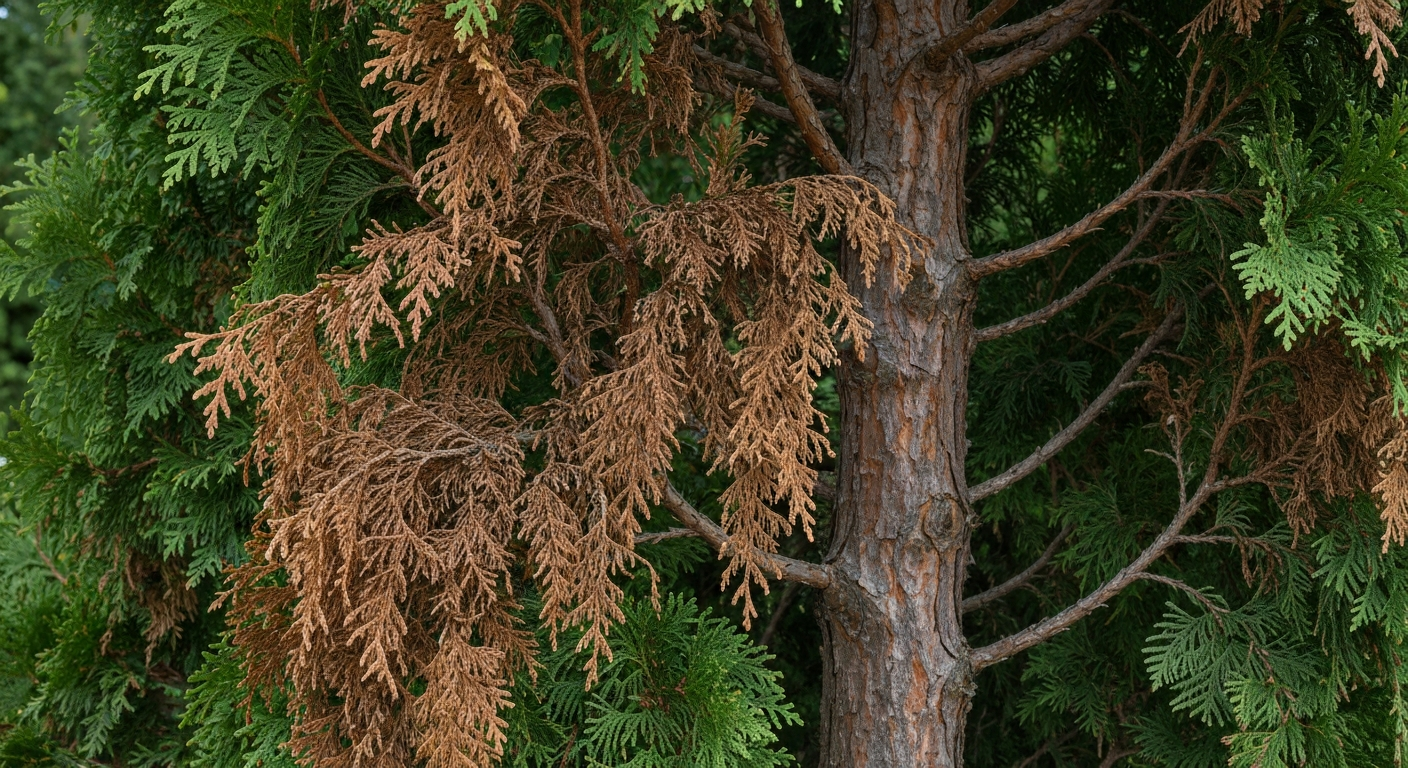

Arborvitae turns brown due to environmental stress, pests, disease, or root problems—with winter burn, drought, and spider mites being the most common culprits in 2026. The good news is that browning doesn't always mean your tree is dying, and many causes are reversible when caught early.
| ✓Our Pick |
Arborvitae fertilizer and treatment products for stressed evergreens Great value for money — this product tackles the root cause rather than just masking the symptoms. See on Amazon → |
Arborvitae browning stems from seven main causes: winter desiccation, drought stress, overwatering, pest infestations, fungal diseases, transplant shock, and physical damage from animals or salt.
Understanding which cause is affecting your trees requires examining the pattern of browning, the time of year it appeared, and recent weather or care changes. Brown foliage on the inner portions of the tree is often normal shedding, while browning on branch tips or entire sections signals a problem that needs attention.
Arborvitae (Thuja species) are generally hardy evergreens, but they're more sensitive to environmental extremes than many homeowners realize. Their shallow root systems and dense foliage make them vulnerable to both moisture stress and pest damage.
| ✓Quick Fix |
The Go-To Fix for This Right Now Quick to get, easy to try — a sensible first move while you figure out next steps. See on Amazon → |
Winter burn is the most common reason arborvitae turn brown in late winter or early spring, especially in zones 4–6 where cold, dry winds combine with frozen soil.
Winter burn happens when your arborvitae loses moisture through its foliage faster than its frozen roots can replace it. The result is desiccated, brown foliage that typically appears on the south or southwest side of the tree—the side that gets the most winter sun and wind exposure.
"Winter injury results when dry winds and bright sunshine cause the needles to lose water faster than it can be replaced by roots in cold or frozen soils." — University of Minnesota Extension
You'll notice winter burn damage becoming visible in February through April as temperatures warm. The foliage may have looked fine all winter, then suddenly turns bronze or brown as the tree "wakes up" and reveals the damage.
Signs your arborvitae has winter burn:
- Browning concentrated on one side of the tree (usually south-facing)
- Damage appeared after a particularly cold, dry, or windy winter
- Interior foliage remains green
- Branch tips feel dry and brittle
The silver lining: winter burn often looks worse than it is. Many arborvitae recover once spring moisture returns and new growth emerges. Wait until late May or early June before pruning—what looks dead may still push new growth from dormant buds.
Also Read: Why Is My Palm Tree Turning Brown? 8 Causes & Proven Fixes
Drought stress causes arborvitae foliage to turn yellow, then brown, typically starting at the top of the tree or on the innermost branches where water reaches last.
Arborvitae have shallow, fibrous root systems that dry out quickly during hot summers or extended dry spells. Unlike deeper-rooted trees, they can't tap into lower soil moisture reserves, making them highly dependent on regular rainfall or irrigation.
You'll often see drought damage in late summer or fall, though the browning may not become obvious until weeks after the dry period ends. The tree prioritizes survival of its core structure, so outer and upper branches show stress first.
| Drought Stress Signs | What You'll See |
|---|---|
| Timing | Mid-summer through fall |
| Pattern | Top-down or inside-out browning |
| Soil condition | Dry several inches below surface |
| Branch flexibility | Branches bend without snapping |
| Recovery potential | Good if caught early |
To check for drought stress, push your finger 3–4 inches into the soil near the base of your arborvitae. If it's dry at that depth, your tree needs water. Arborvitae need about 1 inch of water per week during the growing season—either from rainfall or supplemental irrigation.
Spider mites are tiny pests that suck sap from arborvitae foliage, causing a distinctive stippled, bronze discoloration that spreads rapidly in hot, dry weather.
These nearly invisible pests (smaller than a pinhead) thrive when conditions are dry and dusty—exactly the conditions that also stress your arborvitae. A severe infestation can turn an entire tree brown within a few weeks.
To confirm spider mites, hold a white piece of paper under a branch and shake the foliage firmly. Tiny specks that move on the paper are mites. You may also notice fine webbing between branches, though this is more visible in heavy infestations.
"Spider mite damage on arborvitae appears as a bronze or tan discoloration, and close inspection may reveal fine webbing and tiny moving specks on the foliage." — University of Illinois Extension
Spider mite control starts with a strong blast of water from your hose, which physically knocks mites off the plant. For persistent infestations, horticultural oil or insecticidal soap applied thoroughly to all foliage can help. Avoid broad-spectrum insecticides, which kill the beneficial predatory insects that naturally keep mite populations in check.
| ✓Our Pick |
Anti-pest sprays for evergreen trees and shrubs One of the highest-rated products in its category — a reliable fix used by thousands of people. See on Amazon → |
Several fungal diseases cause arborvitae browning, with tip blight (Kabatina and Phomopsis) and root rot (Phytophthora) being the most destructive.
Fungal problems typically show up in consistently wet conditions—either from overwatering, poor drainage, or prolonged rainy periods. The pattern of browning helps identify which disease you're dealing with.
| Disease | Pattern | Timing | Conditions |
|---|---|---|---|
| Kabatina tip blight | Tips of inner branches brown | Late winter/early spring | Wet fall weather |
| Phomopsis tip blight | New growth tips brown | Late spring/summer | Wet spring weather |
| Root rot (Phytophthora) | Entire sections or whole tree browns | Any season | Poorly drained soil |
| Needle blight | Random patches throughout | Summer/fall | Humid, crowded planting |
Tip blight diseases kill branch tips but rarely kill entire trees. Prune affected branches back to healthy growth during dry weather, and disinfect pruning tools between cuts with rubbing alcohol or a 10% bleach solution.
Root rot is more serious. If your arborvitae's browning is accompanied by soft, dark roots when you dig near the base, the fungal infection has likely progressed beyond treatment. Improving drainage and avoiding overwatering can prevent root rot in remaining healthy trees.
Overwatering causes root suffocation, leading to browning foliage that's often mistaken for drought stress—but the treatment is opposite.
Roots need oxygen to function. When soil stays waterlogged, roots can't breathe and begin to die. Dead roots can't absorb water, so the tree wilts and browns even though the soil is wet. This creates a frustrating cycle where concerned homeowners water more, making the problem worse.
Signs your arborvitae is overwatered rather than underwatered:
- Soil feels soggy days after watering or rain
- Browning is uniform throughout the tree (not top-down)
- Base of trunk feels soft or bark is peeling
- Tree was planted in a low spot or clay soil
- Roots are brown and mushy when examined
If overwatering is the culprit, stop supplemental watering immediately and let the soil dry out. For trees in chronically wet areas, you may need to improve drainage with French drains or consider relocating the tree.
Also Read: Why Is My Cactus Turning Black? 6 Causes & How to Save It
Transplant shock causes browning in arborvitae planted within the last 1–2 years as the tree struggles to establish roots in its new location.
Newly planted arborvitae are particularly vulnerable because their root systems are limited to the root ball they arrived with. Until new roots grow out into the surrounding soil—which can take 1–2 full growing seasons—the tree has a greatly reduced ability to absorb water and nutrients.
Transplant shock browning typically appears during the tree's first summer, especially during hot or dry periods. The tree simply doesn't have enough roots to keep up with water demand.
To minimize transplant shock:
- Water deeply 2–3 times per week during the first summer
- Apply 2–3 inches of organic mulch around the base (not touching the trunk)
- Avoid fertilizing the first year—it stimulates top growth the roots can't support
- Consider anti-desiccant sprays before winter for fall-planted trees
Most arborvitae recover from transplant shock if they receive consistent care. Don't prune brown branches until the second spring—they may still produce new growth.
Physical damage from deer browsing, dog urine, or road salt causes localized browning that follows predictable patterns based on the source.
Deer damage appears on lower branches (up to about 6 feet) and shows as ragged, torn foliage rather than clean browning. If deer are present in your area, you'll often see tracks or droppings nearby.
Dog urine damage creates brown patches at the base of the tree where dogs habitually mark. The high nitrogen and salt content in urine burns foliage on contact.
Road salt damage affects trees planted along driveways, sidewalks, or roads where de-icing salt is used. Salt spray from passing traffic can brown foliage several feet up, while salt absorbed by roots causes browning throughout the tree.
| Damage Type | Location | Pattern | Prevention |
|---|---|---|---|
| Deer browsing | Lower 6 feet | Ragged, chewed appearance | Deer netting or repellent |
| Dog urine | Base of tree | Concentrated brown patch | Physical barrier or training |
| Road salt spray | Street-facing side | Matches traffic pattern | Burlap screen in winter |
| Root salt damage | Throughout tree | Gradual, overall decline | Salt-tolerant plant selection |
For salt-affected trees, deep watering in spring helps flush accumulated salts from the root zone. However, repeatedly salt-damaged trees in high-exposure areas may be better replaced with salt-tolerant species.
Inner browning on arborvitae is usually normal annual needle drop, not a sign of disease—healthy evergreens shed 2–3 year old foliage every fall.
Many homeowners panic when they notice brown foliage inside their arborvitae, but this is often just the tree's natural shedding process. Evergreens aren't truly "ever-green"—they simply keep some foliage year-round while shedding older needles seasonally.
Normal shedding characteristics:
- Brown foliage is on interior branches, close to the trunk
- Outer tips and new growth remain bright green
- Occurs in fall, typically September through November
- Affects all arborvitae in the landscape similarly
- Brown needles fall away naturally
Problem browning characteristics:
- Browning on branch tips or outer portions
- Browning progresses from one section to others
- Occurs outside normal fall shedding season
- Affects individual trees differently
- Accompanied by other symptoms (webbing, soft bark, oozing)
If your arborvitae browning matches the normal shedding pattern, no action is needed. The brown interior foliage will fall away, and the tree will remain healthy.
A systematic approach examining timing, location, and accompanying symptoms will identify the cause of your arborvitae's browning.
Work through these diagnostic questions:
Shortly after planting → Transplant shock
Where is the browning located?
Base of tree → Dog urine or root rot
What are the soil conditions?
Near road or driveway → Salt damage
Are pests present?
Treatment depends on the specific cause, but most arborvitae browning responds to improved watering practices, pest control, or simply patience.
| Cause | Immediate Action | Long-term Prevention |
|---|---|---|
| Winter burn | Wait until late spring to assess; prune only dead wood | Burlap windscreen; anti-desiccant spray |
| Drought | Deep watering 1–2 times weekly | Mulch; drip irrigation |
| Overwatering | Stop watering; improve drainage | Raised planting; soil amendment |
| Spider mites | Hose down foliage; apply horticultural oil | Adequate watering; avoid dusty conditions |
| Fungal disease | Prune affected branches; improve air circulation | Proper spacing; avoid overhead watering |
| Transplant shock | Consistent deep watering; mulch | Proper planting depth; patience |
| Salt damage | Deep spring watering to flush | Relocate or protect; salt-tolerant alternatives |
For most causes, patience is as important as any active treatment. Arborvitae are resilient, and damaged sections often recover with new growth if the underlying stressor is addressed. Avoid the temptation to over-fertilize or drastically prune—both can stress an already weakened tree.
Also Read: Why Is My Venus Fly Trap Turning Black? 7 Causes & Fixes
Arborvitae browning is most commonly caused by winter burn, drought stress, or spider mites—all of which are treatable with proper identification. Check the timing and pattern of browning to narrow down the cause: late winter damage on one side suggests winter burn, summer browning from the top down points to drought, and stippled bronze discoloration with tiny moving specks indicates mites. Don't prune until you've given the tree time to recover, as many brown branches will push new growth when conditions improve.
Browning from the inside out is usually normal annual needle shedding, not a disease. Arborvitae naturally drop their oldest foliage (2–3 years old) each fall, and this inner foliage turns brown before falling away. As long as the outer tips and new growth remain green, your tree is healthy. This shedding is more noticeable after dry summers or when trees are planted close together.
Yes, many arborvitae recover from browning if the cause is identified and addressed. Trees affected by winter burn, drought, or transplant shock often push new growth from dormant buds once conditions improve. However, recovery depends on how much of the tree is affected—if more than 50% of the foliage is brown or if browning reaches the main trunk, survival is less likely. Give the tree until late spring or early summer before assessing recovery.
When only one arborvitae in a hedge browns while others stay green, suspect localized root damage, a drainage
Reviewed and Updated on June 20, 2026 by George Wright