Sleep
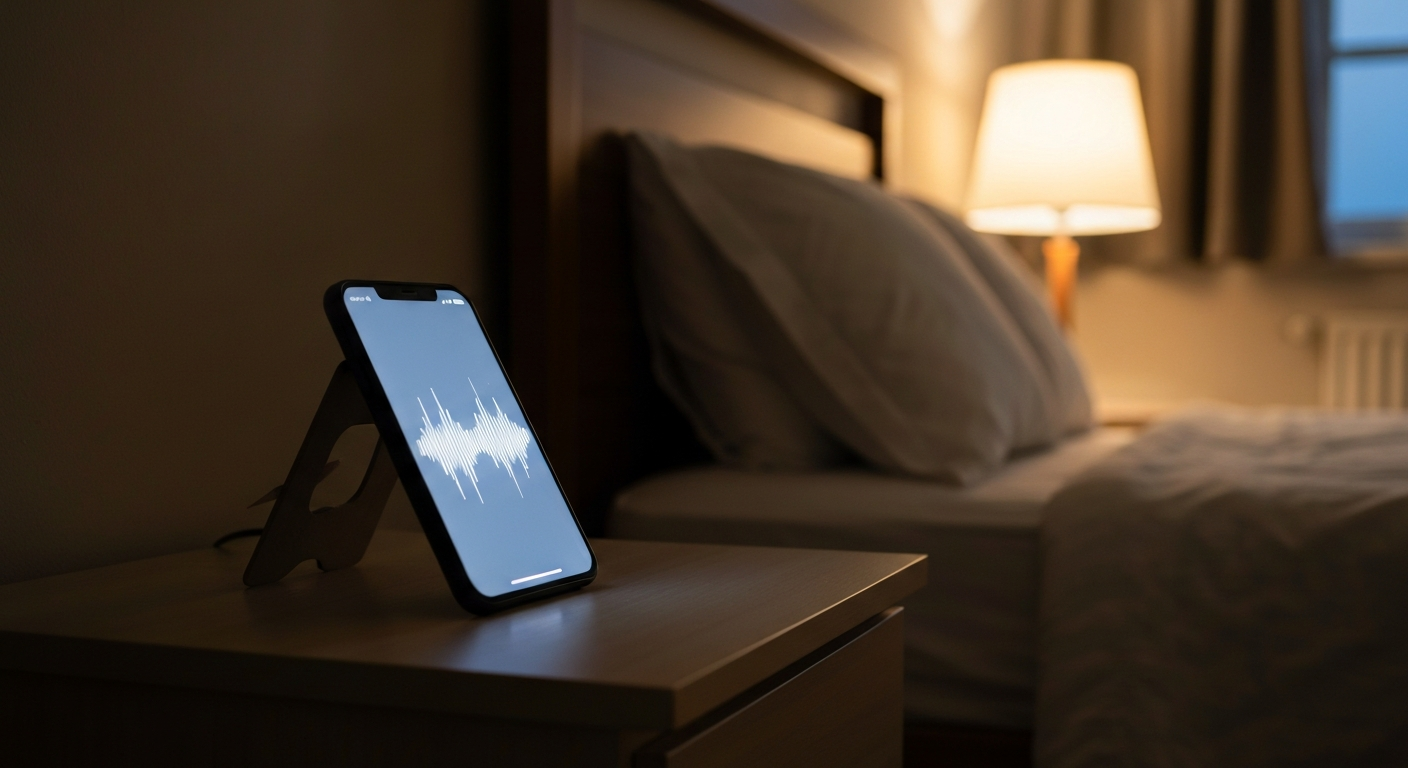

Smartphone snoring apps use your phone's microphone to record and analyze sound while you sleep, flagging snoring episodes and estimating how often and how loudly they happen. They're useful for confirming snoring exists and tracking it over time, but they cannot diagnose sleep apnea or fix the cause of the noise.
Most people download a snore app after a partner complains, or after waking up mid-snort and wondering how bad it really gets. The app promises an answer without an awkward conversation or a sleep clinic visit. That part works reasonably well. What it can't do is tell you why you're snoring or make it stop — and in 2026, with snoring apps now standard on app stores, it's worth knowing exactly where that line sits before you trust the data too much.
A snore app listens through your phone's built-in microphone while you sleep, using sound-pattern recognition to tell snoring apart from other night noise. It then logs the timing, loudness, and frequency of each episode into a chart you see in the morning.
The app sits on your nightstand, picks up airborne vibration from your throat and soft palate, and runs that audio through an algorithm trained to recognize the rhythmic, low-frequency pattern of a snore (as opposed to a cough, a dog barking, or a partner talking). Some apps also record short audio clips so you can play back exactly what you sounded like. Most pair this with basic sleep-tracking features — total sleep time, movement, and sometimes a "sleep score."
Independent testing backs up that the basic detection function works, at least for clear cases. A 2021 validation study tested the popular SnoreLab app against simultaneous lab-grade recordings.
"94.7% accuracy, 100% sensitivity, 94.1% specificity, a positive prediction value of 66.6% and a negative prediction value of 100%" — Katharina Klaus, Anna-Lena Stummer, and Sabine Ruf at International Journal of Environmental Research and Public Health
That accuracy held specifically for nights with heavy snoring (more than half the night spent snoring) — lighter or more occasional snoring was harder for the app to catch consistently.
Also Read: Snoring Symptoms: What's Normal vs. What's a Warning Sign
No. A snore app can flag that you're snoring loudly or often, but it cannot diagnose obstructive sleep apnea (OSA) or rule it out. Apnea is a breathing disorder; snoring is a sound. They overlap, but one app metric does not equal the other.
This distinction matters because the loudest, most disruptive snoring is also the symptom most likely to make someone suspect apnea — and the symptom an app is least equipped to evaluate medically. Sleep apnea involves repeated pauses in breathing during sleep, sometimes dozens of times an hour, each one triggering a partial wake-up the sleeper rarely remembers. A microphone can hear the snore that often comes before or after a pause, but it can't measure airflow, blood oxygen, or brain activity — the actual data a diagnosis requires.
The same study above that validated the SnoreLab app's snore-counting accuracy was explicit about this gap:
"The SnoreLab app should not be used for OSA screening, but can possibly be a helpful tool for monitoring snoring." — Katharina Klaus, Anna-Lena Stummer, and Sabine Ruf at International Journal of Environmental Research and Public Health
The American Academy of Sleep Medicine, the professional body that accredits sleep clinics nationwide, takes the same position on self-assessment apps generally, not just one brand:
"They are unable to diagnose sleep apnea or confirm its absence." — American Academy of Sleep Medicine, Health Advisory
Also Read: See What Actually Helps With Loud, Disruptive Snoring Fast
If your app shows gasping sounds, long silent gaps between snores, or you wake up gasping yourself, that's a conversation for a doctor, not a setting to adjust in an app.
Also Read: CPAP and Snoring: Do You Actually Need One?
Snore apps are genuinely useful for tracking patterns over time and giving you proof to bring to a partner or a doctor — they're far less useful as a treatment or a diagnostic tool. Think of them as a notebook with a microphone, not a stethoscope.
| Snore apps are good at | Snore apps are not good at |
|---|---|
| Confirming snoring happens and roughly how often | Diagnosing sleep apnea |
| Tracking loudness/frequency trends night to night | Measuring oxygen levels or breathing pauses |
| Recording playback clips as evidence for a partner or doctor | Identifying the anatomical cause (tongue, jaw, nose, tissue) |
| Flagging whether a fix is working over weeks | Treating or reducing the snoring itself |
| Free or low-cost, no hardware needed | Replacing a sleep study for an accurate apnea risk score |
Accuracy also depends heavily on phone placement, ambient noise (a fan, a partner's own snoring, traffic outside a window), and the specific phone model's microphone. None of that changes the underlying cause of the snoring — relaxed throat tissue, a tongue that falls back, a blocked nasal passage, or jaw position during sleep. The app can describe the noise. It cannot move your jaw forward or open your airway.
That's the gap most people hit after a week or two of data: they finally have proof of how bad it is, and no built-in way to do anything about it.
Once a snore app confirms frequent or loud snoring, the next step is addressing the physical cause — usually airway or jaw position during sleep — not collecting more data. The most common and well-studied at-home fix is a mandibular advancement device, a mouthpiece worn during sleep that holds the lower jaw slightly forward.
As Medical News Today explains, medically reviewed by sleep medicine physician Raj Dasgupta, MD:
"A MAD is an alternative treatment method that people can try. It works by temporarily moving the jaw and tongue forward, which reduces throat constriction and prevents sleep apnea and snoring." — Steph Coelho, medically reviewed by Raj Dasgupta, MD at Medical News Today
The mechanism is straightforward: snoring happens when the soft tissue at the back of the throat narrows and vibrates as air passes through during sleep. Moving the jaw forward physically widens that space (less narrowing means less vibration, and a quieter airway). That's a mechanical fix to a mechanical problem — something no app, regardless of how good its microphone is, can deliver.
Mandibular advancement devices aren't the right fit for every case (people with diagnosed moderate-to-severe sleep apnea typically need CPAP or a doctor-supervised plan instead), but for ordinary positional and tissue-related snoring, they're one of the most consistently effective non-surgical options available without a prescription.
| ✓Our Pick |
Custom-fit anti-snoring mouthpiece that repositions the jaw to reduce snoring Trusted by professionals and everyday users alike — a smart investment that pays for itself. Learn More → |
A snore app is a tracking tool, not a treatment. It uses your phone's microphone to log how often and how loudly you snore, and validated apps like SnoreLab can hit over 90% accuracy for heavy snoring nights. What it cannot do is diagnose sleep apnea, identify the anatomical cause, or make the snoring stop. Once the data confirms a snoring problem, the next move is a physical fix — most commonly a jaw-repositioning mouthpiece — or a doctor's evaluation if the data shows signs pointing toward apnea rather than ordinary snoring.
For heavy snoring (more than half the night), validated apps like SnoreLab have shown accuracy above 90% in independent testing, with very high sensitivity for catching snoring events. Accuracy drops for lighter or occasional snoring, and results vary by phone model and microphone placement. Treat the trend over several nights as more reliable than any single night's number.
No. An app can hear that you're snoring, but it can't measure breathing pauses, airflow, or blood oxygen — the data needed to diagnose obstructive sleep apnea. The American Academy of Sleep Medicine states plainly that self-assessment apps "are unable to diagnose sleep apnea or confirm its absence." If your app recordings show gasping or long silent gaps, see a doctor.
Not directly. Snore apps track and measure snoring; they don't treat it. Some include white noise or "nudge" alarms meant to shift sleep position, but the core cause — airway narrowing or jaw position — needs a physical intervention like a mandibular advancement device, positional therapy, or medical treatment to actually change.
SnoreLab is one of the few snoring apps with independently published, peer-reviewed validation data, showing 94.7% accuracy for heavy snoring nights in lab testing. Other apps may perform similarly but often lack published third-party accuracy studies, so claims on app store listings alone shouldn't be taken at face value.
Yes — bringing a few nights of app data or audio clips to a doctor's appointment can speed up the conversation and give them concrete patterns to evaluate. Just be clear with them that the data is from a consumer app, not a diagnostic device, so they can decide whether a formal sleep study is needed.
Reviewed and Updated on June 23, 2026 by George Wright