Health
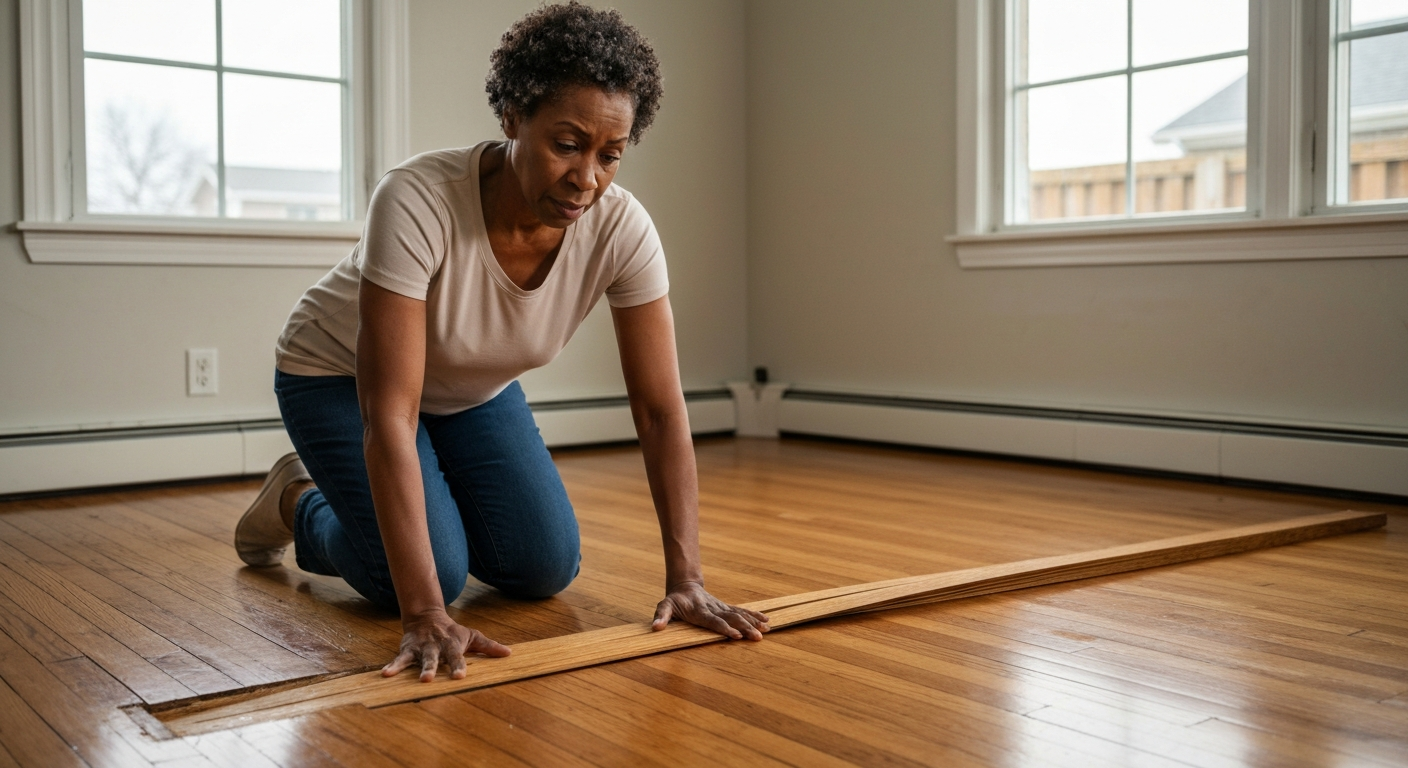

Wood floors buckle when moisture causes the planks to expand beyond their installed boundaries, forcing boards to lift, warp, or tent upward from the subfloor. The most common culprits are water leaks, high humidity, improper installation, and inadequate acclimation — and catching the problem early often means the difference between a simple repair and a full floor replacement.
| ✓Our Pick |
Moisture meter for detecting hidden water damage in wood floors One of the highest-rated products in its category — a reliable fix used by thousands of people. See on Amazon → |
Buckling is the most severe form of moisture damage to wood flooring — it happens when boards literally detach from the subfloor and push upward, sometimes by several inches.
Unlike minor cupping (where board edges curl up while the center stays down) or crowning (where the center rises above the edges), true buckling creates a visible hump or ridge you can trip over. The boards may tent against each other, creating a peak, or pull completely free from nails and adhesive.
Hardwood floor buckling, laminate floor lifting, and even carpet buckling share a common root cause: moisture and expansion pressure with nowhere to go. Whether you're dealing with solid hardwood, engineered wood, laminate planks, or carpet stretched over a wood subfloor, the physics remain the same.
"Wood is hygroscopic, meaning it absorbs and releases moisture depending on the environment. When wood takes on more moisture than it can handle, it expands — and if there's no room for that expansion, something has to give." — National Wood Flooring Association
| ✓Quick Fix |
The Quick Fix Most People Reach for First Most people dealing with this exact problem start here — quick, affordable, and easy to try today. See on Amazon → |
Excess moisture is responsible for over 90% of buckling cases — but that moisture can enter your floor system from multiple sources, each requiring a different fix.
The most dramatic buckling typically follows a water event: a burst pipe, washing machine overflow, dishwasher leak, or flood. When large amounts of water saturate wood planks quickly, they swell rapidly and push against neighboring boards. You'll often see buckling within 24 to 48 hours of the water exposure.
Check for water damage near:
- Kitchens (dishwasher and refrigerator ice maker lines)
- Bathrooms (toilet seals, shower pans, supply lines)
- Laundry rooms (washing machine hoses)
- Water heaters (tank failures or slow leaks)
- Exterior doors and windows (rain intrusion)
A slow leak can be harder to detect. Wood may absorb moisture for weeks before visible buckling appears. By then, damage extends beyond the immediate leak area.
Also Read: Why Is My Water Heater Leaking From the Bottom? 4 Causes & Fixes
Chronic high humidity causes gradual swelling across your entire floor rather than localized damage. This is common in:
- Coastal climates with year-round humidity above 60%
- Homes without air conditioning or dehumidification
- Basements and ground-level installations over concrete
- Houses closed up during humid summer months
Wood flooring performs best when indoor relative humidity stays between 30% and 50%. Above 60%, solid hardwood begins absorbing atmospheric moisture. Engineered wood tolerates slightly higher humidity due to its cross-layer construction, but even it has limits.
"Maintaining consistent humidity levels throughout the year is critical for wood floor stability. Significant fluctuations between seasons cause repeated expansion and contraction cycles that stress the wood and its fastening system." — Hardwood Floors Magazine
Wood flooring must acclimate to your home's environment before installation. Planks should sit in the room where they'll be installed for at least three to five days (longer for solid hardwood), allowing them to reach equilibrium with local temperature and humidity.
When installers skip this step — or acclimate in a garage rather than the actual living space — the wood continues absorbing or releasing moisture after installation. Boards delivered from a dry warehouse into a humid home will expand. The reverse creates gaps, but that expansion leads to buckling.
Laminate floor lifting typically results from inadequate expansion gaps, moisture from below, or poor-quality underlayment.
Laminate is a floating floor — it's not nailed or glued down but rather clicks together and rests on an underlayment. It needs a 1/4 to 1/2 inch gap around all walls and fixed objects to accommodate expansion. When baseboards, door frames, or transition strips pin the laminate tight against the wall, the floor has nowhere to expand and lifts in the middle.
Moisture migrating up through concrete subfloors is another common cause of laminate lifting. Without a proper vapor barrier, concrete releases moisture continuously, and the fiberboard core of laminate absorbs it readily.
Gaps between boards (separation) and buckling are opposite responses to the same problem — seasonal humidity changes.
When indoor humidity drops below 30% (common in winter with central heating), wood releases moisture and shrinks. Boards pull away from each other, creating visible gaps. This isn't buckling, but it's related: a floor that gaps severely in winter may buckle in summer when humidity returns and boards re-expand.
Chronic separation suggests your home's humidity swings are too extreme. A whole-house humidifier for winter and dehumidifier or air conditioning for summer keeps wood stable year-round.
Sometimes buckling originates below the visible flooring:
| Subfloor Issue | How It Causes Buckling |
|---|---|
| Wet concrete slab | Moisture migrates upward continuously |
| Plywood with water damage | Warped subfloor transfers unevenness to flooring above |
| Missing vapor barrier | Ground moisture enters floor system |
| Crawl space humidity | Moisture rises through floor joists |
A moisture meter reading above 12% in wood subfloors or above 3 lbs per 1,000 square feet on concrete (calcium chloride test) indicates a problem that must be resolved before the flooring can be repaired.
Also Read: Why Is My House So Humid? 8 Causes & Proven Fixes
Start by identifying whether the damage is localized (water event) or widespread (humidity or installation issue).
Walk the entire floor and mark buckled sections with painter's tape. Look for patterns:
- Buckling near a specific appliance or fixture = probable leak
- Buckling along exterior walls = possible water intrusion
- Buckling throughout the room = humidity or acclimation problem
- Buckling at room edges only = expansion gap issue
Use a pin-type moisture meter to test:
- The buckled boards themselves
- Boards 3 to 4 feet away from the damage
- The subfloor (if accessible from below or through a removed board)
Normal readings for interior wood are 6% to 9%. Readings above 14% indicate active moisture that must be addressed before repairs.
If you find elevated readings, trace backward:
- Check appliances, supply lines, and drain connections
- Look for discoloration on walls, ceilings below, or subfloor
- Test concrete slabs for moisture transmission
- Measure indoor relative humidity (a hygrometer costs under $15)
Take photos and moisture readings with dates. This documentation helps if you file an insurance claim or hire a remediation contractor.
The repair strategy depends on the severity of damage, the moisture source, and whether the flooring can dry out without permanent warping.
| Damage Level | Signs | Typical Fix |
|---|---|---|
| Minor | Slight lifting, boards still attached | Dry area, wait for boards to flatten, resecure |
| Moderate | Boards tenting 1/2 inch or more | Remove damaged sections, dry subfloor, replace boards |
| Severe | Multiple boards detached, visible warping | Full section replacement, moisture remediation |
| Catastrophic | Large area affected, subfloor damaged | Complete floor replacement, subfloor repair |
Yes — if caught within 24 to 48 hours and the wood hasn't permanently warped, many buckled floors flatten on their own once dried.
Remove standing water immediately. Run dehumidifiers and fans continuously. If possible, weight the buckled area with heavy objects (books, furniture) to encourage flattening as the wood dries. This process takes one to three weeks depending on severity.
After boards flatten, check if they're still secure. Loose nails or failed adhesive may need reinforcement. Some boards may cup or crown slightly even after drying — this is normal and often corrects over one to two seasonal cycles.
Replace boards when they've:
- Warped permanently (twisted, cupped, or crowned beyond 1/16 inch after drying)
- Delaminated (engineered wood layers separating)
- Developed mold or mildew
- Cracked or split from expansion stress
Solid hardwood can sometimes be sanded and refinished after drying, removing minor surface damage. Laminate cannot be refinished — warped laminate planks must be replaced.
| ✓Our Pick |
Replacement hardwood planks for floor repairs This is what many people find solves the problem quickly, without a costly professional visit. See on Amazon → |
Prevention costs a fraction of repair — maintaining stable humidity and catching leaks early protects your investment.
Keep relative humidity between 30% and 50%:
- Use air conditioning or a dehumidifier when humidity exceeds 50%
- Run a humidifier when winter heating drops humidity below 30%
- Monitor with a digital hygrometer in the room with wood flooring
For installations over concrete or in basements:
- Use 6-mil polyethylene sheeting as a vapor barrier
- Consider moisture-resistant underlayment rated for your flooring type
- Ensure crawl spaces are encapsulated and dehumidified
Floating floors need room to breathe:
- Leave 1/4 to 1/2 inch gaps at all walls
- Don't pin flooring under heavy built-ins
- Use flexible transition strips at doorways
The first 48 hours determine whether buckling is fixable:
- Remove standing water immediately
- Run dehumidifiers at maximum capacity
- Call a restoration professional for floods larger than a few square feet
Carpet buckling shares some causes with wood floor buckling — particularly humidity and moisture from subfloors — but also has unique triggers.
Carpet stretches over time, especially in high-traffic areas or when humidity is chronically high. The backing absorbs moisture and expands, creating ripples and bulges. Unlike wood, carpet buckling rarely indicates structural damage to the floor beneath, but it can be a symptom of underlying moisture problems.
Carpet installed without adequate power stretching will buckle within months. If your carpet buckled soon after installation, it may need re-stretching. Chronic buckling in older carpet often means replacement is more practical than repeated re-stretching.
DIY repairs work for minor, localized buckling — but widespread damage or unknown moisture sources require expert diagnosis.
Call a professional when:
- Buckling covers more than 20 square feet
- You can't identify the moisture source
- Subfloor damage is visible or suspected
- The floor has been wet for more than 48 hours
- You see or smell mold
Floor restoration specialists have commercial-grade drying equipment and moisture detection tools that homeowners can't replicate. For insurance claims, their documentation also carries more weight than self-assessment.
Wood floor buckling is your floor's emergency signal that moisture has exceeded its limits — usually from leaks, high humidity, improper acclimation, or missing expansion gaps. Act fast when you spot buckling: remove water immediately, run dehumidifiers, and identify the moisture source before it causes permanent damage. Minor buckling often resolves on its own once the floor dries, but severely warped or delaminated boards need replacement. The best prevention is maintaining indoor humidity between 30% and 50% year-round and catching leaks before they saturate your subfloor.
Laminate floor separation happens when boards shrink due to low humidity or when the locking mechanism fails. Winter heating often drops indoor humidity below 30%, causing the fiberboard core to contract. The fix is twofold: maintain humidity above 35% with a humidifier, and tap separated boards back together (use a tapping block and rubber mallet to avoid damaging the click-lock edges). If boards won't stay locked, the joint may be damaged and those planks need replacement.
Many buckled hardwood floors recover fully if dried within 48 hours and the wood hasn't permanently warped. After removing the moisture source, run dehumidifiers and fans continuously for one to three weeks. Weight the buckled area to encourage flattening. Once dry, boards that remain cupped or crowned beyond 1/16 inch may need sanding and refinishing (solid hardwood) or replacement (engineered wood).
Signs of subfloor water damage include soft or spongy spots when you walk, visible discoloration or staining on the subfloor surface, a musty smell, and moisture meter readings above 12% in wood or elevated calcium chloride test results on concrete. If you can access the subfloor from a basement or crawl space, look for water stains, warping, or mold growth on the underside.
Most homeowner's insurance covers sudden and accidental water damage — a burst pipe, appliance failure, or storm flooding. Gradual damage from humidity, poor installation, or deferred maintenance is typically excluded. Document the damage immediately with photos and moisture readings, and contact your insurer before making major repairs to understand your coverage and claims process.
Visible buckling can appear within 24 to 48 hours of significant water exposure. However, slow leaks may take weeks or months to cause noticeable damage, as wood gradually absorbs moisture until it reaches a tipping point. If you suspect a hidden leak, use a moisture meter to check flooring near appliances, plumbing fixtures, and exterior walls before visible damage appears.
Reviewed and Updated on June 20, 2026 by George Wright