DIY
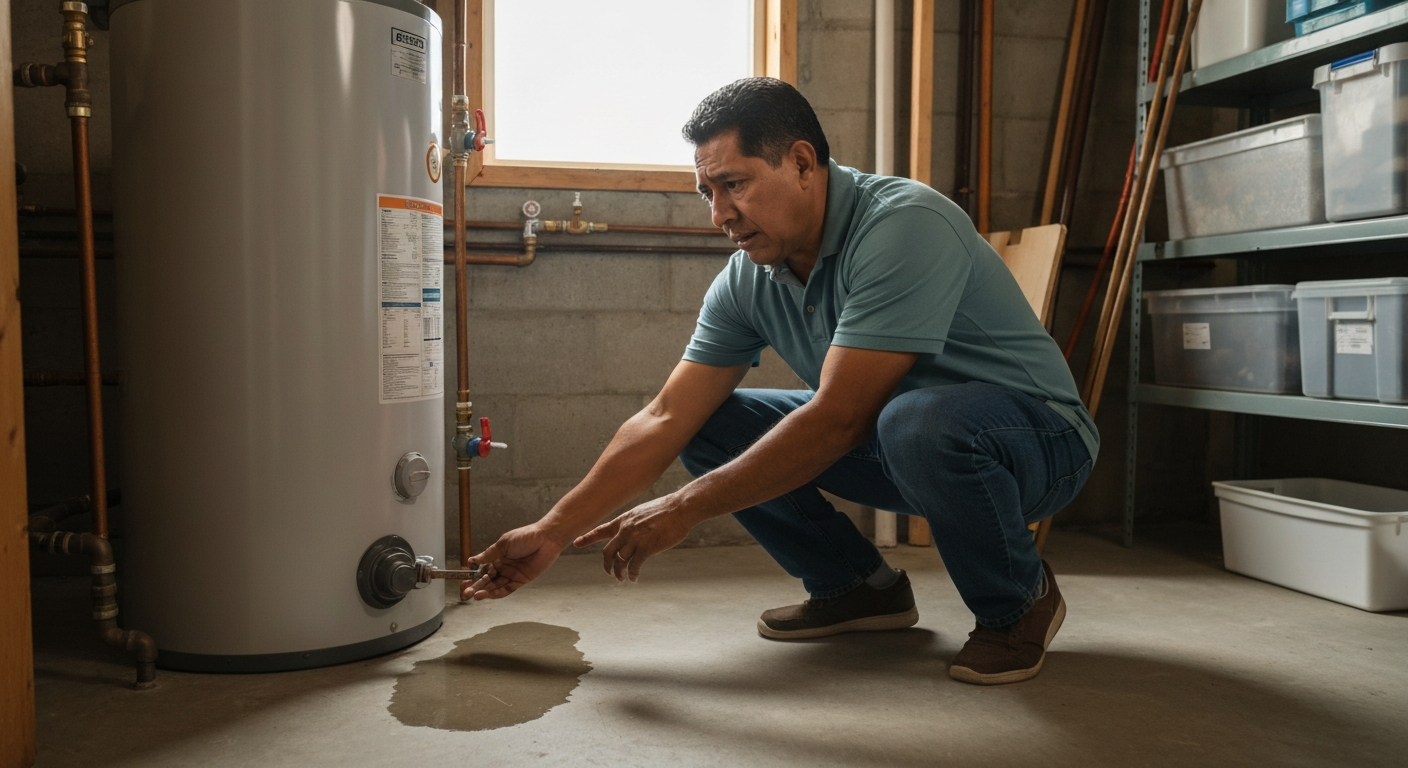

A water heater leaking from the bottom typically signals one of four issues: a failing drain valve, internal tank corrosion, a discharging temperature and pressure (T&P) relief valve, or condensation that's dripping down from above.
The good news is that not every bottom leak means your tank is ruined. Some fixes take five minutes and cost under $20. Others mean it's time to start shopping for a replacement. This guide walks you through exactly how to diagnose which leak you're dealing with, what's causing it, and whether you can fix it yourself or need to call a plumber.
| ✓Our Pick |
Drain valve replacement kit for water heaters You'll wonder why you didn't try this sooner — practical, well-reviewed, and easy to get started. See on Amazon → |
The four most common sources of bottom leaks are the drain valve, the T&P relief valve discharge tube, condensation, and internal tank failure—each requiring a different response.
Understanding which component is leaking determines whether you're facing a simple repair or a full replacement. Let's break down each cause.
The drain valve sits at the very bottom of your tank and is designed to flush out sediment during maintenance. Over time, the valve's plastic or brass components can crack, corrode, or simply loosen from vibration.
To check: Place a dry towel directly under the drain valve and wait 15 minutes. If the towel is wet and the moisture clearly originates from the valve itself (not dripping from above), you've found your culprit.
A loose drain valve can often be tightened with a wrench—give it a quarter turn clockwise. If water still seeps out, the valve's internal washer may be degraded and the entire valve needs replacement. This is a $10-15 part and a 30-minute DIY job for most homeowners.
The temperature and pressure relief valve is a critical safety device located on the side of your tank, usually near the top. It has a discharge tube that runs down the side of the tank and terminates a few inches above the floor. When this valve releases water, it exits at the bottom—making it look like a bottom leak.
"The temperature-pressure relief valve is designed to open and release water if the temperature exceeds 210°F or the pressure exceeds 150 psi. Periodic discharge is normal, but continuous leaking indicates a problem." — U.S. Department of Energy at Energy.gov
If you see water pooling at the base of the discharge tube, check whether the T&P valve itself is the source. A valve that's constantly dripping or releasing small amounts of water may be faulty, or your system may have excessive pressure. This requires attention—either the valve needs replacement or a plumber should assess your water pressure.
Condensation is the most benign cause of water pooling under a hot water tank, and it's frequently misdiagnosed as a leak. It's especially common when:
Condensation forms on the outside of the tank and drips down to the floor, mimicking a leak. To test: Wipe the exterior of the tank completely dry with a towel, then run your hand over the surface after 30 minutes. If the tank feels damp but there's no visible crack or dripping fitting, condensation is likely the cause.
This typically resolves on its own once the tank reaches operating temperature. If it persists, your tank may be undersized for your household's demand.
This is the most serious cause—and unfortunately, it means replacement is your only option.
Water heater tanks are lined with glass (vitreous enamel) to prevent the steel from rusting. Over time, this lining develops micro-cracks. Sediment buildup accelerates the process by creating hot spots that stress the lining. Once the steel beneath is exposed, corrosion begins.
The anode rod inside your tank is designed to corrode sacrificially, protecting the tank itself. But if the anode rod is depleted and not replaced, the tank becomes vulnerable.
Signs of internal tank failure:
- Rust-colored water coming from hot taps
- Water pooling directly beneath the tank (not from a valve or fitting)
- The tank is more than 8-12 years old
- Visible rust or bulging at the base of the tank
A corroded tank cannot be repaired. Water pressure will eventually cause a full rupture, potentially flooding your home. If you suspect internal corrosion, turn off the power supply (breaker for electric, gas valve for gas) and call a plumber promptly.
Also Read: Why Is My Water Heater Leaking? 7 Causes & Fixes
Top leaks are usually easier to fix than bottom leaks because they typically originate from accessible fittings rather than internal tank failure.
Common sources of top leaks include:
| Location | Cause | Typical Fix |
|---|---|---|
| Cold water inlet pipe | Loose fitting or corroded connection | Tighten or replace fitting |
| Hot water outlet pipe | Loose fitting or corroded connection | Tighten or replace fitting |
| T&P relief valve body | Faulty valve or excessive pressure | Replace valve or install expansion tank |
| Anode rod port | Corroded or loose anode rod | Replace anode rod and re-seal |
Top leaks often drip down the side of the tank and pool at the bottom, which is why it's important to trace the water's origin before assuming the tank itself has failed.
To diagnose: Dry the entire exterior of the tank, then lay paper towels around all top fittings. Check after an hour to see which area is wet first.
For boilers and hot water tanks with sealed systems, bottom leaks often indicate a failed internal component, pressure issue, or corroded heat exchanger.
While traditional tank water heaters and boilers operate differently, the diagnostic approach for bottom leaks overlaps. Boiler-specific causes include:
"Boiler leaks should never be ignored. Even small drips can indicate pressure problems or component failure that could lead to more serious damage or safety issues." — American Society of Home Inspectors at ASHI.org
If your boiler is dripping water from underneath, check the pressure gauge first. Most residential boilers should read between 12-15 psi when cold. If pressure is abnormally high or the gauge shows zero, you've identified a system issue that needs professional attention.
A relief valve that continuously leaks either has a faulty seal, is responding to genuinely excessive temperature or pressure, or has sediment trapped under the seat.
The T&P valve is designed to open at 150 psi or 210°F—whichever comes first. If your valve is leaking, one of these scenarios applies:
The valve is old or faulty: Mineral deposits can prevent the valve from seating properly. Replacement is straightforward—a new valve costs $15-30.
System pressure is too high: Municipal water pressure above 80 psi can cause the valve to discharge. Install a pressure gauge on a hose bib to test. If pressure exceeds 80 psi, you need a pressure reducing valve (PRV).
Thermal expansion is occurring: In closed-loop systems (homes with a check valve or PRV on the main line), heated water expands with nowhere to go, causing pressure spikes. The solution is an expansion tank.
The water temperature is set too high: Check your thermostat setting. Most manufacturers recommend 120°F for safety and efficiency. Settings above 140°F increase relief valve discharge risk.
Also Read: Why Is My Gas Bill Suddenly So High? 8 Causes & Fixes
A systematic inspection takes 15 minutes and tells you exactly what you're dealing with—grab a flashlight, some paper towels, and follow this sequence.
For electric water heaters, switch off the dedicated breaker at your electrical panel. For gas water heaters, turn the gas control valve to the "pilot" or "off" position. This prevents damage and ensures safety while you inspect.
Dry the entire exterior of the tank and the floor beneath it. Place paper towels at these locations:
- Under the drain valve
- At the base of the T&P discharge tube
- Around all top fittings
- Directly beneath the center of the tank
Wait 30-60 minutes, then check which towels are wet. This reveals the leak's origin.
Look for drips, moisture, or corrosion around the drain valve. Try tightening it gently with a wrench. If it's already tight and still leaking, or if the valve body is cracked, it needs replacement.
Lift the T&P valve's lever briefly (water will discharge—have a bucket ready). Release it and see if it seats properly. If water continues trickling out, the valve is faulty or your system has a pressure issue.
If water is emerging directly from the tank's base with no connection to the drain valve or T&P discharge tube, internal corrosion is likely. Look for rust, bulging, or wet spots on the tank itself.
| Symptom | Likely Cause | Action |
|---|---|---|
| Drip from drain valve | Loose or failed valve | Replace valve ($10-20 DIY) |
| Water at T&P discharge tube | Valve issue or pressure problem | Replace valve or install expansion tank |
| Condensation on tank | Normal operation | Wait for tank to reach temperature |
| Rust-colored water + age 10+ years | Internal corrosion | Replace tank |
| Water from tank base (not valve) | Tank failure | Replace tank immediately |
| Top fitting leak | Loose or corroded connection | Tighten or replace fitting |
A tank water heater typically lasts 8-12 years. If yours is approaching that age and showing signs of corrosion, replacement is more cost-effective than repair.
Annual maintenance extends your water heater's lifespan by 3-5 years and catches small problems before they become emergencies.
Key maintenance tasks:
| ✓Our Pick |
Anode rod replacement for water heaters A well-reviewed choice that delivers real results — worth every penny for anyone dealing with this. See on Amazon → |
A water heater leaking from the bottom is most commonly caused by a failing drain valve, a discharging T&P relief valve, condensation, or internal tank corrosion. Drain valve and T&P valve issues are usually repairable for under $30. Condensation resolves on its own. Internal tank corrosion means replacement is your only option. Diagnose by drying the tank, placing paper towels at key points, and waiting 30-60 minutes to identify the water source. If your tank is over 10 years old and showing rust or direct bottom leakage, start planning for replacement before a full rupture floods your home.
Water can travel along pipes and tank surfaces before dripping to the floor, making the source difficult to pinpoint. Dry the entire tank and all visible pipes completely, then place paper towels at every fitting, valve, and along the tank's base. Wait an hour and check which towel gets wet first—that's your leak origin. Top leaks frequently appear as bottom puddles because water runs down the tank exterior.
It depends on the severity and source. A slow drip from a drain valve can wait a day or two. A T&P valve discharging continuously indicates a pressure or temperature issue that needs prompt attention. Water actively streaming from the tank base is an emergency—turn off power and water supply immediately and call a plumber, as tank rupture and flooding are imminent.
For minor leaks from fittings or the drain valve, continued use is generally safe while you arrange repairs. However, if the leak originates from the tank itself or the T&P valve is continuously discharging, shut off the unit. Continuing to operate a failing tank risks flooding, and a constantly discharging relief valve indicates unsafe pressure or temperature conditions.
Repair costs vary by source: a drain valve replacement runs $10-20 for the part plus $100-150 for labor if you hire a plumber. T&P valve replacement is similar. If internal tank corrosion is the cause, repair isn't possible—replacement costs $800-1,500 for a standard tank unit including installation, or $2,000-4,500 for a tankless system.
A boiler dripping when off typically indicates a faulty pressure relief valve, a waterlogged expansion vessel, or a slow leak from a corroded component. Check the pressure gauge—if it reads zero or abnormally high, you have a system pressure issue. Constant dripping from the pressure relief valve discharge means the valve needs replacement or an expansion vessel inspection. Internal leaks from the heat exchanger require professional diagnosis.
Reviewed and Updated on May 6, 2026 by Adelinda Manna