DIY

Your water softener isn't working because of one of these common problems: depleted or bridged salt, a clogged brine line, a failed timer or control valve, resin bead exhaustion, or a power/bypass valve issue. Most malfunctions show up as hard water symptoms returning—soap scum, stiff laundry, and scale buildup on fixtures—even though the unit appears to be running normally.
| ✓Our Pick |
Water softener diagnostic tools and replacement parts Great value for money — this product tackles the root cause rather than just masking the symptoms. See on Amazon → |
The most likely culprit is a salt-related problem—either the tank is empty, the salt has formed a hard crust (called a salt bridge), or the system isn't drawing brine properly during regeneration.
Water softeners work by exchanging hard minerals (calcium and magnesium) for sodium ions stored in resin beads. When any part of this process fails, hard water passes through untreated. The tricky part is that the unit often looks fine from the outside—lights on, no error codes, salt still visible in the tank.
According to the Water Quality Association, "Ion exchange water softeners require regular maintenance to operate effectively, including salt replenishment and periodic cleaning of the brine tank and resin bed." This is the baseline most homeowners overlook.
Let's walk through the specific causes, starting with the most common.
A salt bridge is a hard crust that forms across the top of the salt in your brine tank, creating an air gap that prevents salt from dissolving into water—so the unit regenerates with plain water and produces no soft water.
Salt bridges typically form when:
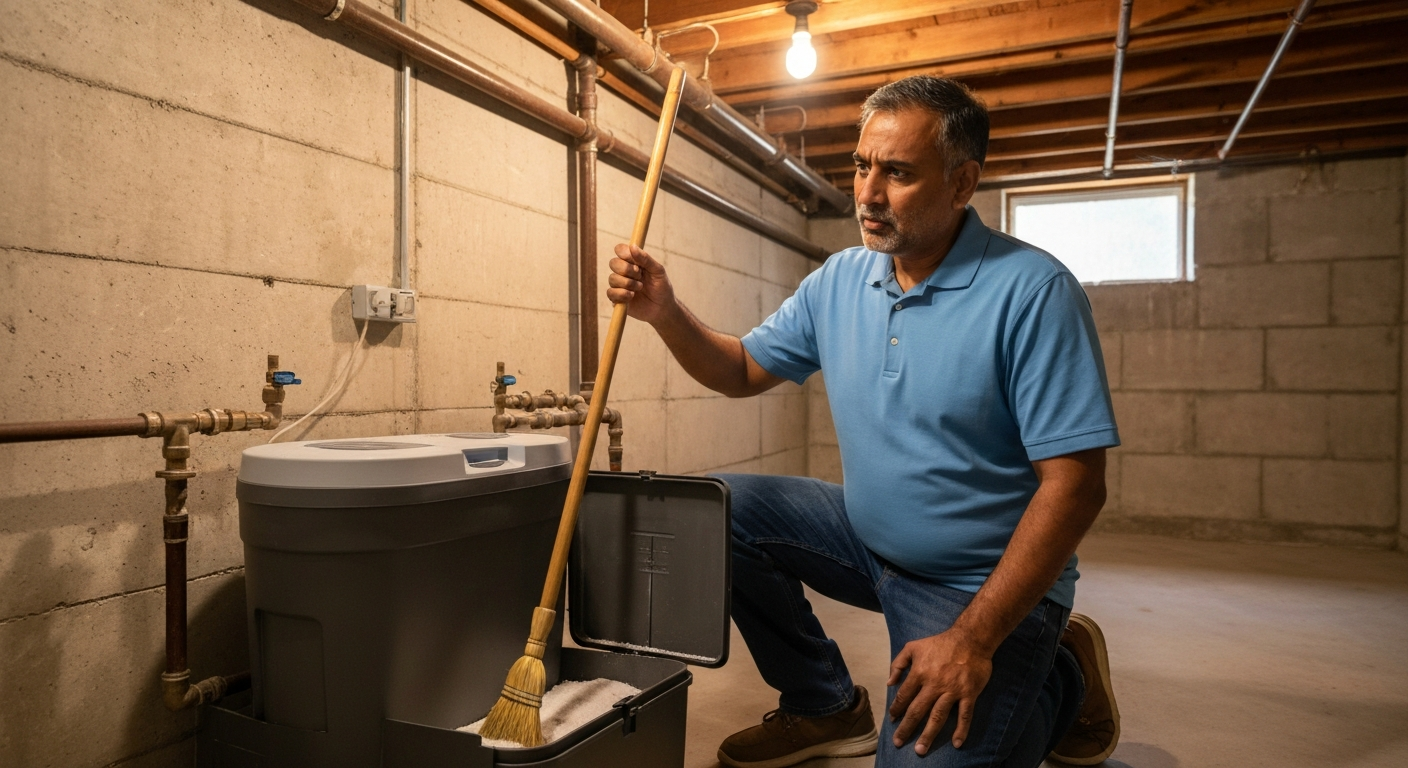
To check for a salt bridge, take a broom handle and gently push down into the salt. If you hit a hard layer 3–4 inches down with hollow space beneath, you've found your problem. Break up the crust carefully—don't damage the brine well in the center of the tank.
| Salt Type | Purity | Bridge Risk | Best For |
|---|---|---|---|
| Solar salt (crystals) | 99.5% | Low | Most households |
| Evaporated salt (pellets) | 99.9% | Very low | High-humidity areas |
| Rock salt | 95–98% | High | Not recommended |
| Potassium chloride | 99% | Low | Sodium-restricted diets |
Switch to evaporated salt pellets if bridging keeps happening. They dissolve more consistently and leave less residue.
If your brine tank is filled with water (more than 6 inches above the salt), the brine line, injector, or drain line is likely clogged—preventing the system from drawing brine or draining properly during regeneration.
A small amount of water in the brine tank is normal. The system fills it between regeneration cycles so the salt can dissolve into brine. But if you see water at or near the top of the tank, something is blocking the flow.
Common causes of a waterlogged brine tank:
To troubleshoot, start by checking the brine line fitting where it connects to the control valve. Disconnect it and blow through gently—you should feel air pass freely. If it's blocked, flush it with warm water or use a thin wire to clear debris.
"The injector assembly is the most commonly overlooked maintenance item in water softener service," explains master plumber Rex Cauldwell in his guide to home plumbing systems. "A partially clogged injector reduces suction enough that regeneration fails even though the unit cycles normally."
Also Read: Why Is My Water Cold? 9 Causes & How to Fix Them
When the salt level in your brine tank doesn't drop over several weeks, the unit is either not regenerating, has a salt bridge hiding empty space, or the brine draw is blocked—all of which mean your water isn't being softened.
Here's how to diagnose this step by step:
If the timer says regeneration happened but salt isn't disappearing, the brine isn't being drawn. This usually points to the injector, venturi, or brine line assembly.
For units older than 10–15 years, the resin beads themselves may be exhausted. They gradually lose capacity to hold sodium ions and need replacement. This is a common issue in high-iron water areas where iron fouls the resin faster.
Strange sounds during operation usually indicate a problem with water flow, motor strain, or air in the system—gurgling and hissing point to air leaks or blockages, while grinding or humming suggests motor or valve issues.
Here's a quick diagnostic table:
| Noise | Likely Cause | Fix |
|---|---|---|
| Gurgling or bubbling | Air leak in brine line or drain | Check all line connections and clamps |
| Constant running water | Stuck valve, failed seal | Inspect control valve for debris or damage |
| Humming or buzzing | Motor strain or stuck piston | Clean or replace motor assembly |
| Clicking (rapid) | Low water pressure affecting valves | Check incoming water pressure (should be 20–125 PSI) |
| Grinding | Worn gears in timer motor | Replace timer motor assembly |
Some noise during regeneration is normal—the unit cycles through backwash, brine draw, slow rinse, and fast rinse phases over 60–90 minutes. But sounds that occur during normal operation or are significantly louder than usual warrant investigation.
Air entering the system is a common noise culprit. This happens when the brine line has a crack, a fitting is loose, or the drain line vents improperly. The fix is usually tightening connections or replacing a cracked tube.
Also Read: Why Is My Sink Gurgling? 7 Causes & How to Fix It
One of the simplest reasons for hard water returning is that someone accidentally turned the bypass valve, unplugged the unit, or a power outage reset the timer—check these first before assuming mechanical failure.
Water softeners have a bypass valve (usually behind or beside the main unit) that lets water flow around the softener. If this is turned to "bypass" mode, raw hard water goes directly to your pipes while the softener sits idle.
To check the bypass:
Also verify the power supply. Most softeners plug into a standard outlet, and the transformer can fail silently. Check that the display lights up and that the outlet has power.
After a power outage, the timer loses its settings. If your water suddenly tastes different after a storm or blackout, reprogram the current time and regeneration schedule.
Modern water softeners rely on electronic timers or demand-based sensors to trigger regeneration—when these fail, the unit either never regenerates or does so at wrong intervals, leaving you with hard water.
There are two main control types:
Demand systems are more efficient but have more components that can fail. The meter turbine that measures flow can stick or wear out, especially in water with sediment. When it fails, the system doesn't know water has been used and never triggers regeneration.
To test a metered system, run water for several minutes and check if the meter dial advances. If it doesn't move, the meter assembly needs cleaning or replacement.
Control valves can also develop worn seals, cracked pistons, or stuck spacers. These require partial disassembly to diagnose. If you're comfortable with DIY, kits are available for most major brands (Fleck, Clack, Autotrol). Otherwise, this is where professional service pays off.
Also Read: Why Is My Sump Pump Beeping? 7 Causes & Quick Fixes
If your softener is 8–15 years old and nothing else fixes the problem, the ion exchange resin may be exhausted, fouled with iron, or contaminated by chlorine—at which point the only fix is replacing the resin bed.
Resin beads are tiny plastic spheres coated in sodium ions. Over time:
Signs of dead resin include persistent hard water despite proper salt levels and successful regeneration cycles. You might also notice fine brown or tan particles in faucet aerators—these are fragments of broken resin beads.
Replacing resin costs $100–$300 for DIY (resin plus labor of removing and refilling the tank) versus $300–$600 professionally. For a unit over 15 years old, a full replacement may be more cost-effective than resin service.
"Resin life expectancy varies widely based on water chemistry," notes the Water Quality Association's technical resources. "High-iron or high-chlorine conditions can reduce effective resin life by 50 percent or more compared to ideal water conditions."
Before calling a technician, run through this list:
| Check | What to Look For | Action |
|---|---|---|
| Power | Display lit, outlet working | Restore power, check transformer |
| Bypass valve | Handle in "service" position | Turn to correct position |
| Salt level | Salt visible above water | Add salt if low |
| Salt bridge | Hard crust with hollow space below | Break up with broom handle |
| Brine tank water | More than 6 inches of water | Check for clogged brine line |
| Timer settings | Current time correct, regeneration scheduled | Reprogram after any power loss |
| Water hardness | Test with strips or kit | Confirm softener is actually failing |
Testing your water hardness is the critical first step. Home test strips cost a few dollars and give results in seconds. If the water tests soft despite your suspicions, the problem might be elsewhere (old pipes, water heater deposits, etc.).
| ✓Our Pick |
Water hardness test kit for accurate diagnosis A top-rated pick that works — readers who tried this reported noticeable improvement within days. See on Amazon → |
A water softener stops working due to salt issues (empty, bridged, or not being drawn), clogged brine components, control valve failures, or exhausted resin. Start by checking the bypass valve and power, then inspect salt level and test for a bridge. If the brine tank is overfilled with water, focus on the brine line and injector. Strange noises point to air leaks or motor strain. For older units, resin replacement may be the only solution.
When your brine tank has more than 6 inches of water above the salt, the brine draw cycle isn't completing properly. This means the unit fills with water before regeneration but can't suck the brine into the resin tank. Check the brine line, injector, and venturi for clogs. Also inspect the drain line—if it's kinked or blocked, water can't exit and backs up into the brine tank.
Most water softeners regenerate at night (typically 2–3 a.m.) because the process takes 60–90 minutes and uses water. Some noise during regeneration is normal—you'll hear water flowing and valves clicking. However, loud grinding, constant humming, or water running for hours indicates a stuck valve, worn motor, or control malfunction. Check the unit the next morning to see if it completed the cycle.
The unit can cycle through regeneration motions without actually drawing brine. This happens when the injector or venturi is partially clogged, the brine line is kinked or disconnected, or there's a salt bridge hiding empty space below. Use a broom handle to probe the salt—if you break through a crust into hollow space, that's your answer. If the salt is genuinely not being consumed, inspect the brine draw system.
Most demand-based softeners regenerate every 3–7 days depending on water hardness and household usage. Timer-based systems regenerate on a fixed schedule regardless of use. If your unit hasn't regenerated in over a week despite normal water consumption, the timer, meter, or control valve may have failed. Check the unit's display for regeneration history if available.
A well-maintained water softener typically lasts 10–15 years. The resin bed usually fails first, especially in high-iron or chlorinated water, and can be replaced independently for $100–$300. Control valves and motors may need service around year 8–10. If multiple components fail simultaneously on an older unit, full replacement is usually more economical than piecemeal repairs.
Reviewed and Updated on May 5, 2026 by George Wright