Health

Sudden low water pressure usually signals a clogged aerator, a partially closed valve, a failing pressure regulator, mineral buildup in pipes, a hidden leak, or a municipal supply issue — and most causes can be diagnosed and fixed in under an hour with basic tools.
When the shower turns into a trickle mid-shampoo or your kitchen sink barely fills a pot, something has changed in the system that delivers water to your fixtures. The drop might affect your whole house, just the hot water, or only one faucet — and that pattern tells you exactly where to start looking. This guide walks you through the most common culprits in 2026, how to test each one, and when a plumber is worth the call.
| ✓Our Pick |
Whole-house water pressure test gauge for diagnosing low flow A top-rated pick that works — readers who tried this reported noticeable improvement within days. See on Amazon → |
A sudden pressure drop almost always points to a discrete event — a valve that moved, a leak that opened, or a blockage that finally reached critical mass — rather than gradual pipe deterioration.
Water pressure in residential plumbing typically sits between 40 and 60 psi. When that number falls sharply without warning, the change is abrupt enough that you can usually trace it to a specific cause. The key diagnostic question is whether the problem affects every fixture in your house or only certain ones.
| Symptom Pattern | Most Likely Cause | Where to Check First |
|---|---|---|
| Low pressure throughout entire house | Main shutoff valve, PRV failure, municipal issue, main line leak | Meter, PRV, street valve |
| Low pressure in one bathroom or kitchen | Clogged aerator, fixture shutoff valve, localized pipe blockage | Aerator, angle stops under sink |
| Low hot water pressure only | Water heater inlet valve, sediment in tank, failing dip tube | Water heater connections |
| Low pressure in shower only | Showerhead clog, shower valve cartridge, flow restrictor | Showerhead, mixing valve |
Understanding which pattern matches your situation saves hours of troubleshooting the wrong component.
| ✓Quick Fix |
The Go-To Fix for This Right Now Quick to get, easy to try — a sensible first move while you figure out next steps. See on Amazon → |
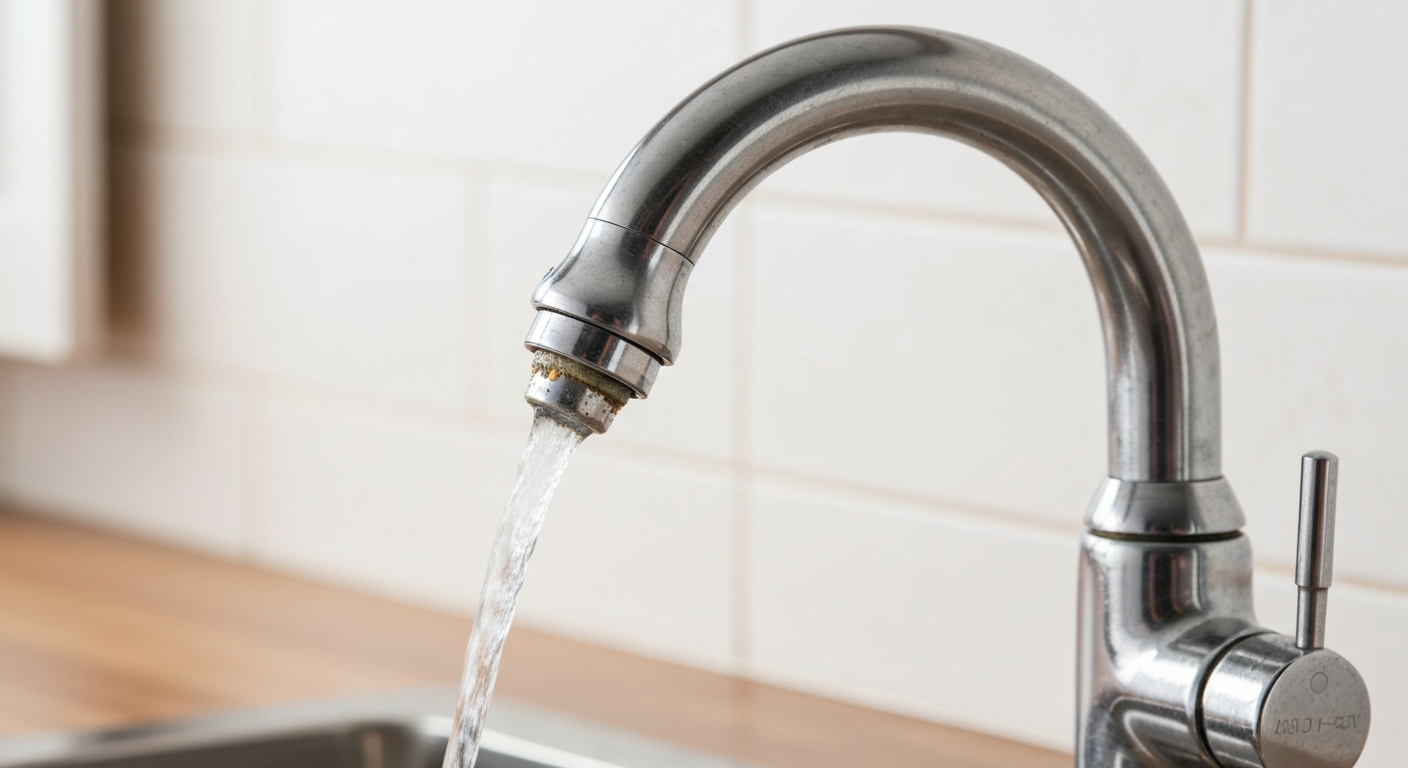
Aerator clogs are the number-one cause of suddenly low kitchen or bathroom sink pressure — and they take two minutes to fix.
The aerator is the small mesh screen screwed onto the tip of your faucet. It mixes air into the water stream to reduce splashing and conserve water. Over time, mineral deposits, sediment, and pipe debris accumulate in the mesh. When enough material builds up, water struggles to pass through.
You'll know the aerator is the problem if only one faucet has weak flow while others work normally. To test, unscrew the aerator counterclockwise (use a cloth to protect the finish), then turn on the faucet. If pressure returns to full strength, the aerator was the bottleneck.
Cleaning is simple: soak the aerator in white vinegar for 30 minutes to dissolve calcium deposits, then scrub with an old toothbrush. Replace it if the mesh is corroded or damaged. Aerators cost under five dollars and are stocked at every hardware store.
"Mineral buildup in aerators and showerheads is the most common cause of reduced water flow at individual fixtures." — International Association of Certified Home Inspectors
Also Read: Why Is My Tap Water Cloudy? 5 Causes & Easy Fixes
A main shutoff valve that's only 80% open can cut your whole-house pressure in half — and someone may have bumped it without telling you.
Your home has at least two critical valves: the main shutoff (usually near the water meter or where the main line enters your house) and the street-side valve (controlled by the utility). If either is partially closed, every fixture downstream suffers.
Gate valves, the older style with a round wheel handle, must be fully open to allow unrestricted flow. Even a quarter-turn toward closed creates significant resistance. Ball valves (lever handles) should have the lever parallel to the pipe — perpendicular means closed.
Check these locations:
If you recently had plumbing work, a contractor may have turned a valve and not fully reopened it. This is one of the most common "mystery" pressure drops.
When only hot water runs weak, the problem lives between your water heater and your faucets — not in the main supply.
The most frequent causes of isolated hot-water pressure loss:
Start by checking the inlet valve on top of the water heater. Next, drain a few gallons from the tank's drain valve into a bucket — if you see sand-like sediment, the tank needs flushing. For tanks older than 8 years, internal corrosion and sediment are common enough that annual flushing is recommended maintenance.
Also Read: Why Is My Water Heater Leaking? 7 Causes & Fixes
Showerhead clogs, flow restrictors, and worn mixing-valve cartridges cause most cases of weak shower pressure that don't affect the rest of the house.
Federal law limits new showerheads to 2.5 gallons per minute, and manufacturers achieve this with small plastic flow restrictors inside the showerhead or hose connection. If your home has hard water, mineral scale can reduce that flow even further.
To diagnose:
Shower cartridges wear out after 10 to 20 years. Calcium deposits can also restrict flow inside the valve body. Replacing a cartridge is a moderate DIY project for single-handle valves; call a plumber if you're uncomfortable working inside the wall.
A failing pressure-reducing valve (PRV) is one of the most overlooked causes of whole-house low pressure — especially in homes built after 1990.
Most homes connected to municipal water have a PRV installed where the main line enters the house. This bell-shaped brass device reduces incoming pressure (often 80+ psi from the street) to a safe 50–60 psi for your pipes and appliances.
PRVs typically last 10 to 15 years. When they fail, they can stick in a nearly closed position, throttling flow to a trickle. Signs of PRV failure include:
You can test pressure downstream of the PRV with a simple hose-bib gauge (costs around $15). If pressure reads below 40 psi, the PRV may need adjustment or replacement. Adjustment is done via a screw on top of the valve — turning clockwise increases pressure. If adjustment doesn't help, the diaphragm inside is likely damaged.
"Pressure-reducing valves should be inspected every three to five years and replaced when they no longer maintain consistent downstream pressure." — American Society of Plumbing Engineers
Homes with galvanized steel pipes eventually develop internal corrosion that narrows the pipe diameter — a problem that worsens gradually but can seem sudden once it crosses a threshold.
Galvanized pipes were standard in homes built before 1960. Over decades, zinc coating erodes and rust accumulates inside, reducing the effective pipe diameter from ¾ inch to as little as ¼ inch in severe cases. The result is progressively weaker flow, especially at fixtures farthest from the main line.
Warning signs of corroded pipes:
If your home has galvanized pipes and you're experiencing chronic low pressure, partial repiping with copper or PEX may be the only permanent solution. A plumber can scope the lines with a camera to assess the extent of buildup.
Hard water also deposits calcium and magite inside any pipe material over time. Whole-house water softeners prevent new scale; descaling treatments can sometimes restore flow in moderately affected lines.
Also Read: Why Is My Well Water Brown? 5 Causes & How to Fix It
A significant leak anywhere in your supply line diverts water away from your fixtures — and the bigger the leak, the worse your pressure.
Leaks don't always announce themselves with puddles. Slab leaks (under your foundation), underground main-line leaks, and leaks inside walls can run for weeks before you notice water damage. But you'll often notice pressure loss first.
To check for a hidden leak:
A spinning leak indicator (the small triangle or dial on most meters) confirms active flow. If you detect a leak but can't find it, a plumber with acoustic leak-detection equipment can pinpoint the location without tearing up floors or walls.
Sometimes the issue isn't your house at all — water main breaks, hydrant flushing, and peak-demand periods can temporarily tank neighborhood pressure.
Municipal systems occasionally experience:
Before you tear into your plumbing, ask your neighbors if they're experiencing the same issue. Check your utility's website or social media for service alerts. If the problem is system-wide, it will resolve once the utility addresses it — no action needed on your end.
You can call your water provider and ask them to test pressure at your meter. If street-side pressure is normal but your house pressure is low, the problem is on your side of the meter.
A systematic approach saves time: start at the fixture, work back to the main, and test pressure at each stage.
| Step | Action | What It Tells You |
|---|---|---|
| 1 | Check if the problem affects one fixture or all | Isolates local vs. whole-house issue |
| 2 | Remove and inspect aerators/showerheads | Rules out the most common clog |
| 3 | Verify all shutoff valves are fully open | Eliminates valve-related restriction |
| 4 | Test hot vs. cold water separately | Identifies water-heater-specific issues |
| 5 | Attach a pressure gauge to an outdoor hose bib | Measures actual system pressure |
| 6 | Check the water meter for movement when nothing is running | Detects hidden leaks |
| 7 | Inspect the PRV (if present) | Confirms regulator is functioning |
| 8 | Contact your utility or neighbors | Rules out municipal supply problems |
If you complete these steps and pressure remains low with no obvious cause, a licensed plumber can run a camera inspection or perform pressure-drop tests to identify blockages or damage inside walls or underground.
DIY troubleshooting handles most aerator clogs and valve issues, but some problems require professional tools and expertise.
Call a plumber if:
A diagnostic visit typically costs $75 to $150 and can save you from unnecessary parts replacement or water damage from an undetected leak.
Also Read: Why Is My Water Heater Leaking From the Bottom? 4 Causes & Fixes
Sudden low water pressure almost always traces back to a clogged aerator, a partially closed valve, a failing pressure regulator, sediment buildup, a hidden leak, or a municipal supply issue. Start by checking whether the problem affects one fixture or the whole house — that single observation narrows your search dramatically. Clean aerators and verify valves before assuming you need expensive repairs. If pressure stays low after basic troubleshooting, a plumber can pinpoint blockages or leaks you can't see.
The aerator on your kitchen faucet is the most likely culprit. Kitchen sinks see heavy use, and the aerator traps sediment and mineral scale faster than bathroom fixtures. Unscrew the aerator, soak it in vinegar, and scrub the mesh clean. If that doesn't help, check the angle-stop valves under the sink — they may be partially closed or corroded internally.
Peak demand in your neighborhood typically occurs between 6 and 9 a.m. when households are showering, running dishwashers, and watering lawns simultaneously. Municipal systems can struggle to maintain pressure during these windows, especially in older infrastructure. If the problem is consistent every morning and resolves by mid-morning, peak demand is the likely cause.
Yes. Water softeners can reduce pressure if the bypass valve is partially engaged, the resin bed is fouled, or the unit is undersized for your household's flow rate. During regeneration cycles, some softeners restrict flow entirely. Check your softener's bypass valve and consider having the resin inspected if pressure problems coincide with softener installation or maintenance.
Water pressure naturally decreases with elevation — roughly 0.43 psi per foot of height. If your home's incoming pressure is on the lower end (40–45 psi), upstairs fixtures may feel noticeably weaker. Additionally, older homes often have smaller-diameter pipes feeding upper floors. A pressure booster pump can solve this if your PRV is already maximized and incoming municipal pressure is adequate.
Test pressure at an outdoor hose bib with a gauge. If pressure reads below 40 psi and your utility confirms street-side pressure is normal (typically 60–80 psi), the PRV is likely failing. Other signs include pressure that fluctuates randomly, water hammer when valves close, or a PRV that's visibly corroded or leaking. Most PRVs last 10–15 years before the internal diaphrag
Reviewed and Updated on June 20, 2026 by George Wright