DIY

Your vape is leaking juice into your mouth because of one or more common issues: a flooded coil, incorrect wattage settings, damaged o-rings, overfilling the tank, using the wrong e-liquid viscosity, or inhaling too hard—all of which force liquid past the atomizer instead of vaporizing it properly.
Getting a mouthful of vape juice is unpleasant at best and can cause nausea or irritation at worst. The good news is that most leaking problems have straightforward fixes you can do in minutes without replacing your entire device. Whether you're using a Geek Vape, SMOK, Voopoo, or any other brand, the underlying causes are nearly identical. This guide walks you through exactly why your vape is leaking and how to stop it for good.
| ✓Our Pick |
Replacement o-rings and seals for vape tanks A top-rated pick that works — readers who tried this reported noticeable improvement within days. See on Amazon → |
E-liquid reaches your mouth when it bypasses the heating coil without being vaporized—this happens when excess liquid floods the coil chamber, when seals fail, or when the liquid is too thin to be held properly by the wicking material.
In a properly functioning vape, the coil heats the e-liquid absorbed by the wick, turning it into vapor. When any part of this system is out of balance, liquid accumulates faster than it can be vaporized. That excess has to go somewhere, and the path of least resistance is often straight up the mouthpiece and onto your tongue.
Understanding which specific issue is causing your leak helps you fix it without unnecessary trial and error.
A flooded coil is the most frequent cause of juice leaking into your mouth. Flooding happens when the wick becomes oversaturated and liquid pools in the coil chamber. When you inhale, you pull that pooled liquid directly into your mouth.
Signs of a flooded coil include:
- Gurgling or bubbling sounds when you inhale
- Weak vapor production despite a full tank
- Liquid visible in the mouthpiece or drip tip
Flooding often occurs after refilling the tank, leaving the device sitting for extended periods, or priming a new coil with too much liquid.
Running your device at too low a wattage means the coil cannot vaporize liquid as fast as the wick delivers it, leading to flooding and spit-back.
Every coil has a recommended wattage range printed on its side or listed in the product documentation. If you're vaping at the low end—or below the range entirely—the coil produces insufficient heat. Liquid accumulates, floods the chamber, and ends up in your mouth.
| Coil Resistance | Typical Wattage Range | Too Low (Risk of Flooding) |
|---|---|---|
| 0.15–0.2 ohm | 60–80W | Below 50W |
| 0.3–0.4 ohm | 40–60W | Below 35W |
| 0.5–0.6 ohm | 25–45W | Below 20W |
| 1.0+ ohm (MTL) | 10–20W | Below 8W |
Increase your wattage incrementally until vapor production is consistent and the gurgling stops.
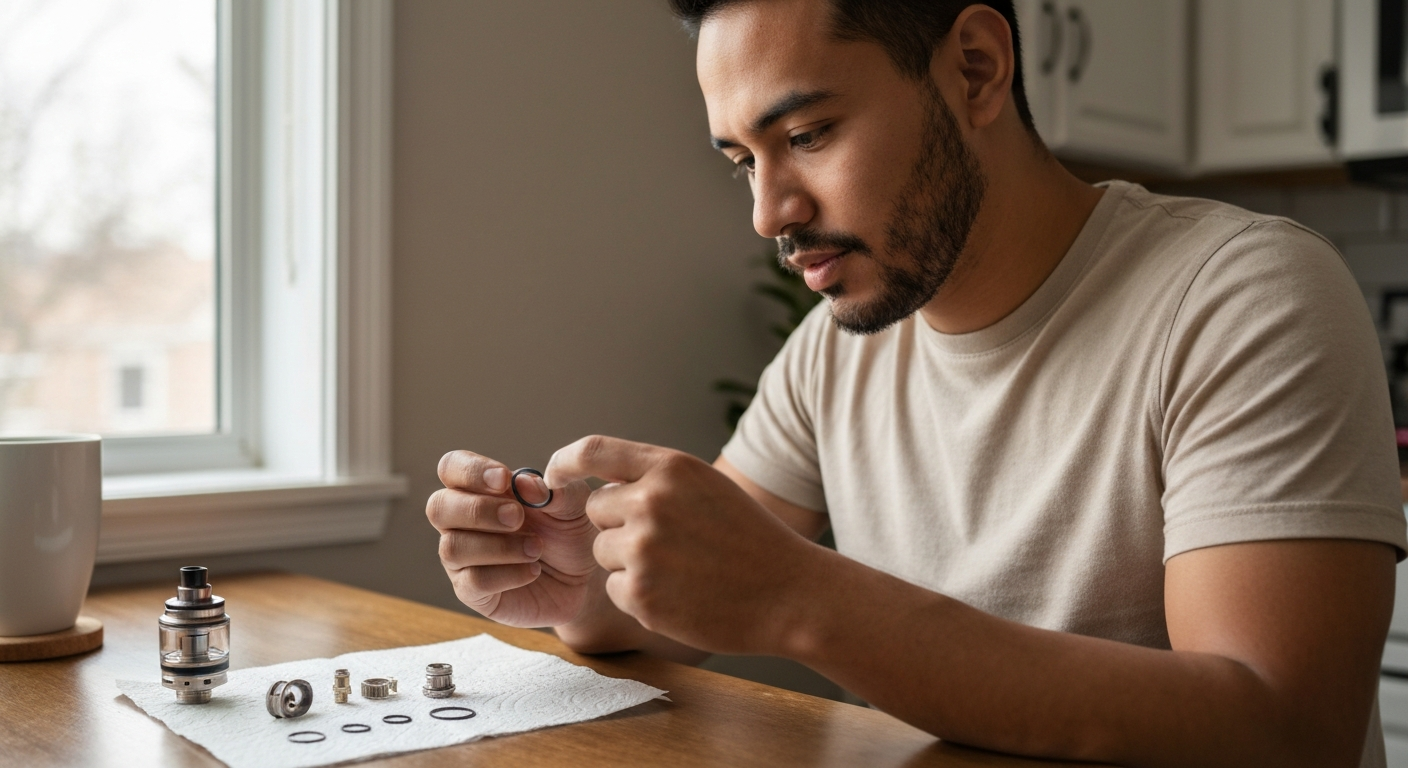
O-rings are the small rubber gaskets that create airtight seals between your tank's components. Over time, they crack, stretch, or slip out of position. When seals fail, liquid seeps through gaps and leaks out the airflow vents or up through the mouthpiece.
Inspect the o-rings around:
- The base of the glass tank
- The top cap where you refill
- The coil housing where it connects to the base
If any o-ring looks flattened, torn, or missing, replace it immediately. Most tanks include spare o-rings in the packaging, and universal replacement kits are widely available.
Filling your tank past the maximum fill line compresses the air space inside, creating pressure that forces liquid down through the coil and out the airflow slots or mouthpiece.
Tanks are designed with a small air pocket that allows proper pressure balance. When you overfill, there's nowhere for displaced air to go when the tank heats up, so liquid gets pushed through whatever openings are available.
Leave at least 2–3mm of space below the fill line. If you've already overfilled, pour out the excess before your next puff.
E-liquid viscosity is determined by the ratio of vegetable glycerin (VG) to propylene glycol (PG). Higher VG liquids are thicker; higher PG liquids are thinner and more fluid.
Sub-ohm tanks with large wicking ports require high-VG liquids (70% VG or higher). If you use a 50/50 or high-PG liquid in a sub-ohm tank, the thinner consistency flows through the wicking material too quickly, flooding the coil.
| Device Type | Best VG/PG Ratio | What Happens With Wrong Ratio |
|---|---|---|
| Sub-ohm tank | 70/30 or 80/20 VG | High-PG causes flooding |
| MTL tank | 50/50 or 60/40 | High-VG may wick poorly |
| Pod system | 50/50 or nic salts | High-VG may not wick |
Check your e-liquid bottle for the VG/PG ratio and match it to your device type.
"Using e-liquid with the wrong viscosity for your device is one of the most common reasons for leaking and spit-back." — Dr. Konstantinos Farsalinos, tobacco harm reduction researcher at Onassis Cardiac Surgery Center
Drawing on your vape with excessive force pulls liquid through the coil before it has time to vaporize, especially in devices designed for a gentler mouth-to-lung draw.
If you're used to cigarettes, you might naturally take a hard, sharp inhale. Most vapes—particularly sub-ohm devices—are designed for slow, steady draws. Aggressive inhalation creates a vacuum that yanks liquid straight through the atomizer.
Practice taking slower, more relaxed puffs. If your device has adjustable airflow, open the vents wider to reduce the vacuum effect.
Coils have a limited lifespan, typically 1–3 weeks depending on usage. As the coil degrades, the wicking material loses its ability to hold liquid properly. Burnt or gunked-up wicks create uneven saturation, leading to flooding in some areas while other spots run dry.
Signs your coil needs replacing:
- Burnt or off-taste
- Noticeably darker e-liquid in the tank
- Leaking that started suddenly after weeks of normal use
- Visible carbon buildup on the coil
Replace the coil and see if the leaking stops before troubleshooting other causes.
| ✓Our Pick |
Replacement coils for sub-ohm tanks A top-rated pick that works — readers who tried this reported noticeable improvement within days. See on Amazon → |
Geek Vape devices, particularly the Aegis series, experience the same leaking issues as other vapes but have some model-specific quirks related to their top-fill mechanism and coil compatibility.
Geek Vape tanks like the Zeus and Cerberus use top-airflow designs that are generally more leak-resistant than bottom-airflow tanks. If your Geek Vape is leaking, the cause is almost always:
To clear condensation, remove the drip tip and blow firmly through the mouthpiece with the tank inverted over a paper towel.
Follow this diagnostic sequence to identify and resolve your specific leak without replacing parts unnecessarily.
Clear the flooded coil — Remove the tank from the mod. Hold the tank upside down over a paper towel and blow firmly through the mouthpiece. This forces excess liquid out through the airflow. Wipe the airflow vents clean.
Check your wattage — Look at the coil's recommended range and increase power if you're running low. Start at the midpoint of the range.
Inspect all o-rings — Disassemble the tank completely. Check every rubber seal for damage or displacement. Reseat any that have slipped and replace any that are damaged.
Verify fill level — If the tank is overfilled, pour out enough liquid to leave an air gap.
Confirm e-liquid compatibility — Check the VG/PG ratio on your bottle against your device requirements.
Examine the coil — If it's older than two weeks or tastes burnt, install a fresh one.
Reassemble carefully — Hand-tighten all components firmly but not excessively. Overtightening can crush o-rings.
Let the tank sit upright — After reassembly, leave the tank standing upright for 5 minutes before vaping to let the wick saturate evenly.
"Most vape leaking issues can be traced to improper coil installation, damaged seals, or incompatible e-liquid viscosity. Systematic troubleshooting resolves the majority of cases without professional repair." — CASAA (Consumer Advocates for Smoke-free Alternatives Association)
Once you've fixed the immediate problem, these habits keep leaking from returning:
Also Read: Why Is My Electric Bill So High in My Apartment?
If you've tried all the fixes above and your vape still leaks, the tank itself may have structural damage—hairline cracks in the glass, stripped threads, or a warped base.
Glass tanks can develop micro-cracks invisible to the naked eye that allow slow seepage. Metal threading can strip from repeated disassembly, preventing a proper seal. In these cases, replacing the tank is more cost-effective than repeated repairs.
Consider upgrading to a top-airflow tank if you've had persistent problems with bottom-airflow designs—top-airflow systems are inherently more resistant to leaking because gravity works in your favor.
Vape juice leaks into your mouth when liquid floods the coil faster than it can be vaporized—usually due to low wattage, worn o-rings, overfilling, wrong e-liquid viscosity, or aggressive inhaling. Clear the flooded coil, check your settings and seals, match your liquid to your device, and replace worn components. Most leaking problems resolve in minutes once you identify the specific cause.
Geek Vape devices typically leak from the airflow when the coil isn't seated properly or o-rings are damaged. Remove the coil, check that it threads in straight without resistance, and inspect the base o-ring. Condensation mimicking leaking is also common with top-airflow tanks—clear it by blowing through the mouthpiece with the tank inverted.
A new coil can leak if it wasn't installed correctly, if you primed it with too much liquid, or if the o-rings were damaged during installation. Check that the coil is hand-tight (not over- or under-tightened), wait 5 minutes after priming before vaping, and verify the o-rings are intact and properly seated.
Yes. Significant temperature changes cause the e-liquid to expand or thin, and the air inside the tank to pressurize. Leaving your vape in a hot car or cold environment frequently leads to leaking. Store your device at room temperature and avoid extreme conditions.
Inspect o-rings every time you change coils. Replace them immediately if you notice any cracking, stretching, or loss of elasticity. With regular use, o-rings typically last 2–3 months before showing wear, but damage can occur from overtightening or repeated disassembly.
Spit-back is related but distinct. Leaking refers to liquid escaping from seals or airflow vents. Spit-back is when hot droplets pop up through the mouthpiece during vaping. Both are caused by coil flooding, but spit-back happens actively while you're inhaling. The fixes are the same: increase wattage, clear the flooded coil, and avoid overfilling.
Reviewed and Updated on May 2, 2026 by George Wright