
DIY
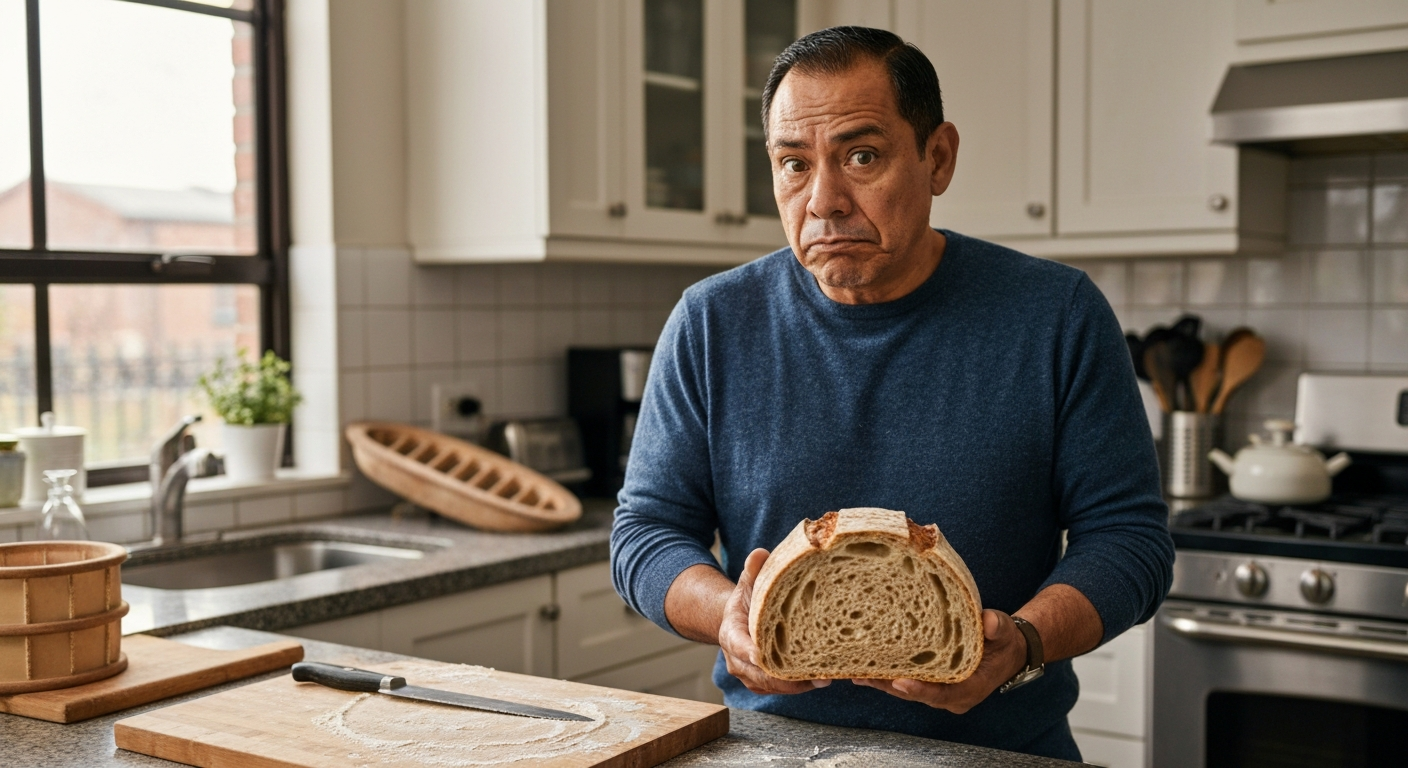

Sourdough bread turns out gummy and dense when the dough is underproofed, underfermented, or baked before the starches fully set — meaning the crumb never develops the open, airy structure you're after.
The good news: this is one of the most fixable problems in home baking. Once you identify which variable went wrong — your starter's strength, your fermentation timing, your shaping, or your bake — you can adjust and get an entirely different loaf next time. Below, you'll find the most common causes of dense, heavy, gummy sourdough and exactly how to fix each one in 2026.
| ✓Our Pick |
Sourdough bread baking supplies and tools Trusted by professionals and everyday users alike — a smart investment that pays for itself. See on Amazon → |
Dense, gummy sourdough happens when the crumb structure doesn't open up properly during fermentation or doesn't set properly during baking — trapping moisture and leaving you with a heavy, wet-feeling interior.
To understand this, it helps to know what's supposed to happen. Your sourdough starter produces carbon dioxide as it ferments, and that gas gets trapped by the gluten network you build during mixing and folding. If the gluten is weak, the gas escapes. If fermentation is too short, not enough gas forms. If you cut the loaf too early, steam condenses back into the crumb.
The result is bread that feels like wet clay when you slice it — no spring, no holes, no satisfying chew. The texture issue stems from either a structural problem (the dough itself) or a process problem (how you handled it). Let's break down each cause.
A weak or immature starter is the single most common reason sourdough bread comes out dense and heavy.
Your starter needs to be at peak activity when you mix it into the dough. "Peak" means it has doubled or tripled in volume, the surface is domed (not collapsed), and it's bubbly throughout. If you use it too early, it hasn't produced enough wild yeast to leaven the bread. If you use it too late — after it's fallen and smells sharply acidic — much of the leavening power is spent.
The float test helps: drop a teaspoon of starter into room-temperature water. If it floats, it's ready. If it sinks, wait longer or feed it again.
Fix: Feed your starter 4–8 hours before you plan to mix (depending on your kitchen temperature), and only use it at peak rise. If your starter is new — under 3 weeks old — it may not have enough microbial diversity to leaven bread reliably yet. Keep feeding it daily until it doubles predictably within 4–6 hours at 75°F.
Underproofing means the dough didn't ferment long enough, so there's not enough gas trapped in the gluten to create an open crumb.
This is tricky because sourdough timelines vary wildly depending on temperature, starter strength, flour type, and hydration. A recipe that says "bulk ferment 4 hours" assumes certain conditions that may not match your kitchen. If your house is 65°F instead of 78°F, that same ferment might need 8–10 hours.
Signs of underproofed dough: it feels dense and doesn't jiggle when you shake the bowl, it tears rather than stretches during shaping, and the baked loaf has a tight crumb with no large holes.
Fix: Go by dough behavior, not the clock. The dough is ready when it has increased 50–75% in volume, feels lighter and airier, has visible bubbles on the surface and sides, and passes the poke test (a floured finger indent springs back slowly but not completely).
Overproofing weakens the gluten network so much that it can't hold gas anymore — the loaf spreads flat in the oven and bakes up gummy inside.
If you let bulk fermentation go too long, or if your final proof in the fridge extends past 18–24 hours, the acids produced by fermentation start breaking down the gluten. The dough becomes slack, sticky, and hard to shape. When you score it, it deflates. When you bake it, it spreads sideways instead of rising.
Signs: the dough feels like wet bubble gum, it's hard to hold any shape, and the baked loaf is flat with a dense, even crumb (no gradient from crust to center).
Fix: End bulk fermentation earlier — at 50% rise rather than 100%. If you cold-proof in the fridge, bake straight from cold within 12–18 hours for most recipes. Warmer kitchens speed up fermentation, so adjust accordingly.
High-hydration doughs (above 75%) are harder to handle and more likely to turn out gummy if your technique isn't dialed in.
Many popular sourdough recipes online call for 80%+ hydration because it produces those coveted large holes and thin, crispy crusts. But high hydration requires strong gluten development, confident shaping, and a very hot oven with steam. If any of those elements are off, the extra water stays trapped in the crumb.
"Higher hydration doughs require more skill to handle... if you're just starting out, I'd recommend starting with a lower hydration and working your way up." — Maurizio Leo at The Perfect Loaf
Fix: Start with 65–70% hydration until you can consistently produce loaves with good oven spring. Then increase by 5% at a time. Also consider your flour: whole wheat and fresh-milled flours absorb more water than white bread flour, so adjust accordingly.
A loaf pulled from the oven too early will be gummy inside because the starches haven't fully gelatinized — they need sustained high heat to set.
Internal temperature matters more than crust color. Many bakers pull their loaves when they look beautiful and golden, but the inside is still wet. The target internal temperature for fully baked sourdough is 205–210°F. Below that, the crumb won't set.
Fix: Use an instant-read thermometer. Insert it into the bottom center of the loaf — if it reads below 205°F, keep baking. It's almost impossible to overbake sourdough; erring on the side of a darker crust is better than gummy crumb. Most loaves need 45–50 minutes total: 20 minutes covered (with steam), then 25–30 minutes uncovered.
Cutting into hot bread releases steam that was meant to redistribute through the crumb — making the inside wet and gummy even if it was baked correctly.
This is the hardest advice to follow because the bread smells incredible. But the interior is still cooking and setting as it cools. Slicing interrupts that process and lets moisture escape unevenly.
"You must wait until the loaf is completely cooled before slicing. The carry-over baking that happens as the loaf cools is essential." — King Arthur Baking Company
Fix: Wait at least 2 hours before cutting — ideally until the loaf is room temperature throughout. Store cut-side down on a cutting board to slow moisture loss.
Without enough gluten structure, the dough can't trap the gas produced during fermentation — resulting in dense, flat bread.
Gluten develops through hydration, time, and mechanical action (folding). If you're mixing by hand and doing minimal folds, you may not be building enough structure, especially with lower-protein flours.
Signs of weak gluten: the dough tears easily, it doesn't pass the windowpane test (you can't stretch a small piece thin enough to see light through), and it spreads out during bulk rather than holding its shape.
Fix: Perform 4–6 sets of stretch-and-folds during the first 2–3 hours of bulk fermentation, spaced 30 minutes apart. Use bread flour (11.5–13% protein) rather than all-purpose. If you're incorporating whole wheat or rye, keep them to 20–30% of total flour — both reduce gluten strength.
| Symptom | Likely Cause | Fix |
|---|---|---|
| Dense crumb, no large holes | Underproofed or weak starter | Longer bulk ferment, starter at peak |
| Gummy texture, wet interior | Underbaked or sliced too early | Bake to 205°F+, cool 2 hours |
| Flat loaf, no oven spring | Overproofed or weak gluten | Shorter proof, more folds |
| Tight crumb, even texture | Hydration too low | Increase hydration 5% |
| Sticky dough, hard to shape | Hydration too high or overproofed | Reduce hydration, shape earlier |
| Sour smell, slack dough | Overfermented | Reduce bulk time, cooler environment |
Environmental factors significantly affect fermentation speed and gluten behavior — ignoring them leads to inconsistent results.
Altitude: Above 3,000 feet, dough rises faster because of lower air pressure. Reduce your bulk fermentation time by 25% or use cooler water to slow things down.
Flour type: Fresh-milled, whole grain, and heritage flours behave differently than commercial bread flour. They absorb more water, ferment faster, and produce weaker gluten. Start with a tested all-purpose or bread flour recipe before experimenting.
Kitchen temperature: Fermentation roughly doubles in speed for every 15°F increase. A kitchen at 80°F will proof dough twice as fast as one at 65°F. In summer, use cold water and refrigerate during bulk. In winter, use a proofing box or warm oven (light on, oven off) to create a consistent 75–78°F environment.
| ✓Our Pick |
Digital dough thermometer for bread baking A well-reviewed choice that delivers real results — worth every penny for anyone dealing with this. See on Amazon → |
Following this process helps ensure your dough ferments properly and bakes through completely.
Feed your starter 5–6 hours before mixing. Use equal weights flour and water. Wait until it peaks — doubled, domed, bubbly.
Autolyse for 30–60 minutes. Mix flour and water (no starter, no salt) and let it rest. This hydrates the flour and starts gluten formation.
Add starter and salt, then mix until combined. The dough will feel shaggy. That's fine.
Perform 4–6 stretch-and-fold sets during the first 2.5 hours, spaced 30 minutes apart. The dough should become smoother, stronger, and more cohesive.
Bulk ferment until the dough has risen 50–75% and shows bubbles on the surface and sides. This could take 4–12 hours depending on temperature.
Pre-shape gently, rest 20 minutes, then final shape with enough tension to hold the form but not so much that you degas completely.
Cold proof in the fridge for 8–16 hours in a banneton or bowl lined with a floured cloth.
Bake straight from cold in a preheated Dutch oven at 450–500°F. Cover for 20 minutes, then uncover for 25–30 minutes until the internal temperature reaches 205–210°F.
Cool completely — at least 2 hours — before slicing.
Dense, gummy sourdough almost always comes down to one of three problems: insufficient fermentation (weak starter or underproofing), insufficient baking (pulled too early or sliced too soon), or weak dough structure (not enough gluten or too-high hydration for your skill level). Go by dough behavior rather than clock time, bake until the internal temperature hits 205°F, and resist cutting until the loaf is fully cooled. With those adjustments, your next loaf should have the open, airy crumb and satisfying chew you're after.
Even if the dough appears to rise during bulk fermentation, it may not have risen enough — or it may have overproofed and collapsed slightly. The dough should increase 50–75% in volume and feel noticeably airier and lighter. If it rose but still baked dense, consider whether your oven spring was adequate (did it puff up in the oven?) and whether you baked it long enough.
Consistent density usually points to a weak starter or a systematic timing issue. Make sure your starter reliably doubles within 4–6 hours of feeding at 75°F before using it. Also check your bulk fermentation environment — if your kitchen is cold, you may be chronically underproofing without realizing it.
You can improve slightly gummy bread by slicing it and toasting it, which drives off excess moisture. For a whole loaf, return it to a 300°F oven for 10–15 minutes to continue setting the crumb. This won't fully fix a severely underbaked loaf, but it can rescue one that's borderline.
Yes. Bread flour (11.5–13% protein) produces stronger gluten and taller loaves than all-purpose flour. Whole wheat and rye absorb more water and produce denser crumbs — keep them to 20–30% of total flour when you're troubleshooting. Fresh-milled flour ferments faster and may need shorter bulk times.
The crust should be deeply golden to dark brown, and the loaf should sound hollow when you tap the bottom. The most reliable test is internal temperature: insert an instant-read thermometer into the center bottom of the loaf. If it reads 205–210°F, the starches have set and the loaf is done.
Reviewed and Updated on May 2, 2026 by George Wright