
Health
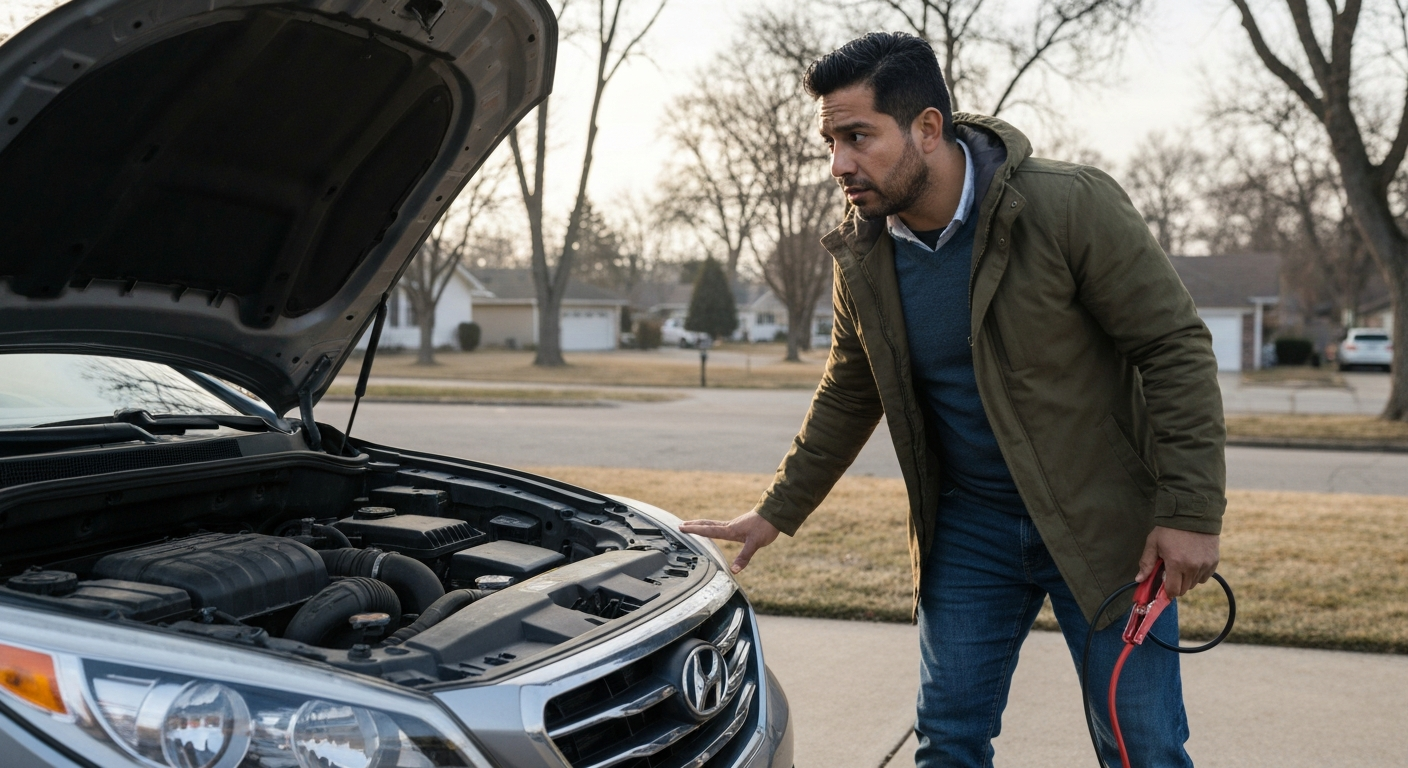

Your Hyundai Sonata isn't starting because of a dead or weak battery, a faulty starter motor, a bad fuel pump, a failing ignition switch, or a problem with the engine's sensors or immobilizer system — the exact cause depends on what you hear (or don't hear) when you turn the key.
When your Sonata won't start, it's telling you something. A rapid clicking sound usually points to a battery that can't deliver enough power. Complete silence often means a dead battery or a broken connection. Cranking without the engine catching suggests fuel or spark issues. Understanding these sounds is the first step to getting back on the road.
The sound your car makes (or doesn't make) when you turn the key is the most important diagnostic clue — it narrows down the problem before you open the hood.
Pay attention to exactly what happens when you attempt to start your Sonata. Different sounds point to different systems, and this quick assessment can save you hours of guesswork.
| Sound When Turning Key | Most Likely Cause | System Affected |
|---|---|---|
| Rapid clicking | Weak battery or corroded terminals | Electrical |
| Single loud click | Faulty starter motor or solenoid | Starting system |
| Cranking but no start | Fuel pump, spark plugs, or sensors | Fuel/ignition |
| Complete silence | Dead battery, ignition switch, or immobilizer | Electrical/security |
| Slow, labored cranking | Weak battery or starter motor failing | Electrical/starting |
| Normal crank, then dies | Fuel delivery or anti-theft lockout | Fuel/security |
Also Read: Why Is My Steering Wheel Locked? 5 Causes & How to Fix It
A failing battery is responsible for roughly 40 percent of no-start situations, and it's often the culprit even when your dashboard lights come on normally.
Many Sonata owners assume their battery is fine because the headlights work or the radio turns on. Here's the thing: those accessories draw a fraction of the power needed to crank an engine. Your starter motor demands hundreds of amps in a single burst — something a weak battery simply can't deliver.
Having power to your dashboard doesn't rule out battery problems. A battery with enough charge to illuminate your instrument panel may still lack the cranking amps to turn over the engine. This explains why your car might have power but still refuses to start — a scenario that confuses many Jeep, Ford, and Hyundai owners alike.
"A battery can show 12.4 volts at rest but fail under load. The only accurate test is checking voltage while cranking — it should stay above 9.6 volts." — Jim Gocka at ASE-Certified Master Technicians
If you've just installed a new battery and your Sonata still won't start, the problem lies elsewhere. Common culprits include:
Check your terminal connections first. Even a thin layer of corrosion creates resistance that blocks the massive current flow needed for starting.
When the engine cranks normally but refuses to catch, your starting system is working — the problem is either fuel not reaching the cylinders or spark plugs not firing.
This is one of the most frustrating scenarios because everything sounds like it should work. Your Ford F150, Jeep, or Sonata turns over with that familiar whirring sound, but the engine never catches. Three systems need to work together for combustion: air, fuel, and spark. If any one fails, you get cranking without starting.
A failing fuel pump can't deliver gasoline to the engine at the correct pressure. You might notice this problem appearing intermittently at first — sometimes the car cranks but doesn't start, other times it fires up normally. As the pump deteriorates, failures become more frequent.
Listen carefully when you first turn your key to the "on" position (without cranking). You should hear a brief whirring sound from the rear of the car lasting two to three seconds. That's your fuel pump priming. No sound often means a dead pump or blown fuel pump fuse.
Spark plugs in a Hyundai Sonata typically last 60,000 to 100,000 miles, depending on the type. Worn plugs can misfire or fail to ignite the fuel-air mixture entirely. If your Sonata has higher mileage and you've never replaced the spark plugs, they're worth checking.
Also Read: Why Is My Speedometer Off? 6 Causes & How to Fix
Rapid clicking when you turn the key almost always indicates insufficient electrical power reaching the starter — either from a weak battery, corroded connections, or a failing starter solenoid.
That machine-gun clicking noise happens when the starter solenoid tries to engage but can't hold its position. It pulls in, loses power, releases, pulls in again — creating that distinctive rapid-fire sound. Each click represents a failed attempt to engage the starter gear.
A single loud click followed by silence suggests a different problem than rapid clicking. One click usually means the solenoid is engaging, but the starter motor itself has failed. The solenoid receives enough power to move once, but the motor can't turn. This often indicates a worn-out starter that needs replacement.
Multiple rapid clicks point toward a power delivery issue. Your battery might have enough voltage to activate the solenoid repeatedly but not enough amperage to actually spin the starter motor. In cold weather, this problem becomes more common as batteries lose capacity in freezing temperatures.
Batteries lose approximately 35 percent of their capacity at 32°F and up to 60 percent at 0°F, which is why winter morning no-starts are so common.
Cold weather creates a perfect storm against starting your car. The battery produces less power, the engine oil thickens (making it harder to turn over), and fuel doesn't vaporize as easily. A battery that worked fine in September might leave you stranded in January.
"At 0°F, a fully charged battery delivers only about 40 percent of the power it provides at 80°F. Meanwhile, the engine requires roughly 150 percent more power to start in those conditions." — AAA Automotive Research Center
If your Sonata struggles in winter, try these approaches:
Modern Hyundai Sonatas use an immobilizer system that prevents the engine from starting if it doesn't recognize the key — a dead key fob battery can trigger this anti-theft lockout.
Your Sonata's immobilizer communicates with a transponder chip in your key. If this signal isn't received, the car's computer blocks fuel delivery and ignition as a theft-prevention measure. The security light on your dashboard (often a key or car-with-lock symbol) will typically flash or stay illuminated when this happens.
Try replacing the battery in your key fob first — it's a CR2032 coin cell in most Sonatas and costs under five dollars. If you have a spare key, test whether the car starts with that one instead.
Complete silence when you turn the key suggests a totally dead battery, a failed ignition switch, or a broken connection in the starting circuit.
No clicking, no cranking, no dashboard dimming — just nothing. This scenario actually helps narrow down the diagnosis because it eliminates the starter motor as the immediate suspect. Something is preventing any electrical signal from reaching the starting system.
Sometimes the solution is as simple as wiggling your gear shifter firmly into Park and trying again. A misaligned neutral safety switch can prevent any starting attempt.
Follow this systematic approach to identify why your Sonata won't start without wasting time on unlikely causes.
Before you start replacing parts, work through this diagnostic sequence. It moves from most common (and cheapest) to least common causes.
Note exactly what happens when you turn the key. Does the dashboard light up? Do you hear any sound? Does the engine try to turn over? Write these observations down — they'll help if you need to explain the problem to a mechanic.
Check for corrosion on the terminals. Test the battery voltage with a multimeter if you have one — a healthy battery should read 12.6 volts or higher at rest. If it reads below 12.2 volts, the battery needs charging or replacement.
If you suspect the battery, attempt a jump start using jumper cables and another vehicle. If the car starts, let it run for at least 20 minutes to recharge the battery, then have the battery and alternator tested at an auto parts store (most do this free).
Turn the key to "on" without cranking. Listen for the fuel pump whir from the back of the car. No sound may indicate a failed pump or blown fuse.
If you hear a single click but no cranking, try tapping the starter motor gently with a wrench while someone turns the key. If the car starts after tapping, the starter is failing and needs replacement.
| ✓Our Pick |
Search starter motors and ignition parts on AutoPartsToys No special skills required — straightforward to use and most orders ship quickly. Learn More → |
If basic diagnostics don't reveal the problem, or if you're uncomfortable working with electrical systems, professional help prevents you from throwing money at unnecessary parts.
Some no-start conditions require specialized diagnostic equipment. A mechanic with a scan tool can read fault codes from your Sonata's computer, check fuel pressure precisely, and test the ignition system with an oscilloscope. For complex issues involving the immobilizer, crankshaft position sensor, or engine control module, professional diagnosis saves time and money in the long run.
Call a mechanic if:
- Jump starting doesn't help and the battery tests good
- You smell fuel when cranking (possible flooded engine or injector leak)
- The check engine light was on before the no-start condition
- You've replaced parts without solving the problem
- The car intermittently starts sometimes but not others
Your Hyundai Sonata won't start due to battery problems, starter failure, fuel delivery issues, ignition system faults, or immobilizer lockouts — diagnosing correctly requires paying attention to what sounds the car makes when you turn the key. Rapid clicking points to battery or connection issues. A single click suggests starter problems. Cranking without starting indicates fuel or spark failure. Complete silence often means a dead battery or broken connection. Start with the simplest checks (battery terminals and charge level) before moving to more complex components.
Slow, labored starting that eventually succeeds usually indicates a battery losing its capacity or a starter motor beginning to fail. In cold weather, this problem worsens because the battery has to work harder. Have your battery tested — most auto parts stores do this free. If the battery passes, the starter motor bearings may be worn, creating extra resistance that will eventually cause complete failure.
When your accessories work (lights, radio, dashboard) but the engine won't crank, the issue lies in the starting circuit rather than general electrical power. Check your neutral safety switch by wiggling the shifter firmly into Park. Inspect the starter fuse and relay. If those check out, the ignition switch that sends the "start" signal may have failed internally.
A bad alternator doesn't directly prevent starting, but it causes starting problems indirectly by failing to recharge your battery. If your alternator died while driving, the battery would have drained completely — leaving you with a no-start condition. After jump starting, have both the battery and alternator tested. A failing alternator often causes a burning smell or squealing noise before complete failure.
Intermittent starting problems are tricky because the faulty component works sometimes. Common causes include a fuel pump that's failing under heat, a crankshaft position sensor with a loose connection, or corroded battery terminals that make inconsistent contact. These issues tend to worsen over time, so don't ignore occasional no-starts — the component will eventually fail completely.
Jump starting usually answers this question. If a jump gets the car running, the battery was likely the problem. If the car still won't start with jumper cables attached, the starter or another component has failed. You can also listen carefully: rapid clicking suggests insufficient power (battery issue), while a single click followed by silence points to the starter motor itself.
Reviewed and Updated on June 11, 2026 by George Wright