DIY

Your garage door is not closing all the way because something is blocking the safety sensors, the sensors are misaligned, the close-limit switch needs adjustment, or the tracks are obstructed—any of these issues prevents the door from completing its downward travel.
A garage door that stops partway, reverses, or refuses to close completely is one of the most common—and frustrating—home problems. The good news is that most causes are easy to diagnose and fix yourself in under 30 minutes. This guide walks you through every reason your garage door won't close fully and exactly how to resolve each one.
| ✓Our Pick |
Garage door safety sensor replacement kit Used by over 10,000 satisfied customers — an easy, affordable option you can start using today. See on Amazon → |
Modern garage door openers use multiple safety systems that can trigger a premature stop—understanding how they work is the first step to fixing the problem.
Every garage door opener manufactured after 1993 includes photoelectric safety sensors mounted near the floor on both sides of the door opening. These sensors create an invisible beam across the doorway. If anything breaks that beam while the door is closing, the opener immediately reverses the door to prevent injury or damage.
Beyond the sensors, your opener also relies on limit switches that tell it where the door's fully open and fully closed positions are. Force settings control how much resistance the motor will push through before reversing. When any of these systems detect something abnormal, your door won't close completely.
"The most common cause of a garage door that won't close is an obstruction of the safety sensors or misalignment of the sensors." — International Door Association Technical Bulletin
Debris, dirt, or objects in the sensor path are the number-one reason garage doors refuse to close.
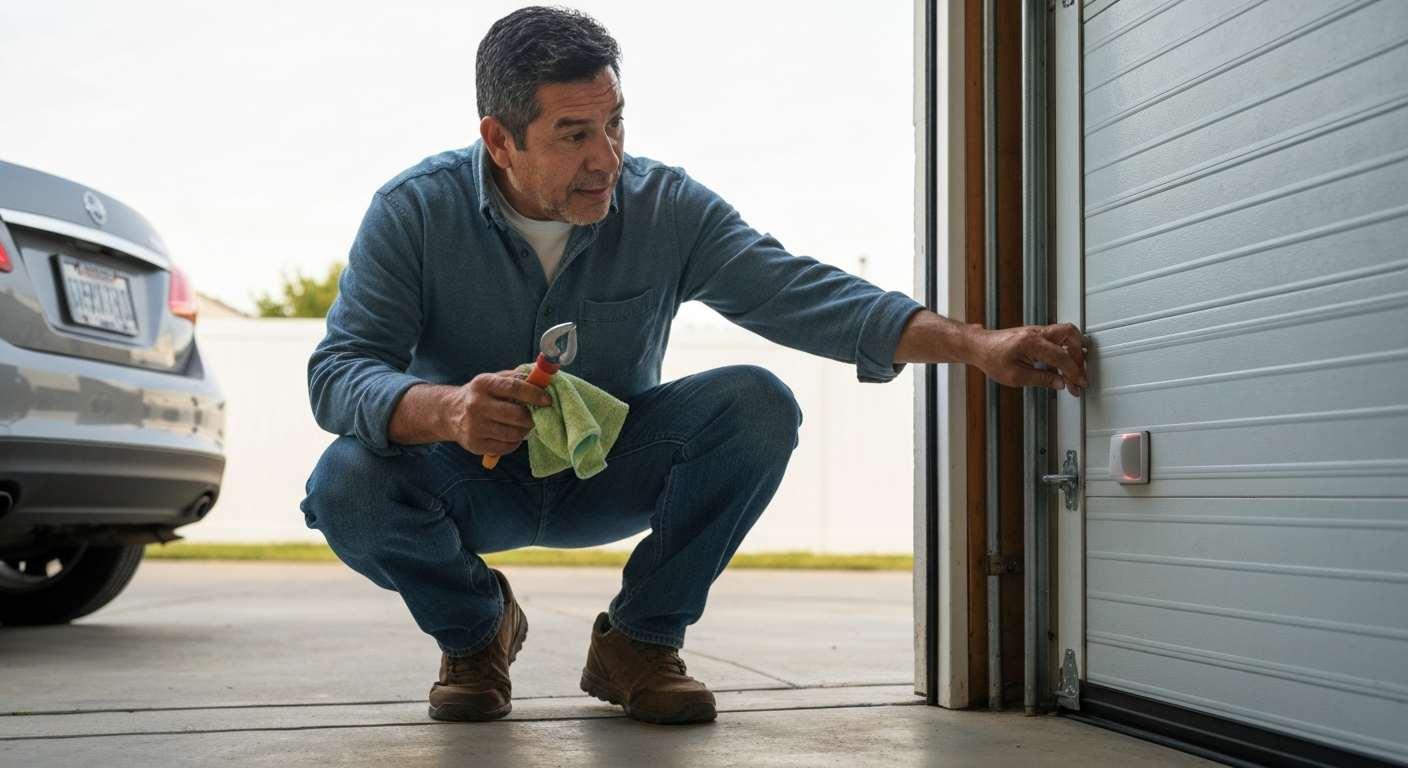
The photoelectric sensors sit about 4 to 6 inches off the ground on either side of your garage door opening. Anything that interrupts the beam between them—a leaf, a cobweb, a child's toy, even a buildup of dust on the sensor lens—will prevent the door from closing.
Walk to your garage door opening and crouch down to sensor level. Look for anything in the path between the two sensors. Check the sensor lenses themselves for dirt, spider webs, or condensation. A quick wipe with a dry cloth often solves the problem immediately.
If one sensor has been bumped or shifted, the beam can't connect to its partner, and your door won't budge.
Each sensor has a small LED indicator light. When both sensors are properly aligned and communicating, both lights should be solid (typically green on the receiving sensor and amber on the sending sensor, though colors vary by brand). If one light is blinking or off, the sensors aren't aligned.
To realign sensors, loosen the wing nut or bracket screw on the blinking sensor. Gently adjust the sensor angle until the light becomes solid. Tighten the bracket. Many homeowners find it helpful to use a level to ensure both sensors point directly at each other.
If your door closes most of the way but reverses just before touching the floor, the close-limit switch is set incorrectly.
The close-limit switch tells your opener where "fully closed" is. If it's set too shallow, the opener thinks the door has hit an obstruction when it's actually just reaching the floor, causing an automatic reversal.
Locate the limit adjustment screws on your opener unit—usually on the back or side of the motor housing. The "down" or "close" limit screw controls how far the door travels downward. Turn it clockwise in small increments (quarter turns) to extend the travel distance. Test after each adjustment until the door closes flush with the floor without reversing.
| Symptom | Likely Cause | Adjustment |
|---|---|---|
| Door reverses inches from floor | Close-limit too shallow | Turn close-limit screw clockwise |
| Door hits floor hard and bounces | Close-limit too deep | Turn close-limit screw counterclockwise |
| Door closes but leaves gap | Close-limit too shallow | Turn close-limit screw clockwise |
| Door closes then immediately reopens | Force setting too sensitive | Increase close force slightly |
An overly sensitive force setting causes the door to reverse at the slightest resistance.
Your opener has a force setting that determines how hard the motor will push the door down before deciding something is blocking it. If this setting is too low, the normal friction of the door's operation triggers a safety reversal.
Find the force adjustment screws near the limit screws on your opener. The "down force" screw controls closing force. Increase it by small increments (quarter turns clockwise). Test the door after each adjustment. The door should close smoothly without straining the motor or crushing objects in its path.
"Garage door opener force settings should be adjusted so the door reverses when it contacts a 2-inch-thick board laid flat on the floor. If the door doesn't reverse, the force is set too high." — U.S. Consumer Product Safety Commission
Also Read: Why Is My Garage Door Clicking and Not Opening? 6 Causes & Fixes
Physical obstructions in the door tracks prevent smooth travel and can stop the door at any point.
Inspect both vertical tracks on either side of your garage door from top to bottom. Look for dents, bends, accumulated debris, or rust. Even a small pebble wedged in the track can halt the door's progress.
Clean the tracks with a damp cloth to remove dirt and grime. For minor bends, you can sometimes gently tap the track back into alignment with a rubber mallet and a block of wood. Significant bends or damage require track replacement—a job best left to a professional, since the door's spring tension makes this dangerous.
Worn rollers create uneven movement that can cause the door to bind and stop partway.
Your garage door rides on rollers that travel within the tracks. Over time, these rollers wear out, crack, or accumulate grime. Damaged rollers can cause the door to move unevenly, creating friction that the opener interprets as an obstruction.
Examine each roller for cracks, flat spots, or excessive wobble. Nylon rollers typically last 10,000 to 15,000 cycles, while steel rollers last longer but are noisier. Replacing rollers is straightforward—you can remove most rollers by bending the track slightly at a joint—but avoid touching the bottom roller brackets, which are under dangerous spring tension.
Broken springs or frayed cables prevent the opener from lifting the door's weight, causing incomplete closure or dangerous operation.
Garage door springs do the heavy lifting—literally. They counterbalance the door's weight so your opener motor only needs to provide a small amount of force. If a spring breaks or a cable frays, the door becomes too heavy for the opener, and the safety systems prevent full closure.
Look at the springs above your door (torsion springs) or on either side (extension springs). A broken spring will have a visible gap in the coil. Cables run along the sides of the door—check for fraying or slack. Spring and cable repair involves lethal tension and should only be performed by trained technicians. This is not a DIY fix.
A systematic approach saves time and ensures you don't miss the obvious fix.
Follow these steps in order to pinpoint why your door won't close:
| ✓Our Pick |
Garage door lubricant spray for tracks and rollers You'll wonder why you didn't try this sooner — practical, well-reviewed, and easy to get started. See on Amazon → |
Most sensor and adjustment issues are safe DIY fixes, but spring and cable problems require a trained technician.
| Problem | DIY Safe? | Estimated Repair Cost |
|---|---|---|
| Dirty or blocked sensors | Yes | $0 (cleaning) |
| Misaligned sensors | Yes | $0–$25 (if replacement needed) |
| Limit switch adjustment | Yes | $0 |
| Force setting adjustment | Yes | $0 |
| Dirty or obstructed tracks | Yes | $0–$15 (cleaning supplies) |
| Worn rollers | Yes (except bottom brackets) | $10–$50 for roller set |
| Bent tracks | Maybe (minor only) | $125–$200 professional |
| Broken springs | No | $150–$350 professional |
| Frayed or broken cables | No | $100–$200 professional |
| Opener motor failure | Maybe (depends on model) | $200–$500 professional |
Springs and cables are under extreme tension. A snapping spring or cable can cause severe injury or death. If you suspect a spring or cable problem, stop using the door and call a garage door technician immediately.
Regular maintenance keeps your garage door closing smoothly and extends the life of all components.
Perform these maintenance tasks every six months:
"Annual professional inspection of your garage door system can identify worn parts before they fail, preventing inconvenient breakdowns and ensuring safe operation." — Garage Door Safety Month Coalition
Your garage door isn't closing all the way because of safety sensor issues, limit switch misadjustment, track obstructions, or component wear. Start by cleaning and realigning the sensors—this fixes the problem about 70% of the time. If sensors aren't the issue, check tracks and rollers, then adjust limit and force settings. Leave spring and cable repairs to professionals, since these components are under dangerous tension. Regular maintenance every six months prevents most closing problems before they start.
If your garage door starts closing, stops partway, and reverses back up, the safety sensors are the most likely culprit. Something is either blocking the sensor beam, or the sensors are misaligned. Check that both sensor lights are solid (not blinking), clean the lenses, and remove any objects between them. If sensors aren't the issue, the close-limit switch may be set too shallow, causing the opener to think the door has hit an obstruction.
When your remote won't close the door but the wall button works, the issue is usually with the remote itself—dead batteries are the most common cause. Replace the batteries first. If that doesn't help, the remote may need reprogramming to the opener, or the remote's internal circuitry may have failed. If neither the remote nor the wall button closes the door, the problem lies with the opener, sensors, or mechanical components.
You can close your garage door with malfunctioning sensors by pressing and holding the wall button continuously until the door reaches the floor. This bypasses the sensor safety feature. However, this is a temporary workaround only—operating without functional sensors is dangerous, especially if children or pets access the garage. Fix or replace the sensors as soon as possible.
If your door only closes when you hold the wall button down continuously, the safety sensors are definitely the problem. The opener is operating in "manual override" mode because it's not receiving a clear signal from the sensors. This behavior confirms sensor issues—clean the lenses, clear obstructions, and realign the sensors until both indicator lights are solid.
Most garage door closing issues cost nothing to fix if you can diagnose and resolve sensor or adjustment problems yourself. Professional sensor replacement runs $85–$150. Track repair costs $125–$200. Spring replacement—the most expensive common repair—ranges from $150–$350 depending on spring type and local labor rates. Opener motor replacement typically costs $200–$500 installed.
Reviewed and Updated on May 2, 2026 by George Wright