DIY
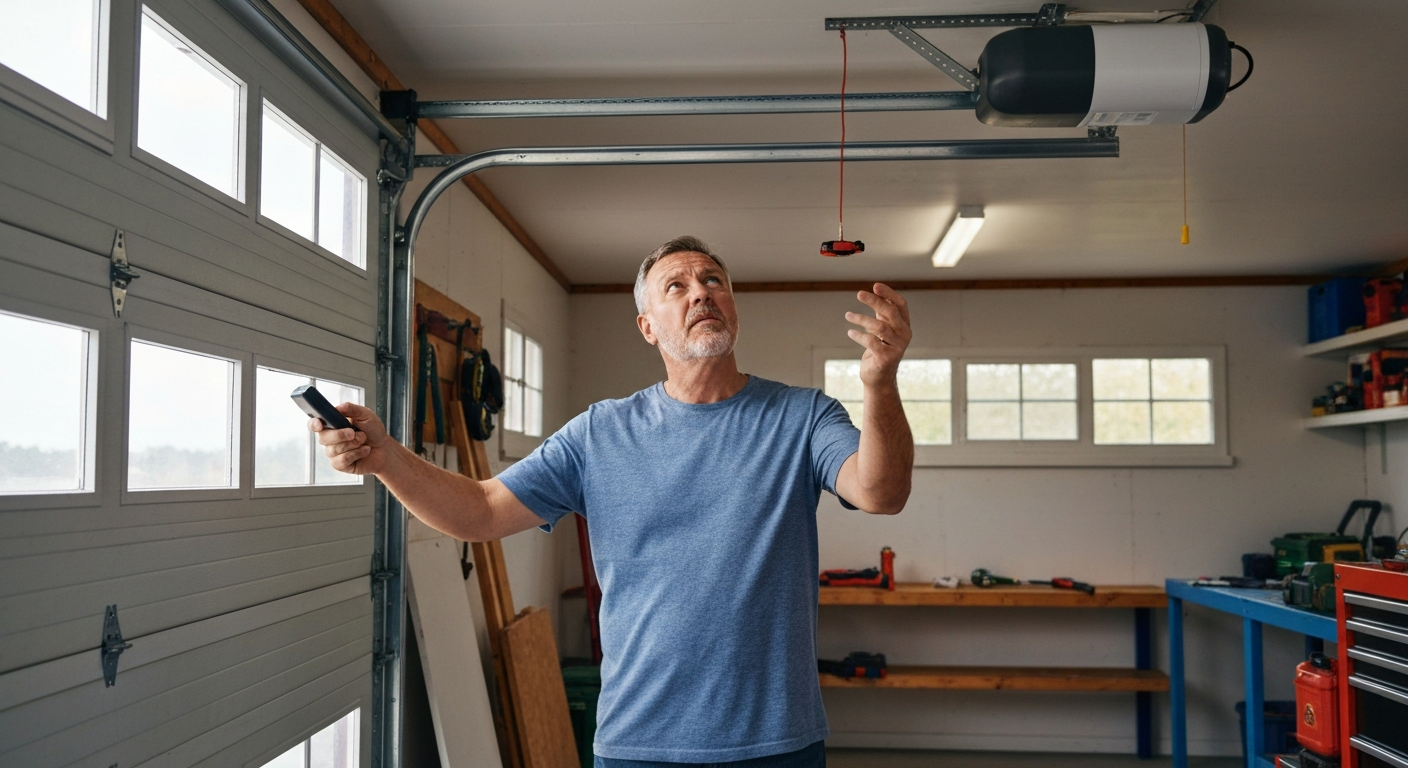

A garage door that clicks but refuses to open is almost always caused by one of six issues: dead remote batteries, misaligned or dirty safety sensors, a stripped drive gear inside the opener, broken torsion springs, a disconnected trolley carriage, or a locked manual release — and most of these can be diagnosed and fixed in under 30 minutes without calling a technician.
That repetitive clicking sound is your opener motor trying and failing to engage the drive mechanism. The motor receives the signal, attempts to lift the door, encounters resistance or a safety fault, and shuts down. Understanding which component is failing helps you fix it fast — or know when to call a professional.
| ✓Our Pick |
Garage door opener replacement parts and accessories One of the highest-rated products in its category — a reliable fix used by thousands of people. See on Amazon → |
The clicking noise indicates your opener motor is activating but cannot complete the lifting cycle — either because a safety system is blocking it, a mechanical part has failed, or the door itself is physically stuck.
When you press your remote or wall button, the opener's circuit board sends power to the motor. The motor spins, engaging either a chain, belt, or screw drive to pull the trolley carriage along the rail. If something prevents the carriage from moving the door, the motor clicks repeatedly as it tries and fails.
Different click patterns point to different problems:
| Click Pattern | Likely Cause |
|---|---|
| Single click, then silence | Remote battery dead or signal not received |
| Rapid clicking (3–5 times) | Safety sensors blocked or misaligned |
| Grinding click with vibration | Stripped main drive gear |
| Click followed by humming | Motor running but carriage disconnected |
| Click plus flashing lights on opener | Sensor error code being displayed |
The opener's LED indicator lights often flash in specific patterns to communicate what's wrong. Check your owner's manual for your brand's diagnostic codes — Chamberlain and LiftMaster openers, for example, use 1 to 10 flashes to indicate different faults.
Dead batteries are the single most common reason a garage door clicks once and does nothing — the opener receives a partial signal, attempts to respond, but doesn't get enough input to complete the cycle.
Remote batteries typically last 1–2 years. Wall-mounted keypads last longer but still fail. When batteries weaken, the signal becomes intermittent — sometimes the door opens, sometimes you hear a click and nothing happens.
Test this by using the hardwired wall button inside the garage. If the door opens normally from the wall button but not the remote, replace the remote batteries. Standard remotes use CR2032 coin cells or AAA batteries depending on the model.
"A weak battery may still be able to transmit a partial signal, but not one strong enough to trigger the opener's receiver consistently." — The Family Handyman
Garage door safety sensors (photo eyes) sit 4–6 inches off the ground on either side of the door opening — if they're blocked, dirty, or misaligned, the opener clicks but refuses to close, and often won't open either.
Federal law requires all automatic garage door openers sold after 1993 to include photo-eye sensors that detect obstructions. If the infrared beam between the two sensors is broken, the opener assumes something is in the door's path and stops operation.
Check for:
- Cobwebs, dirt, or moisture on the sensor lenses
- One or both sensors knocked out of alignment (usually after bumping with a bike, trash can, or car)
- LED indicator lights on the sensors — typically green means aligned, red or amber means misaligned or blocked
- Direct sunlight hitting the sensors (can overwhelm the infrared beam)
Clean the lenses with a soft cloth. Adjust the sensor brackets until both show steady green lights. On Chamberlain and LiftMaster models, one sensor (the sending unit) always shows amber, while the receiving unit should show solid green when properly aligned.
A loud clicking or grinding noise coming from inside the opener unit itself — especially on models over 5 years old — usually means the main drive gear's plastic teeth have worn down or stripped completely.
Most residential garage door openers use a nylon or plastic drive gear that meshes with a metal worm gear attached to the motor. This plastic gear is intentionally designed as a "sacrificial" part — it fails before the motor does. When the teeth strip, you hear the motor spinning and the gears clicking, but the chain or belt doesn't move.
This repair requires opening the motor housing and replacing the gear assembly. Replacement gear kits cost $15–$40 and are available for most major brands. The repair takes about an hour if you're comfortable with basic tools. If the opener is more than 15 years old, replacement may be more cost-effective than repair.
"The plastic drive gear is the most common point of failure in chain-drive openers because it's designed to fail before the motor burns out." — Garage Door Doctor
Broken torsion springs make the door too heavy for the opener to lift — you'll hear the motor click and strain, the door may rise an inch or two, then stop because the opener cannot physically move the weight.
Torsion springs (mounted horizontally above the closed door) or extension springs (running along the horizontal tracks) counterbalance the door's weight. A standard two-car garage door weighs 150–250 pounds. With working springs, the door effectively weighs only 10–15 pounds to the opener motor.
Signs of broken springs:
- Visible gap in the torsion spring above the door
- The door feels extremely heavy when lifted manually
- A loud bang heard recently (springs breaking often sound like a gunshot)
- Door opens only a few inches before the opener gives up
Warning: Torsion spring replacement is dangerous. These springs are under extreme tension and can cause serious injury or death if mishandled. This is the one garage door repair most professionals strongly recommend leaving to trained technicians.
If someone pulled the emergency release cord (usually red, hanging from the rail), the trolley carriage is disconnected from the opener — the motor runs normally, you hear the click and chain movement, but the door stays put.
The emergency release allows you to open the door manually during power outages. Once pulled, the carriage slides freely along the rail without engaging the drive mechanism. To reconnect:
On some models, you may need to manually slide the trolley until it clicks back onto the drive chain or belt attachment.
Older garage doors and some modern models have manual slide locks that bolt the door to the track — if engaged, the opener clicks and strains but cannot move the door at all.
Look for a T-handle in the center of the door or horizontal slide bars that extend from the door into the tracks on either side. If these are engaged, the door is physically locked in place. Disengage the lock before operating the opener.
Some homeowners forget they locked the door manually during a power outage or security concern. Repeated attempts to open a manually locked door can burn out the opener motor.
A beeping garage door opener — especially Chamberlain and LiftMaster models — is communicating a specific fault through audible alerts, most commonly a dying backup battery, sensor alignment issues, or a Wi-Fi connectivity problem.
| Beep Pattern | Meaning | Fix |
|---|---|---|
| Single beep every 30 seconds | Backup battery needs replacement | Replace 12V backup battery |
| Continuous beeping | Sensor obstruction or misalignment | Clear obstruction, realign sensors |
| Beeping plus flashing lights | Diagnostic error code | Count flashes, consult manual |
| Beeping after power outage | Battery drained during outage | Recharge or replace battery |
| Beeping from myQ device | Wi-Fi disconnected or app error | Reconnect Wi-Fi, update app |
Chamberlain and LiftMaster openers with battery backup beep persistently when the 12V backup battery can no longer hold a charge — typically every 2–3 years.
These openers include a sealed lead-acid or lithium battery that allows the door to operate during power outages. When the battery degrades, the opener beeps every 30 seconds to alert you. The door still operates normally on AC power, but the beeping continues until you replace the battery.
Replacement batteries cost $30–$50 depending on the model. The battery compartment is usually accessible without tools — consult your specific model's manual for location.
Also Read: Why Is My Electric Bill So High in My Apartment?
Follow this systematic approach to identify why your garage door clicks but won't open:
| Symptom | Most Likely Cause | DIY Fix? |
|---|---|---|
| Clicks once, no movement | Dead remote battery | Yes |
| Rapid clicks, sensor light blinking | Misaligned sensors | Yes |
| Grinding click, door won't move | Stripped drive gear | Yes, with tools |
| Click and strain, door rises 2 inches | Broken springs | No — call a pro |
| Motor runs, chain moves, door stays | Disconnected trolley | Yes |
| Persistent beeping | Dead backup battery | Yes |
If your opener is less than 10 years old and has a single failed component, repair is usually cost-effective; if it's over 15 years old or has multiple issues, replacement with a modern Wi-Fi-enabled model often makes more sense.
Consider replacement if:
- The opener lacks safety sensors (pre-1993 models)
- Motor burns out after a gear replacement
- You want smartphone control and battery backup
- Parts are no longer available for your model
- Multiple components have failed within the same year
Modern openers cost $200–$400 for the unit plus $100–$200 for professional installation. DIY installation is possible for experienced homeowners.
| ✓Our Pick |
Garage door opener units with battery backup A top-rated pick that works — readers who tried this reported noticeable improvement within days. See on Amazon → |
A clicking garage door that won't open is usually caused by dead remote batteries, misaligned safety sensors, a stripped drive gear, broken springs, a disconnected trolley, or an engaged manual lock. Start by testing the wall button — if it works, replace your remote batteries. Check that both sensor lights show steady green. If the clicking comes from inside the motor housing, the drive gear has likely stripped. If the door feels impossibly heavy when lifted manually, the springs are broken and you need a professional. Persistent beeping on Chamberlain and LiftMaster models means the backup battery needs replacement. Most of these fixes take under 30 minutes and cost less than $50 in parts.
If your garage door opener shows no lights, makes no sounds, and doesn't respond to any controls, the power source is likely the problem. Check that the opener is plugged in, test the outlet with another device, and look at your circuit breaker panel for a tripped breaker. Openers with GFCI outlets can trip silently. If power is confirmed but the unit is dead, the circuit board may have failed — this is repairable but often costs nearly as much as a new opener.
A Chamberlain opener that beeps every 30 seconds is alerting you that the backup battery needs replacement. The beeping will continue until you replace the battery, even though the door operates normally on AC power. Locate the battery compartment (usually on the side or back of the motor housing), note the battery model number, and purchase a replacement. Installation takes about 5 minutes.
LiftMaster openers beep to alert you to non-critical issues that don't prevent door operation. The most common cause is a depleted backup battery. Other causes include sensor alignment warnings (the door may still work but with reduced safety features) or Wi-Fi disconnection on myQ-enabled models. Count the beeps and check your owner's manual for the specific fault code.
Yes — every automatic garage door has an emergency release that disconnects the door from the opener. Pull the red cord hanging from the trolley carriage (usually located near the center of the rail). Once released, you can slide the door up and down manually. To re-engage the opener, pull the release cord toward the motor unit and run the opener through a cycle. If the door is extremely heavy to lift manually, your springs have likely failed and manual operation may not be safe.
Most residential garage door openers last 10–15 years with normal use, though high-quality belt-drive models can exceed 20 years. Replace the opener when major components fail repeatedly, safety features become unreliable, or parts are no longer available. Technology improvements in the past decade — including smartphone control, battery backup, and quieter belt drives — make replacement attractive even for openers that still technically function.
Reviewed and Updated on May 2, 2026 by George Wright