Sleep

You can lessen snoring — often dramatically — by targeting the specific cause rather than applying generic fixes. Side sleeping, avoiding alcohol before bed, treating nasal congestion, and using a mandibular advancement device are the four highest-evidence strategies for most adults in 2026.
| ✓Our Pick |
 |
Custom-fit anti-snoring mouthpiece that repositions your jaw to open the airway One of the highest-rated products in its category — a reliable fix used by thousands of people. Learn More → |
Snoring is produced when the upper airway partially narrows during sleep and soft tissue in the throat vibrates as air forces through. Identifying where the narrowing occurs is the key to choosing the right fix.
The sound originates in the pharynx — the section of the throat behind the mouth and nasal cavity. During sleep, the muscles that hold this passage open relax. In snorers, relaxation is excessive enough that the airway narrows, causing turbulent airflow and tissue vibration.
Different people snore for different reasons:
A quick test: close your mouth and try to make a snoring sound. If you can't, you're primarily a mouth or nasal snorer. If you can, the issue is deeper in the throat.
According to the Mayo Clinic, about half of all adults snore at some point, and identifying the cause is the most effective first step.
"Snoring can be caused by a number of factors, such as the anatomy of your mouth and sinuses, alcohol consumption, allergies, a cold, and your weight." — Mayo Clinic
Not every strategy works for every snorer. These 9 approaches are ordered from easiest to implement to most involved — start at the top and add more if needed.
Sleeping on your back is the single most correctable snoring trigger for positional snorers, because gravity pulls the tongue and soft palate directly into the airway.
When you roll onto your side, the tongue stays in front of the throat instead of falling back into it. For people who snore primarily on their back (positional snorers), this change alone can eliminate or dramatically reduce the noise.
How to stay on your side:
- Use a body pillow to keep yourself from rolling over
- Sew a tennis ball or firm bumper into the back of your sleep shirt
- Use a positional sleep device (wedge pillow, specialized positioning strap)
Alcohol relaxes the muscles throughout your body, including the throat. Even one drink within a few hours of bed pushes those muscles past their normal sleep-relaxation point, making airway collapse more likely.
Many people who don't regularly snore will snore after an evening of drinking. For established snorers, alcohol reliably produces their loudest nights. Simply shifting your last drink to 3 or more hours before sleep can produce a noticeable reduction.
Blocked nasal passages force mouth breathing, which sends unfiltered, unregulated air directly through the pharynx — increasing turbulence and snoring. Addressing the congestion often fixes the snoring.
Options:
- Nasal saline spray or rinse (neti pot, NeilMed) — clears mucus, reduces swelling, promotes nasal breathing. Safe for nightly use.
- Nasal strips (Breathe Right type) — mechanically widens the nostrils, reducing resistance for nasal snorers.
- Antihistamines for allergy-driven congestion — take a non-sedating daytime version (cetirizine/loratadine) or a sedating version (diphenhydramine) at night.
- Nasal steroid sprays (Flonase, Nasacort — available OTC) — reduce mucosal inflammation over 1–2 weeks of consistent use.
Fat deposited around the neck and throat compresses the airway from outside. Even a modest reduction — 5 to 10% of body weight — can visibly reduce neck circumference and meaningfully decrease snoring frequency and severity.
Weight-related snoring often goes unrecognized because people assume snoring is inevitable. If your neck circumference is over 17 inches (men) or 15 inches (women), weight is likely contributing to your airway narrowing.
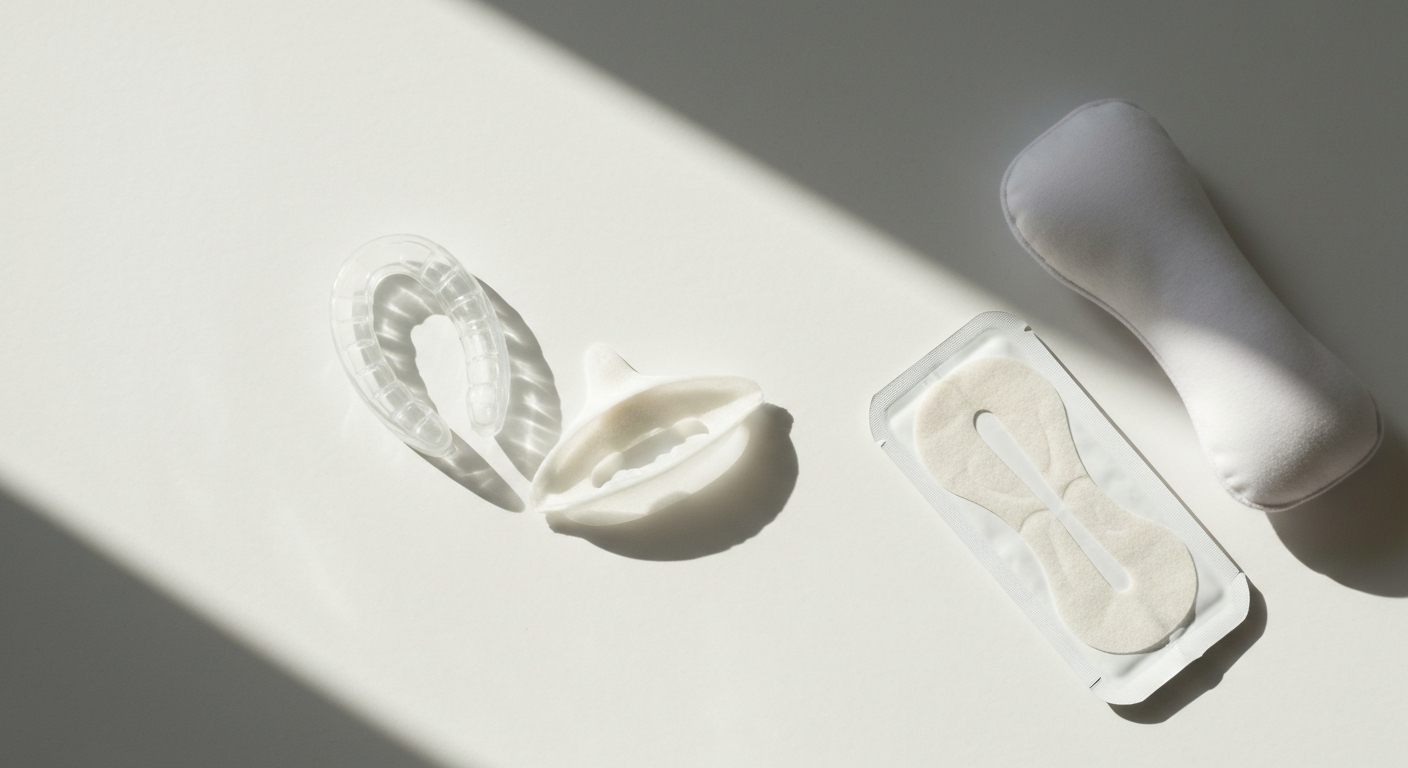
This is the most consistently effective non-surgical, non-prescription solution for most adult snorers. A MAD holds the lower jaw slightly forward during sleep, which keeps the tongue base pulled away from the throat wall.
The result: a wider, less obstructable airway. Clinical studies show that MADs reduce snoring in 75–85% of users, with most experiencing significant improvement within the first week.
Custom-fit MADs — molded to your specific teeth — are significantly more comfortable and more effective than generic boil-and-bite versions. They hold the jaw at the correct position without slipping.
The American Academy of Sleep Medicine considers oral appliances a first-line treatment for snoring and mild-to-moderate sleep apnea.
"Oral appliances are effective in reducing snoring and treating mild to moderate obstructive sleep apnea. Custom-fit devices made by a dentist or through impression kits provide better outcomes than over-the-counter alternatives." — American Academy of Sleep Medicine
Pillows that prop your head too high or too low can both worsen snoring by changing the angle of your airway. A medium-height pillow that keeps your head and neck aligned with your spine is optimal. Some people find that slightly elevating the head of the bed (by 4 inches or so) reduces snoring by preventing tissue from falling into the airway.
Sleep deprivation causes deeper, heavier sleep — which in turn causes greater muscle relaxation and more significant airway collapse. People who are sleep-deprived snore more loudly and more often than well-rested people, even if the underlying anatomy is the same. Getting consistent 7–9 hours per night reduces this amplification effect.
Smoking irritates and inflames the membranes lining the nasal passages and throat, increasing mucus production and causing the tissue to swell. Swollen, irritated tissue is narrower and more likely to vibrate. The effects are both acute (each cigarette session) and cumulative (chronic smoking changes tissue structure). Snoring is one of many health improvements that typically occur after quitting.
For snorers whose primary issue is tongue-based (the tongue falls back into the throat), a tongue retaining device (TRD) is an alternative to a MAD. A TRD holds the tongue gently forward using gentle suction, preventing it from falling back. They're typically bulkier and harder to tolerate than MADs, but effective for cases where the tongue specifically is the culprit.
Some of these approaches take days or weeks to work; others can make a difference the same night.
| Approach | Timing of Effect |
|---|---|
| Side sleeping | Immediate — that same night |
| No alcohol before bed | Immediate — noticeable the first night |
| Nasal strips | Immediate — opens airway on contact |
| Saline nasal rinse | Near-immediate — within 30–60 min |
| Mandibular advancement device | First night improvement, full benefit by week 1 |
| Weight loss | Weeks to months |
| Nasal steroid sprays | 1–2 weeks of consistent use |
| Quitting smoking | Weeks to months |
If you need results tonight — for example, your partner has a big day tomorrow and needs sleep — side sleeping + a nasal strip + skipping the evening drink is the fastest combination.
Also Read: Why Is My Lip Twitching? 7 Causes & How to Stop It
Snoring alone is usually harmless but can reflect a more serious condition. See a doctor if:
These may indicate obstructive sleep apnea (OSA), a condition where the airway fully collapses repeatedly during sleep. OSA has real cardiovascular and metabolic consequences and is diagnosed via a sleep study. Treatment — either CPAP or a custom oral appliance — is highly effective when used consistently.
To lessen snoring, start with the three easiest and fastest changes: sleep on your side, avoid alcohol 3 hours before bed, and treat any nasal congestion. If those don't resolve the problem, a custom-fit mandibular advancement device is the most consistently effective non-surgical solution — improving snoring in 75–85% of users. Weight loss, consistent sleep schedules, and treating smoking or underlying medical conditions (like hypothyroidism) complete the picture for stubborn snorers.
The fastest interventions are behavioral: sleep on your side (not your back), skip alcohol that evening, and use a nasal strip. These three changes together can produce a noticeable reduction the same night. A mandibular advancement device typically shows full benefit within the first week of use.
Yes — for positional and nasal snorers especially. Side sleeping, saline nasal rinses, treating allergies, avoiding alcohol before bed, and losing weight all address the underlying causes without any device. That said, for tongue-based and soft-palate snorers, a MAD often produces better results than lifestyle changes alone.
Slightly elevating the head — by raising the head of the bed 3 to 4 inches, not just stacking pillows — can help by preventing tissue from collapsing into the throat. This works best for mild positional snorers. For severe snorers, it's usually insufficient on its own but can complement other approaches.
Throat muscle tone declines with age, just like other muscles. Less muscular rigidity means the airway walls are more likely to collapse during sleep. This is why occasional snorers in their 30s often become regular, louder snorers by their 50s — without any other changes in lifestyle or weight.
Reviewed and Updated on June 16, 2026 by George Wright