Sleep

Yes — snoring can directly cause a sore throat. The mechanism is straightforward: snoring vibrates and partially collapses the tissues of the upper airway, which dries out the throat lining and causes physical micro-abrasions along the pharynx. If you wake up with a scratchy or sore throat and your partner says you snore, the two are almost certainly connected.
| ✓Our Pick |
SnoreMeds anti-snoring mouthpiece — stops snoring and the throat irritation it causes One of the highest-rated products in its category — a reliable fix used by thousands of people. Learn More → |
Snoring isn't just noise — it's the physical vibration of airway tissue under partial obstruction. That vibration causes real tissue stress, and the resulting irritation is the same biological process as any repetitive mechanical abrasion.
The primary damage pathways are:
Mouth breathing and throat drying. Snoring almost always involves mouth breathing. Air moving through the open mouth bypasses the nose, which normally filters, humidifies, and warms air before it reaches the throat. Dry, unhumidified air dehydrates the throat lining directly. Over the course of a 7–8 hour sleep, this produces measurable mucosal drying — the same mechanism that gives singers "dry throat" when they breathe through the mouth during a performance.
Tissue vibration and micro-trauma. The sound of snoring is produced by the soft palate, uvula, and pharyngeal walls vibrating against each other. This sustained vibration over hours stresses the mucosal lining. Mild inflammation and micro-abrasion result, producing the classic "morning sore throat" — typically worst within the first 30 minutes of waking and improving as the throat rehydrates through normal swallowing.
Negative pressure on the pharynx. Partial airway obstruction creates a Venturi effect — as air moves through the narrowed passage at higher velocity, it creates lower pressure around the throat walls. This suction effect draws the walls inward on each breath, adding to mechanical stress. In people with sleep apnea (the extreme end of the snoring spectrum), this suction is strong enough to cause significant pharyngeal swelling that persists into the day.
"Habitual snorers show measurable changes in pharyngeal mucosa including inflammation, epithelial damage, and altered mucociliary clearance. These changes are consistent with repetitive mechanical trauma from vibration." — Sleep and Breathing, published in Springer Nature
Not every morning sore throat is from snoring — but the pattern of a sore throat that's predictably worse after nights when you snore more, and better on quieter nights, is a reliable signal.
| Feature | Snoring sore throat | Strep / Viral |
|---|---|---|
| Timing | Present immediately on waking, improves within 30–60 min | Develops and worsens through the day |
| Severity | Mild to moderate dryness/scratchiness | Often severe, may make swallowing difficult |
| Fever | Never | Common with strep; sometimes with viral |
| Progression | Resolves during the morning as you drink water and swallow | Persists or worsens across the day |
| Linked to alcohol, dry air, or back-sleeping nights | Yes — those nights are consistently worse | No correlation |
| Visible inflammation | Minimal or none | Red, swollen, sometimes exudate (white patches with strep) |
If your sore throat persists past midday, worsens during the day, is accompanied by fever or difficulty swallowing, or doesn't improve with fluids — see a doctor. Snoring is not the cause when a sore throat behaves like an infection.
Snoring severity and the resulting throat irritation are both worsened by the same set of factors.
"Mouth breathing during sleep, which often accompanies snoring, significantly reduces salivary flow and mucosal hydration, contributing to pharyngeal inflammation and morning sore throat symptoms." — Journal of Oral Rehabilitation, Wiley
The most reliable fix is addressing the snoring itself — treating a symptom (the sore throat) without stopping the cause (the snoring) is a losing strategy.
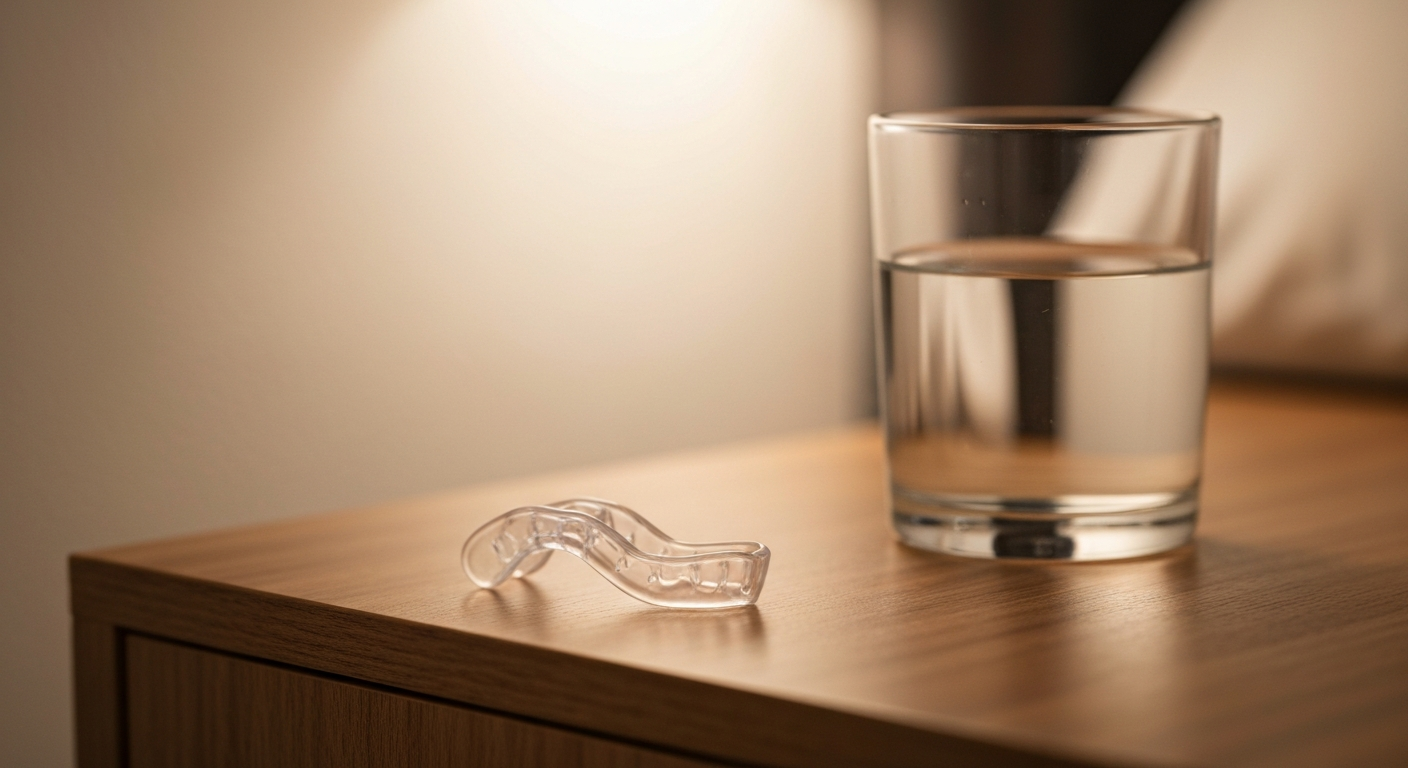
Mandibular advancement devices (MADs) are the most clinically validated non-surgical treatment for snoring. They work by moving the lower jaw slightly forward, which widens the airway opening, reduces the velocity of airflow, and decreases the vibration that damages the throat. For snoring caused by jaw position (the most common anatomical cause), a MAD can eliminate snoring entirely in many cases. The sore throats stop because the mechanism stops.
Other approaches that directly reduce snoring-caused throat irritation:
Also Read: Why Is My Throat Tight? 9 Causes & When to Worry
If snoring and sore throat come with other symptoms, the picture may be more serious than simple tissue irritation.
Snoring that is loud enough to wake others, combined with choking, gasping, or observed breathing pauses during sleep, may indicate obstructive sleep apnea (OSA). The throat involvement in OSA is more severe — the airway is completely closing, not just narrowing, and the suction forces are correspondingly more damaging. OSA-associated sore throats may be more persistent and may come with daytime fatigue, morning headaches, or difficulty concentrating.
If you suspect OSA, discuss a sleep study with your doctor. OSA is treatable (CPAP is standard; MADs are an alternative for mild-to-moderate cases) and the throat symptoms typically resolve with treatment.
Snoring causes sore throats through two main mechanisms: drying from mouth breathing (unfiltered, unhumidified air hitting the pharynx) and physical tissue vibration/abrasion from the snoring itself. The sore throat is typically worst immediately on waking and improves within the morning. Treating the snoring — particularly with a mandibular advancement device for most anatomical snorers — eliminates the cause. In the meantime, bedroom humidity control and hydration reduce the overnight drying component.
The two overnight mechanisms — dry air from mouth breathing and tissue vibration from snoring — both damage the throat lining in ways that accumulate across the night. By morning, you've had 7–8 hours of uninterrupted irritation. The soreness peaks on waking and improves as normal daytime swallowing re-moistens and partially re-coats the pharynx.
For most people, snoring causes irritation but not permanent structural damage with normal snoring intensity. However, research shows that habitual heavy snorers develop changes in pharyngeal mucosa — reduced sensitivity, altered tissue structure — that are consistent with long-term repetitive trauma. Loud, long-term snoring (particularly if associated with sleep apnea) warrants treatment for this reason beyond just comfort.
For most people, yes — if snoring is the cause of the sore throat, a mandibular advancement device that stops the snoring also stops the throat irritation. The key condition is that the device must actually reduce your snoring effectively, which most custom-fit MADs do for the most common type of snoring (caused by jaw and tongue position).
No — strep throat is a bacterial infection caused by Streptococcus pyogenes and is not caused by snoring. Snoring causes non-infectious irritation. However, snoring that repeatedly dries and micro-abrades the throat lining may slightly reduce the throat's first-line mucosal defense against pathogens — but this is speculative. The distinction between "snoring sore throat" and strep is usually clear from timing and severity (see table above).
Reviewed and Updated on June 13, 2026 by George Wright