Health
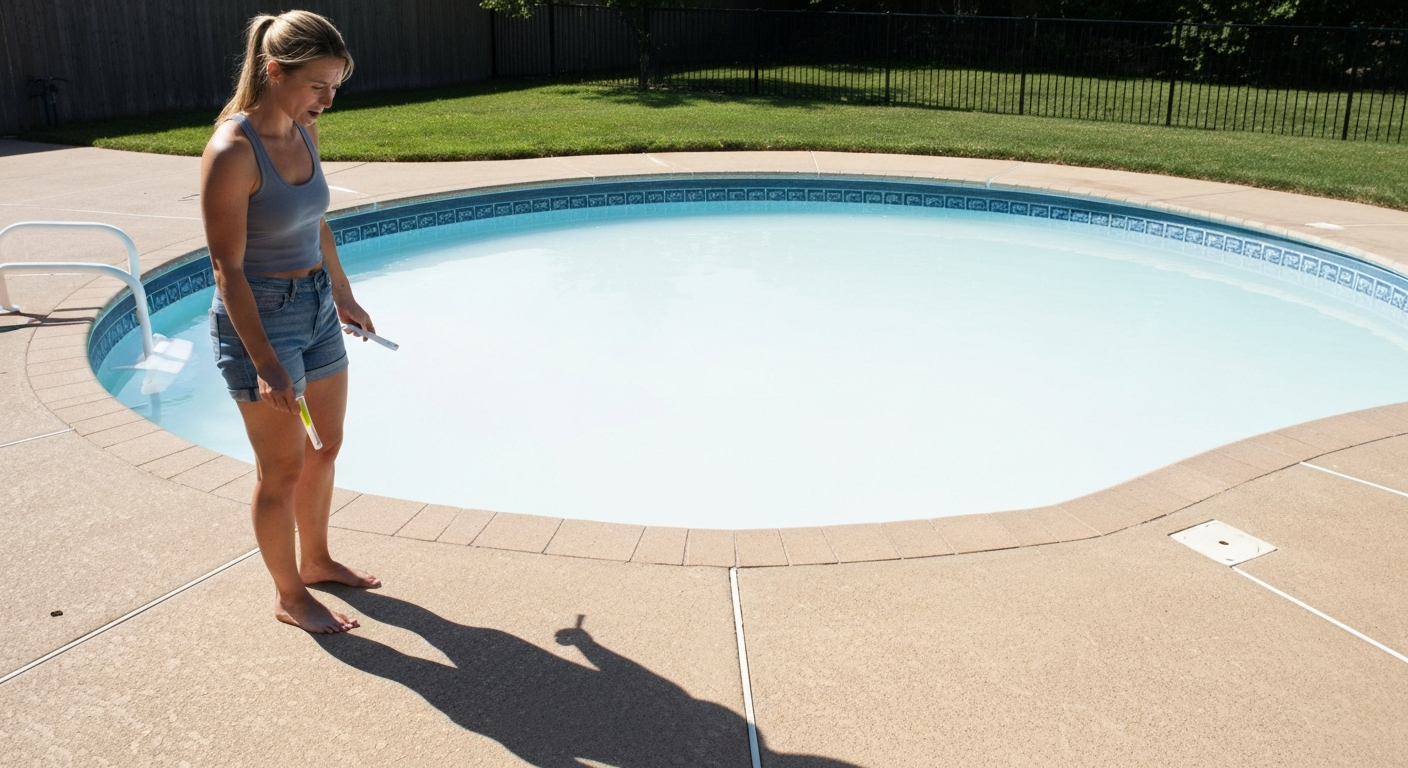

Your pool is cloudy because tiny particles are suspended in the water that your filter cannot remove fast enough—the most common causes are imbalanced water chemistry (especially high pH or low chlorine), inadequate filtration, algae beginning to bloom, or environmental debris like pollen and dust.
Cloudy pool water is rarely dangerous on its own, but it signals that something in your maintenance routine needs attention. Left unchecked, that milky haze can progress to a full algae bloom, skin irritation for swimmers, and expensive equipment repairs. The good news: most cloudy pool problems are fixable within 24 to 48 hours once you identify the root cause.
| ✓Our Pick |
Top-Rated Pool Water Test Kits on Amazon No special skills required — straightforward to use and most orders ship quickly. See on Amazon → |
Cloudy water happens when microscopic particles become suspended faster than your filtration system can clear them—the culprit is almost always chemistry, filtration, contamination, or a combination of all three.
Pool water clarity depends on a delicate balance. When that balance tips, particles as small as 0.5 microns scatter light and make your water look white, gray, or greenish. Understanding the specific cause determines which fix will actually work.
Water chemistry is the number one reason pools turn cloudy. When pH, alkalinity, or sanitizer levels drift outside their ideal ranges, the water cannot stay clear no matter how long you run your pump.
High pH (above 7.8) reduces chlorine effectiveness by up to 75 percent. Your chlorine is still in the water, but it cannot kill bacteria or break down organic matter efficiently. The result is a buildup of particles that cloud the water.
Low free chlorine (below 1 ppm) allows organic contaminants—body oils, sweat, sunscreen, leaves—to accumulate instead of oxidizing. Combined chlorine (chloramines) builds up, giving your pool that sharp chemical smell while doing nothing to sanitize.
High calcium hardness (above 400 ppm) causes calcium to precipitate out of solution, especially in heated pools or spas. Those white particles floating in your water are literally dissolved minerals that have turned solid.
"When pH rises above 7.8, hypochlorous acid converts to hypochlorite ion, which is 60 to 80 times less effective as a sanitizer. This is the most common cause of cloudy water in residential pools." — Rudy Stankowitz at Aquatic Facility Training & Consultants
Absolutely—your filter is the only thing physically removing particles from the water, and if it is clogged, damaged, or too small for your pool, cloudiness is inevitable.
Sand filters need backwashing when pressure rises 8–10 psi above the clean baseline. Cartridge filters need cleaning every 2 to 4 weeks and replacement annually. DE filters require fresh diatomaceous earth after each backwash. Skipping any of these steps means your filter pushes dirty water right back into the pool.
An undersized filter is a less obvious problem. A 24-foot round above-ground pool needs at least a 1 HP pump and a filter rated for 12,000+ gallons. If your equipment was inherited from a previous owner, check the spec plate—many budget systems are borderline adequate even when brand new.
| Filter Type | Particle Size Removed | Maintenance Frequency | Lifespan |
|---|---|---|---|
| Sand | 20–40 microns | Backwash weekly | 5–7 years |
| Cartridge | 10–20 microns | Clean every 2–4 weeks | 1–2 years |
| DE (Diatomaceous Earth) | 3–5 microns | Backwash monthly, recharge with DE | 7–10 years |
Early-stage algae often appears as cloudiness before you see any green color—by the time walls feel slippery, you already have a full bloom.
Algae spores are everywhere: in rain, wind, on swimsuits, on pool toys. When chlorine drops below 1 ppm for even a few hours, spores can begin multiplying. The first sign is usually hazy water with a faint green tint, especially in corners and around steps where circulation is weakest.
A simple test: brush the walls. If the cloudiness gets worse or you see a green dust cloud rise, algae is your problem. If the water stays uniformly hazy with no color change, the cause is likely chemical or filtration-related.
| ✓Our Pick |
Pool Algaecide and Shock Treatment on Amazon Used by over 10,000 satisfied customers — an easy, affordable option you can start using today. See on Amazon → |
Pollen, dust storms, construction nearby, and heavy swimmer loads all introduce particles that overwhelm your filter temporarily.
Spring pollen season is notorious for turning clear pools milky overnight. A single oak tree can release millions of pollen grains per day, and pollen floats—it does not sink where your main drain can catch it. Heavy rain also washes contaminants off your deck, yard, and pool cover directly into the water.
After a pool party with 10+ swimmers, you may see cloudiness from the sheer volume of sunscreen, body oils, and sweat introduced in a few hours. This is normal and typically clears within 24 hours if your chemistry and filtration are otherwise healthy.
Diagnosing cloudiness requires testing your water chemistry first, then inspecting your equipment, then ruling out environmental causes.
Do not skip straight to dumping chemicals—throwing shock at a calcium-hard pool or algaecide at a pH problem wastes money and can make things worse.
Test your water. Use a liquid test kit or test strips to measure free chlorine, pH, total alkalinity, and calcium hardness. Digital testers are more accurate for chlorine readings.
Check filter pressure. If the gauge reads 8–10 psi above your clean baseline, your filter needs backwashing or cleaning regardless of other causes.
Inspect the pump basket and skimmer. A clogged skimmer basket reduces flow rate and filtration efficiency. Empty it and check for debris blocking the intake.
Run the pump. Your pump should run a minimum of 8 hours per day in summer—12 hours if your pool gets heavy use. Insufficient circulation is a common oversight.
Look at the water color. White or gray haze usually means chemistry or filtration. Green tint means algae. Brown tint may indicate metals (iron or copper) oxidizing.
| Cloudiness Color | Likely Cause | First Action |
|---|---|---|
| White/Milky | High pH, calcium precipitation, air in system | Test and adjust pH/alkalinity |
| Gray/Dull | Poor filtration, combined chlorine | Clean filter, shock the pool |
| Green Tint | Early algae bloom | Brush walls, shock to 30 ppm |
| Brown/Rust | Metals (iron, copper) in fill water | Add metal sequestrant |
Also Read: Why Is My Fish Tank Cloudy? Causes and Solutions
The fix depends entirely on the cause—balance chemistry first, then address filtration, then use clarifiers or flocculants only as a final step.
Start by adjusting pH to 7.2–7.6. If pH is high, add muriatic acid or dry acid (sodium bisulfate) according to package directions. If pH is low, add soda ash. Wait 4 hours and retest before making further adjustments.
Next, check total alkalinity. The ideal range is 80–120 ppm. Alkalinity acts as a buffer for pH, so getting this right first makes pH easier to maintain.
Finally, test free chlorine. If it is below 1 ppm—or if combined chlorine (total chlorine minus free chlorine) is above 0.5 ppm—you need to shock the pool.
Pool shock raises chlorine to 10–30 ppm temporarily, oxidizing organic matter and killing algae that regular chlorine levels cannot touch.
Use calcium hypochlorite (cal-hypo) shock for most situations. For pools with high calcium hardness already, use dichlor or non-chlorine shock to avoid adding more calcium. Always shock at dusk—sunlight breaks down unstabilized chlorine within hours.
For a standard 15,000-gallon pool:
- Light cloudiness: 1 pound of cal-hypo shock
- Moderate cloudiness: 2 pounds
- Green water or visible algae: 3–4 pounds (targeting 30 ppm)
Run the pump continuously for 24 hours after shocking. Do not swim until free chlorine drops below 5 ppm.
After shocking, your filter will be working overtime to remove dead algae and oxidized particles. Sand and DE filters should be backwashed the morning after shocking, then again 24 hours later. Cartridge filters should be removed and hosed off with a spray nozzle.
"A filter operating at 50 percent efficiency due to debris buildup takes twice as long to turn the pool over. For cloudy water recovery, aim to turn your pool volume over at least 3 times in 24 hours." — Terry Arko at NPT Pools
Clarifiers and flocculants are not a substitute for proper chemistry—they are a finishing step that speeds up particle removal.
Clarifiers are polymers that bind tiny particles together into larger clumps your filter can catch. Add them to the pool, run the pump for 12–24 hours, and let the filter do the work. Clarifiers are the easier option but slower.
Flocculants (floc) work faster by binding particles into heavy clumps that sink to the bottom. You then vacuum the debris to waste—not through the filter. Floc requires a multiport valve with a "waste" setting; it does not work with cartridge filters unless you vacuum to a separate drain.
| ✓Our Pick |
Pool Clarifier and Flocculant Options on Amazon This is the go-to fix recommended by professionals — save time and money by getting it right the first time. See on Amazon → |
Consistent maintenance prevents 90 percent of cloudy water problems—test weekly, run your pump enough, and stay ahead of chemical drift.
Also Read: Why Is My House So Dusty? 8 Causes & Proven Fixes (2026)
If your pool stays cloudy after 72 hours of proper treatment, or if you suspect equipment failure, a professional diagnosis saves time and money.
Some issues are not DIY-friendly: a cracked filter tank, a failing pump motor, or plumbing air leaks require tools and expertise most homeowners do not have. Persistent cloudiness despite correct chemistry may also indicate a circulation problem—dead zones where water is not moving can harbor algae and debris indefinitely.
Call a professional if:
- Cloudiness persists more than 3 days after shocking and filter cleaning
- Your pump is making unusual noises or losing prime
- You see visible air bubbles returning to the pool from jets
- The pool has a strong chemical smell but low chlorine readings
- Water chemistry will not stabilize despite repeated adjustments
Cloudy pool water is almost always caused by imbalanced chemistry (high pH, low chlorine, or high calcium), inadequate filtration, early algae growth, or environmental debris—test your water first, balance it, shock if needed, and run your filter continuously until clarity returns. Most cloudy pools clear within 24 to 48 hours with the right diagnosis and treatment. Prevent future problems by testing twice weekly, running your pump enough, and staying ahead of chemical drift.
Shocking only works if your pH is in range—if pH is above 7.8, the chlorine you added cannot sanitize effectively, and particles remain suspended. You may also need to shock harder (use 2–3 pounds per 10,000 gallons for severe cloudiness) and run the pump continuously. Finally, check your filter: if it is clogged or undersized, it cannot remove the oxidized particles fast enough.
Swimming in mildly cloudy water is not immediately dangerous, but it is not recommended. Cloudiness indicates that sanitizer levels may be inadequate, increasing risk of skin and eye irritation or waterborne illness. More importantly, you cannot see the bottom—if someone slips or struggles, lifeguards (or you) cannot spot them quickly. Wait until you can clearly see the main drain.
Rain introduces contaminants (dust, pollen, pollutants), dilutes sanitizer, and lowers pH and alkalinity. Heavy rain can drop your chlorine level by 1–2 ppm in a single storm. Test and rebalance your water within 24 hours of any significant rainfall, and shock if chlorine dropped below 1 ppm.
Mildly cloudy water with proper treatment clears in 12 to 24 hours. Moderately cloudy water may take 24 to 48 hours. Severely cloudy or green water can take 3 to 5 days of continuous filtration, multiple shock treatments, and possibly flocculant. The timeline depends on your pump size, filter efficiency, and how quickly you diagnose the root cause.
If test results show balanced chemistry but your pool is still cloudy, the problem is almost certainly filtration or circulation. Check that your filter is clean and not channeled (sand can develop grooves that let water bypass the media). Verify your pump is running enough hours per day. Also test for phosphates—high phosphate levels feed algae even when chlorine looks adequate.
Reviewed and Updated on April 16, 2026 by George Wright