Health

A flat or square-shaped buttocks is primarily determined by genetics and gluteal muscle development — but sitting for long hours, low body fat, undertraining the glutes, or gluteal amnesia (the glutes forgetting to fire) all contribute and are addressable with the right exercises.
The shape of your backside is influenced by your skeletal structure, the size and development of three gluteal muscles, fat distribution patterns, and how much time you spend sitting — some of these factors are fixed, but muscle development is trainable at any age.
Genetics determines the shape and angle of your pelvis, the attachment points of your gluteal muscles, and where your body stores fat. These structural factors create the baseline shape of your buttocks independent of fitness level.
The three common "butt shapes" — round, square, heart, and inverted (V-shape) — reflect pelvis width, hip bone positioning, and fat distribution. People with a square pelvis tend to have a squarer, flatter appearance because the hip bone extends laterally and fat deposits distribute to the sides rather than below.
What genetics cannot override: Muscle development. The gluteus maximus is the largest muscle in the body. Even in people with an anatomically square pelvis, growing the gluteus maximus rounds and lifts the appearance of the buttocks significantly.
Sitting for extended periods — 8+ hours a day — contributes to a flatter buttocks through two mechanisms. First, the hip flexors (at the front of the hip) shorten and become overactive. Second, the glutes become underactive in response — a condition sometimes called "gluteal amnesia" or "dead butt syndrome." The glutes literally forget to fire properly during movement.
When the glutes don't activate well, they are not being used, so they do not develop and may even atrophy mildly over time. People in desk jobs commonly report that their buttocks looks flat despite exercising, because sitting hours outweigh training hours.
Fix: Incorporate glute activation exercises before workouts (clamshells, glute bridges, banded walks). Take standing or walking breaks every 45–60 minutes during prolonged sitting. Address hip flexor tightness with kneeling lunge stretches.
Many people perform "lower body" workouts that primarily develop the quadriceps (front of thigh) and hamstrings without meaningfully targeting the gluteus maximus. Exercises like squats and leg presses train the quads heavily but load the glutes only at specific depth ranges and hip-hinge angles.
The exercises with the highest gluteus maximus activation (per EMG research):
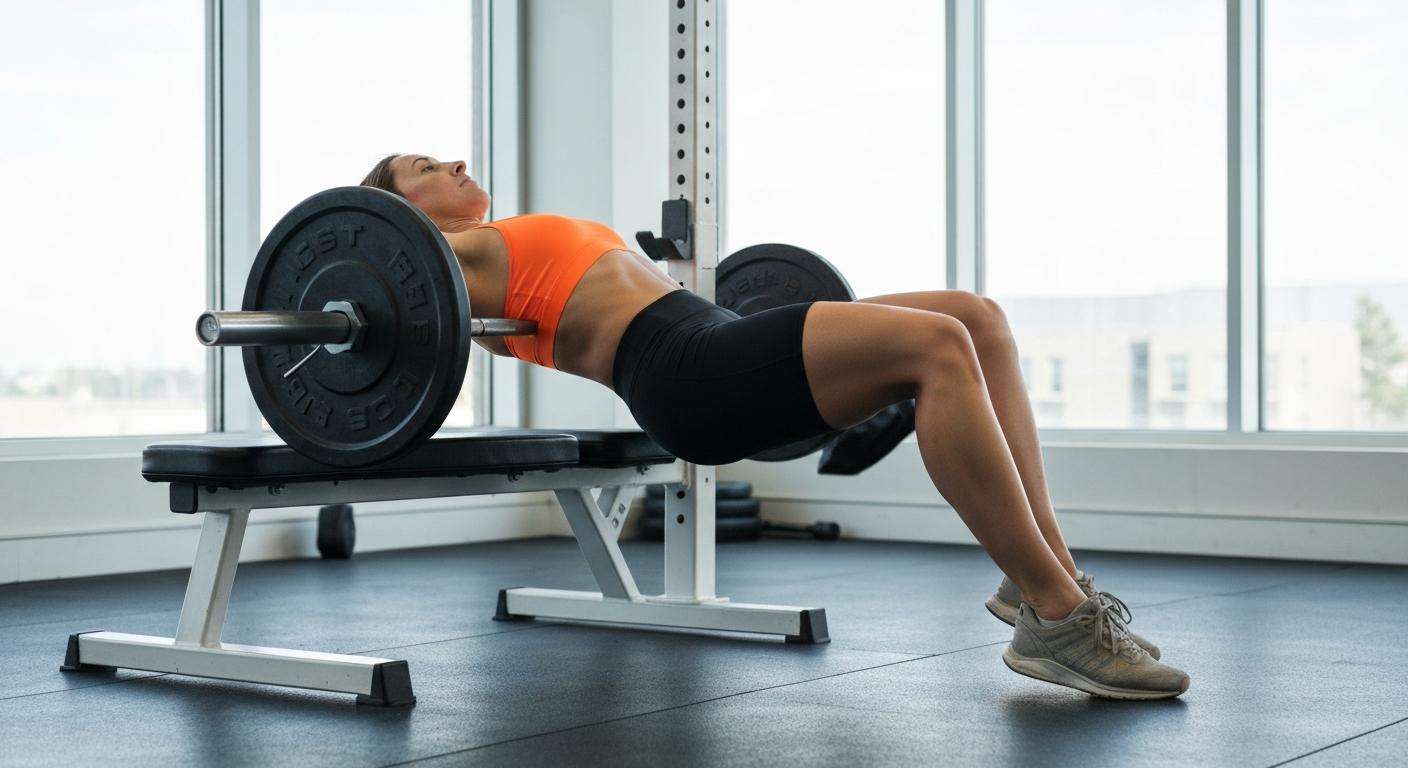
1. Hip thrust and barbell glute bridge — highest overall gluteal activation
2. Romanian deadlift — strong posterior chain activation
3. Bulgarian split squat (rear-foot elevated) — significant unilateral glute load
4. Cable kickbacks and donkey kicks — isolated terminal extension
Squats are effective but not the most efficient glute-builder. If your training is primarily squats and lunges, add hip thrusts and Romanian deadlifts to shift the emphasis to the glutes.
"EMG analysis consistently shows that hip thrust exercises produce significantly higher gluteus maximus activation than squats, approximately 75–80% of maximum voluntary contraction versus 50–60% for back squats at equivalent loads." — Journal of Strength and Conditioning Research — Gluteal EMG During Hip Extension Exercises, National Strength and Conditioning Association
The appearance of a round, full buttocks depends on both muscle and subcutaneous fat beneath the skin. At very low body fat levels — common in distance runners, competitive cyclists, and very lean athletes — even well-developed gluteal muscles can appear flat or angular because there is minimal fat padding the surface.
If you are at a low body fat percentage and want more gluteal volume, building muscle mass (which requires adequate caloric intake, not a deficit) is the primary pathway. Spot fat gain is not possible, but overall mass gain increases fat deposits including in the gluteal region.
Yes. With age, two things happen that reduce gluteal fullness:
1. Sarcopenia (age-related muscle loss): After age 30, muscle mass declines approximately 3–5% per decade without targeted resistance training. The glutes, as a large muscle group, are susceptible
2. Fat redistribution: Hormonal changes — particularly in women after menopause — shift fat storage from the hips and buttocks to the abdomen
Resistance training specifically targeting the glutes counteracts both of these effects. Progressive overload (gradually increasing weight or difficulty) is necessary to continue stimulating muscle growth regardless of age.
Estrogen plays a significant role in female fat distribution — directing fat storage to the hips, buttocks, and thighs (the "pear shape"). Low estrogen levels (from hormonal birth control, thyroid conditions, excessive exercise causing hypothalamic suppression, or perimenopause) can reduce fat deposits in the lower body, contributing to a flatter buttocks.
Testosterone in men plays a parallel role — very low testosterone accelerates muscle loss, including in the glutes. If you notice sudden body composition changes alongside other symptoms (fatigue, libido changes), hormonal evaluation is appropriate.
Muscle development requires both the mechanical stimulus (training) and adequate protein for repair and growth. Without sufficient dietary protein, the gluteal muscles cannot grow even in response to consistent training.
Protein targets for muscle building:
- Sedentary adults: 0.8 g per kg body weight per day
- Active adults building muscle: 1.6–2.2 g per kg body weight per day (approximately 0.7–1.0 g per pound)
Distribute protein intake across meals for optimal muscle protein synthesis. A 150-lb person building muscle targets roughly 105–150 g of protein per day.
Tight hip flexors (from sitting, running, or cycling) pull the pelvis into anterior tilt — the pelvis tips forward and down at the front. This tilt flattens the lumbar curve and changes the angle of gluteal muscle insertion, making the glutes appear flatter. It also inhibits full glute activation during exercises.
Signs of anterior pelvic tilt: Lower back arching excessively, stomach protruding forward, and buttocks appearing tucked under when viewed from the side.
Fix: Stretch the hip flexors daily (kneeling lunge, couch stretch) and strengthen the core and glutes to correct pelvic position.
| ✓Our Pick |
Shop Keppi resistance bands and booty building fitness equipment Consistently earns five-star reviews — reliable, well-supported, and genuinely effective. Learn More → |
| Exercise | Primary Muscle Targeted | Activation Level |
|---|---|---|
| Barbell hip thrust | Gluteus maximus | Very high |
| Romanian deadlift | Gluteus maximus + hamstrings | High |
| Bulgarian split squat | Gluteus maximus (unilateral) | High |
| Cable kickback | Gluteus maximus (isolation) | Moderate-high |
| Glute bridge | Gluteus maximus | Moderate-high |
| Deep back squat | Glutes + quads | Moderate |
A flat butt is primarily caused by undertrained gluteal muscles, prolonged sitting that causes gluteal amnesia, or body composition factors (low body fat, muscle loss from age). The most effective fix is adding hip thrusts and Romanian deadlifts to your training, eating sufficient protein (1.6–2.2 g per kg body weight), addressing hip flexor tightness, and getting up from your desk regularly to keep the glutes activated. Genetics sets the shape of the pelvis but not the size of the muscles that fill it out.
The most common reasons are insufficient progressive overload (not increasing weight or difficulty over time), training with exercises that don't effectively target the gluteus maximus (too much emphasis on squats and not enough on hip thrusts), inadequate protein intake, or sleeping in a caloric deficit that prevents muscle growth. Track your progressive overload and protein intake for 4–6 weeks to isolate the limiting factor.
High-volume endurance cardio — particularly long-distance running — is associated with gluteal muscle loss because the body adapts to be lighter and more efficient, sacrificing muscle mass. This is most pronounced in competitive endurance athletes. For most recreationally active people, moderate cardio does not significantly reduce gluteal muscle. Adding resistance training for the glutes counteracts any cardio-related muscle reduction.
With consistent hip-thrust-focused training and adequate protein intake, measurable gluteal hypertrophy is typically visible within 8–12 weeks. Significant shape change takes 6–12 months of consistent progressive overload. The glutes are a large muscle group and respond well to training, but muscle growth is a slow process — 1–2 lbs of new muscle per month is a realistic maximum for most adults.
Sitting on hard surfaces compresses the gluteal fat pad and does not cause permanent flattening — the shape returns when you stand. However, chronic prolonged sitting causes the gluteal muscles to atrophy from disuse, which is the real mechanism behind "desk worker flat butt." The surface hardness is less relevant than the total hours per day of inactivated glutes.
Reviewed and Updated on June 6, 2026 by George Wright