Sleep


Snoring with your mouth closed is possible because the obstruction causing the sound isn't in the mouth — it's in the nasopharynx (the passage above the soft palate) or the throat. Closed-mouth snoring has a lower-pitched, more resonant sound than open-mouth snoring and is typically caused by nasal obstruction, a large or long soft palate, or tongue-base collapse that produces vibration within the nasal airway rather than through the open mouth.
Most people associate snoring with open-mouth breathing, but the upper airway is a complex structure with multiple potential obstruction points. Closed-mouth snoring occurs when the obstruction is above or behind the point where the mouth opens into the airway.
The upper airway consists of several connected regions:
Closed-mouth snoring originates from obstructions in the nasal passages or nasopharynx — regions that are active during breathing even when the mouth is completely closed. Open-mouth snoring originates in the oropharynx, where mouth-breathing airflow produces vibration at the soft palate and pharyngeal walls.
Nasal obstruction is the most common cause of closed-mouth snoring. When the nasal passages are narrowed — by congestion, polyps, a deviated septum, or enlarged turbinates — air is forced through a restricted space at higher velocity, causing the surrounding nasal tissue to vibrate. This produces a distinctive low-frequency, resonant sound described as "internal" or "buzzing" compared to the louder, more turbulent sound of open-mouth snoring.
The obstruction can be structural (a deviated septum that's always present) or dynamic (seasonal allergy congestion, a cold, or dry-air irritation that waxes and wanes). Structural nasal snoring is consistent regardless of season; dynamic nasal snoring correlates with congestion periods.
A soft palate that is too long or too thick can vibrate against the posterior pharyngeal wall even when the mouth is closed, because airflow from the nose passes directly over the soft palate in the nasopharynx. The mouth doesn't need to be open for this vibration to occur — the nasopharyngeal airway is fully active in closed-mouth breathing.
Soft palate snoring produces the classic mid-register snore sound and is a hereditary trait — the length and thickness of the soft palate are largely determined by genetics.
The tongue can fall backward during sleep and partially or fully obstruct the airway at the base of the tongue, even when the mouth is closed. In closed-mouth sleepers, this produces snoring that is transmitted through the throat walls rather than through the open mouth, giving it a muffled, more "internal" quality.
Tongue-base snoring with closed mouth is particularly common in people who sleep on their backs (gravity pulls the tongue directly backward) or who have anatomically positioned tongues (larger relative to jaw size, or jaw that sits slightly back).
Nasal polyps are benign growths in the nasal passages that can significantly obstruct airflow without any externally visible sign. They produce chronic nasal obstruction that doesn't respond to typical decongestants and typically requires topical corticosteroid treatment or, in severe cases, surgical removal. If nasal snoring persists despite allergy treatment and nasal strips, polyps are worth investigating with a doctor.
"Closed-mouth snoring originates from nasal or nasopharyngeal obstruction in the majority of cases. The acoustic characteristics — lower frequency, more resonant — distinguish it clinically from oropharyngeal (open-mouth) snoring." — Sleep Medicine Reviews, Elsevier
It's different, not uniformly better or worse.
| Feature | Closed-Mouth Snoring | Open-Mouth Snoring |
|---|---|---|
| Sound | Lower pitch, more "buzzing" or resonant | Higher pitch, more turbulent and variable |
| Throat drying | Less — nose humidifies the air | More — unfiltered mouth air dries the throat |
| Throat sore after sleep | Less common | Very common |
| Nasal component | Always present | May or may not be present |
| Responds to MAD | Partially — if tongue base is involved | Yes — jaw advancement directly addresses this |
| Responds to nasal treatment | Yes — if nasal obstruction is the cause | Only if nasal component is present |
| Sleep apnea risk | Present, though slightly lower than open-mouth | Present |
Closed-mouth snoring causes less throat drying (because the nose humidifies the air), but it's still disruptive to both the snorer and their partner, still reduces sleep quality through partial arousals, and can still indicate underlying airway dysfunction.
Treatment choice depends on which of the closed-mouth mechanisms is dominant.
Nasal obstruction is the most treatable cause. Start with the simplest interventions:
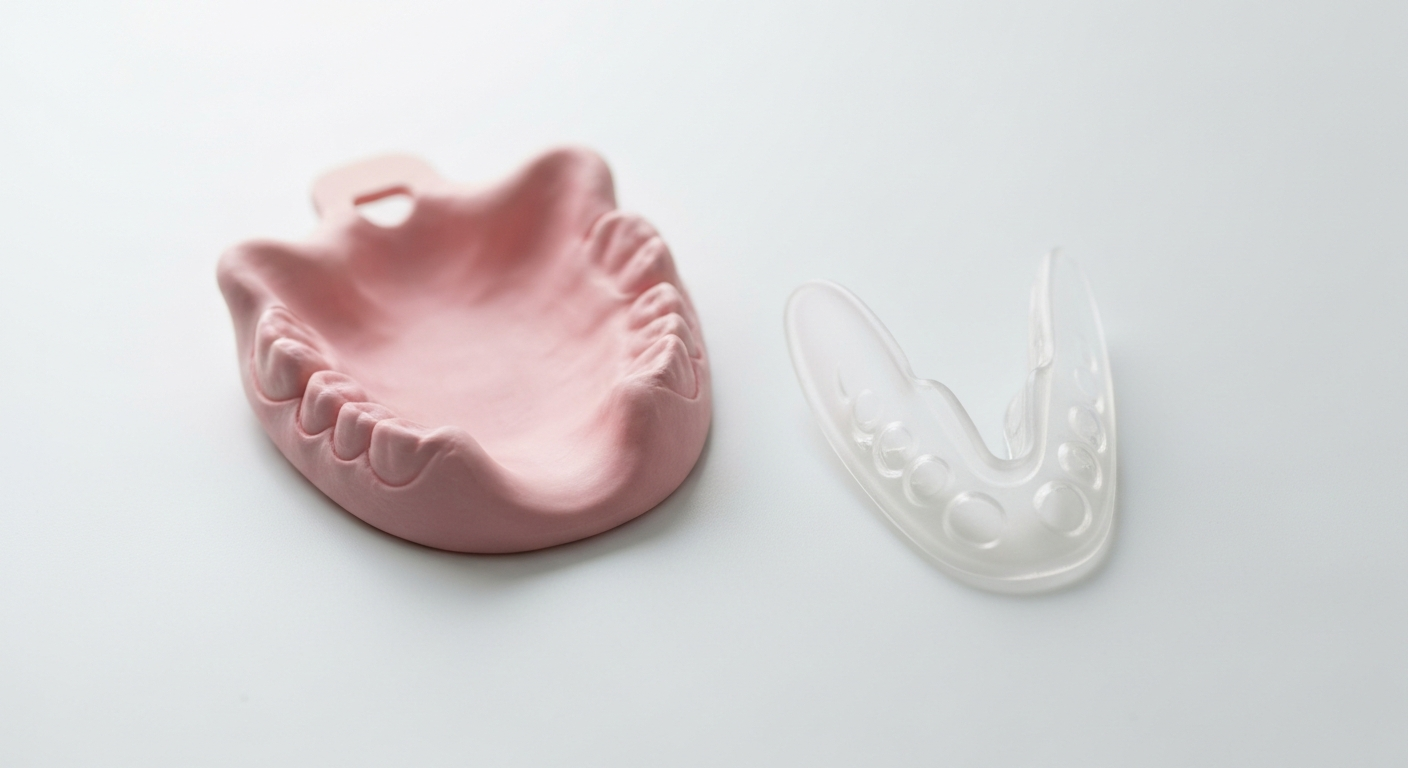
A mandibular advancement device still helps here — even with the mouth closed, advancing the jaw forward tightens the soft palate and moves the tongue base forward, reducing nasopharyngeal vibration. Many closed-mouth snorers achieve significant improvement with a MAD even though their mouth stays closed while wearing it.
Side sleeping dramatically reduces tongue-base collapse regardless of mouth position.
Throat exercises (myofunctional therapy) targeting the tongue and soft palate can reduce the laxity of tissue that collapses during sleep — relevant for both open- and closed-mouth snoring.
| ✓Our Pick |
SnoreMeds custom-fit mouthpiece — advances the jaw to reduce nasopharyngeal vibration No special skills required — straightforward to use and most orders ship quickly. Learn More → |
Snoring with mouth closed occurs when the airway obstruction is in the nasal passages or nasopharynx — above and behind the point where the mouth connects to the airway. The most common cause is nasal obstruction (deviated septum, congestion, polyps), followed by soft palate vibration and tongue-base collapse transmitted through nasal airflow. Treatment starts with nasal interventions (strips, dilators, saline rinse, nasal steroids) and includes side sleeping and mandibular advancement devices, which still help closed-mouth snorers by repositioning the tongue base and tightening the nasopharynx.
Closed-mouth snoring has a lower-frequency, more resonant or buzzing quality because the airway vibration is transmitted through nasal tissue rather than open airway space. Open-mouth snoring tends to be louder and more turbulent-sounding. Closed-mouth snoring also causes less morning sore throat (nasal airflow is humidified), but it's equally disruptive to sleep quality.
Yes — a mandibular advancement device helps closed-mouth snorers via two mechanisms: it advances the tongue base forward (reducing the main obstruction point in closed-mouth snoring) and tightens the soft palate and nasopharynx by repositioning the jaw. The device doesn't need the mouth to be open to provide airway benefits.
For nasal-obstruction-driven closed-mouth snoring, yes. Side sleeping dramatically reduces tongue-base snoring. For allergy-driven congestion, daily nasal steroid spray can resolve the obstruction. Weight management helps with all snoring types. Throat exercises (myofunctional therapy) have published evidence for reducing both open- and closed-mouth snoring.
If snoring with mouth closed comes with: witnessed breathing pauses, extreme daytime sleepiness, morning headaches, or difficulty concentrating — get evaluated for sleep apnea. If nasal snoring persists despite allergy treatment, decongestants, and nasal strips — get an ENT evaluation for a deviated septum or nasal polyps. Both are treatable conditions.
Reviewed and Updated on June 13, 2026 by George Wright