DIY

Your heat pump is not heating because it's stuck in defrost mode, the thermostat settings are wrong, the outdoor unit is blocked by ice or debris, the refrigerant is low, or the reversing valve has failed—any of these common issues can stop your system from producing warm air even when it's running.
When your heat isn't working in your house during a cold snap, it's more than an inconvenience—it's an emergency. The good news is that many heat pump heating failures have simple causes you can diagnose and sometimes fix yourself before calling an HVAC technician. This guide walks you through the most likely reasons your heat pump, mini split, or central heating system isn't turning on or kicking on, plus exactly what to check and when to call for professional help.
| ✓Our Pick |
HVAC diagnostic tools and thermometers for troubleshooting heat pumps A well-reviewed choice that delivers real results — worth every penny for anyone dealing with this. See on Amazon → |
A heat pump that runs without producing heat is usually experiencing a refrigerant problem, a stuck reversing valve, or is trapped in defrost mode—all of which prevent the system from extracting warmth from outdoor air and delivering it inside.
Heat pumps work differently from traditional furnaces. They don't generate heat by burning fuel. Instead, they move heat from outside air into your home using refrigerant. This process relies on several components working in precise coordination. When any single part fails, you get a system that sounds like it's working but blows lukewarm or cold air.
The reversing valve is particularly critical. This valve switches the direction of refrigerant flow, allowing the same unit to cool in summer and heat in winter. When it sticks or fails electrically, the system may stay locked in cooling mode even when you've set it to heat.
"The reversing valve is energized in one mode and de-energized in the other. A faulty valve or solenoid can cause the system to operate in the wrong mode, leaving homeowners with cold air when they need heat." — HVAC School
The top causes include thermostat errors, dirty filters, frozen outdoor units, low refrigerant, electrical issues, and component failures—most of which have visible warning signs you can check yourself.
This sounds too simple, but thermostat problems account for a surprising number of "my heat won't turn on" calls. Check that your thermostat is set to "Heat" mode, not "Cool" or "Auto." Verify the temperature setting is actually higher than the current room temperature. If you have a programmable or smart thermostat, check that the schedule hasn't reverted to a default setting.
Also check the "Fan" setting. It should be on "Auto," not "On." When set to "On," the fan runs continuously, blowing unheated air between heating cycles and making it feel like the system isn't working.
Dirty air filters restrict airflow so severely that your heat pump can't move enough air to heat your home. The system runs, but the warm air can't get through. Worse, restricted airflow can cause the evaporator coil to freeze, compounding the problem.
Check your filter monthly during heavy-use seasons. If you can't see light through it when held up to a window, it's too dirty. Replace it immediately. A standard 1-inch filter costs under $10 and takes two minutes to swap.
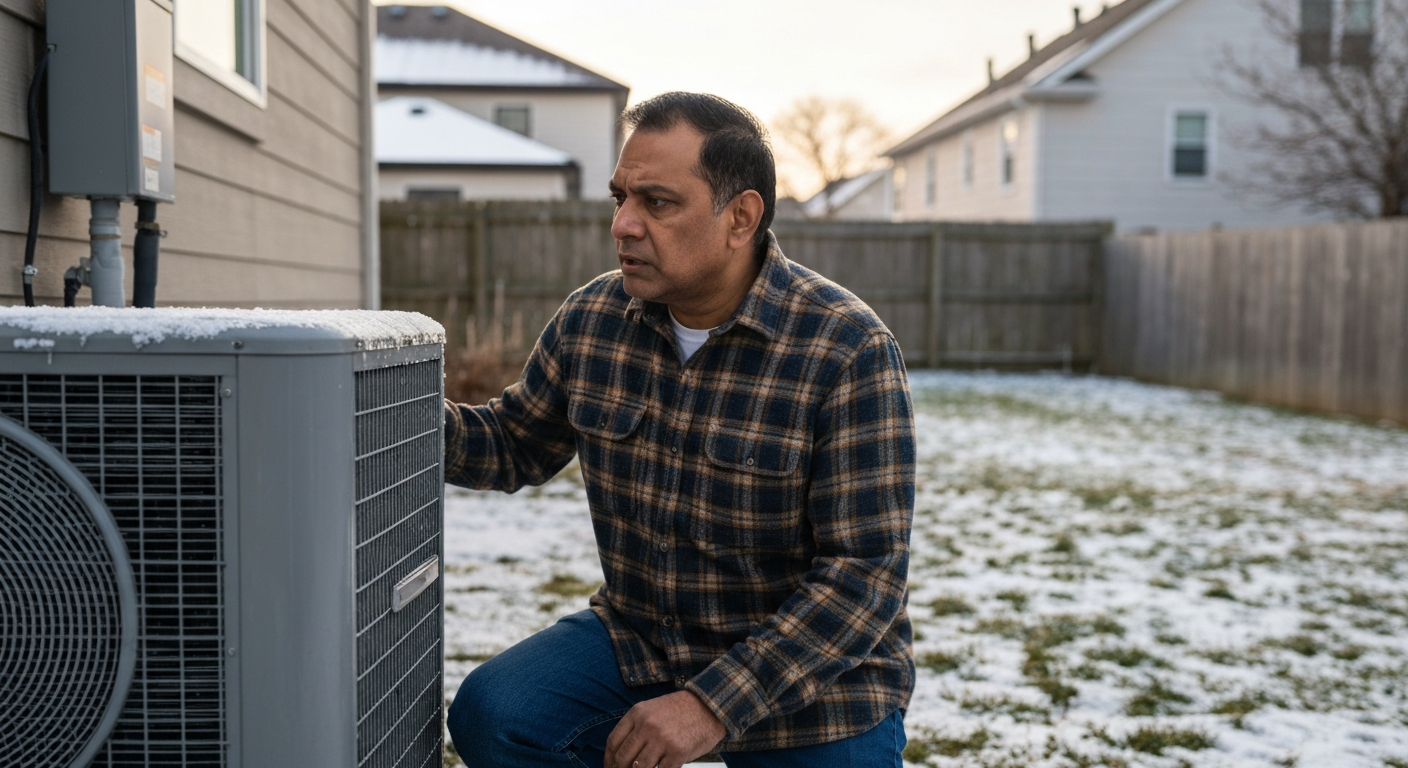
Go outside and look at your heat pump's outdoor unit. In winter, it's normal for some frost to form on the coils. However, if the entire unit is encased in ice, that's a problem. The defrost cycle should automatically melt frost buildup, but it can fail.
Check for:
- Heavy ice coating the entire unit
- Snow piled against or on top of the unit
- Leaves, debris, or vegetation blocking airflow
- A broken defrost control board
Clear any snow or debris with a soft brush. Never use sharp tools or hot water on a frozen unit—you can damage the coils.
Heat pumps need a precise refrigerant charge to operate. If your system has a leak, the refrigerant level drops, and heating capacity plummets. Signs of low refrigerant include:
Refrigerant issues require a licensed HVAC technician. This isn't a DIY repair—refrigerants are regulated substances, and finding and fixing leaks requires specialized equipment.
Also Read: Why Is My Electric Bill So High in My Apartment?
Mini splits fail to heat for the same reasons as central heat pumps—plus a few unique issues like clogged condensate drains, faulty remote settings, and individual unit malfunctions that don't affect the whole system.
Ductless mini splits are essentially small heat pumps with their own quirks. Each indoor unit operates somewhat independently, so one room might not heat while others work fine.
First, check the remote control. Mini split remotes have multiple modes, and it's easy to accidentally switch to "Fan Only" or "Dry" mode. Look for a sun icon or the word "Heat" on the display. If the batteries are dead or the remote's signal isn't reaching the unit, it may not respond to commands at all.
The indoor unit's filters need cleaning every two to four weeks during heavy use. Unlike central systems where a clogged filter is hidden in a closet, mini split filters are right behind the front panel. Pop it open and slide them out for cleaning.
"Mini-split filters should be cleaned regularly—at least once a month during periods of high use. A dirty filter reduces efficiency and can cause the system to freeze up." — Energy Star
Also check that the condensate drain line isn't clogged. If water can't drain, some units will shut down to prevent overflow.
Central heating failures in heat pump systems typically trace back to the air handler, ductwork issues, or the auxiliary heat strips—not the outdoor unit itself.
When central heat isn't kicking on, the problem might be upstream of the heat pump. Your air handler (the indoor unit) contains the blower motor, evaporator coil, and often electric auxiliary heat strips. Any of these can fail independently.
Check your air handler for:
- A tripped high-limit switch (a safety that shuts down heat if components overheat)
- A failed blower motor (listen for humming without airflow)
- Disconnected or damaged ductwork (feel for warm air at vents versus at the unit)
If your heat pump can't keep up in very cold weather, it should automatically activate auxiliary electric heat strips. If these strips have failed, your system loses its backup heating source.
| Component | Symptom When Failed | DIY Fixable? |
|---|---|---|
| Thermostat | No response, wrong mode | Usually yes |
| Air filter | Weak airflow, ice on coils | Yes |
| Blower motor | Humming, no airflow | No |
| Reversing valve | Blows cold in heat mode | No |
| Refrigerant | Ice on lines, weak heating | No |
| Defrost control | Outdoor unit frozen solid | No |
| Auxiliary heat strips | No backup heat in cold weather | No |
If your home has a dual-fuel system (heat pump plus gas furnace), a furnace that won't ignite may have a failed igniter, a closed gas valve, or a tripped safety switch—problems separate from the heat pump itself.
Many homes use heat pumps as the primary heating source with a gas furnace as backup for extremely cold days. If your heat pump works but your furnace doesn't kick in when temperatures drop, the furnace itself needs attention.
Check these furnace-specific issues:
- Pilot light or igniter failure: Modern furnaces use electronic igniters. If you hear the furnace trying to start but not igniting, the igniter may need replacement.
- Gas supply: Verify the gas valve to the furnace is open and that your gas service hasn't been interrupted.
- Flame sensor: A dirty flame sensor tells the system there's no flame, shutting down the gas valve as a safety measure. This sensor can be cleaned with fine sandpaper.
- Condensate drain: High-efficiency furnaces produce condensation. A clogged drain triggers a safety shutdown.
Start with the simplest checks first—thermostat settings, circuit breakers, and filters—before assuming you need a professional repair.
Follow this diagnostic sequence:
If none of these steps restore heat, you likely need professional diagnosis.
Also Read: Why Is My Air Not Blowing Cold? 9 Causes & Fixes
Call a technician immediately if you smell burning, hear grinding or screeching sounds, see ice that won't clear, or if the system repeatedly trips breakers—these indicate serious problems that can worsen without professional repair.
Some repairs are genuinely outside DIY territory:
- Refrigerant recharging or leak repair
- Reversing valve replacement
- Compressor failure
- Electrical component replacement inside the unit
- Defrost control board replacement
A service call typically costs $75–$150 for diagnosis, with repairs ranging from $150 for a capacitor to $1,500+ for a compressor. Get multiple quotes for major repairs, and ask whether replacement makes more sense for older units (typically 10–15 years old).
| ✓Our Pick |
Digital refrigerant gauges for HVAC diagnostics One of the highest-rated products in its category — a reliable fix used by thousands of people. See on Amazon → |
Your heat pump isn't heating because of a thermostat error, clogged filter, frozen outdoor unit, refrigerant leak, failed reversing valve, or defrost system malfunction. Start troubleshooting with simple checks—thermostat settings, breakers, and filters—before moving to the outdoor unit inspection. Mini splits have additional issues like remote settings and clogged drains. Call a professional for refrigerant, electrical, or compressor problems. Most heating failures have identifiable causes, and many can be resolved the same day with the right diagnosis.
If your thermostat is definitely set to Heat mode and the temperature setting is above room temperature, the issue is likely electrical or mechanical. Check your circuit breakers first—heat pumps have separate breakers for the indoor and outdoor units, and either one tripping will stop the system. Also check whether your thermostat has power (display lit and responsive). If breakers are fine and the thermostat works, the problem may be a failed contactor, capacitor, or control board, all of which require professional repair.
Sudden heating failures are often caused by tripped breakers, a frozen outdoor unit after overnight ice accumulation, or a safety switch that triggered due to overheating. Check breakers and the outdoor unit first. If the outdoor unit is encased in ice, the defrost cycle has failed. Clear visible ice gently and give the system time to recover. If the problem recurs daily, the defrost control or sensors need professional attention.
Heat pumps lose efficiency as outdoor temperatures drop. Below about 25–30°F, many heat pumps struggle to extract enough warmth from the air. Your system should switch to auxiliary heat (electric strips or a backup furnace) automatically. If it doesn't, the auxiliary heat may have failed, or the thermostat's "emergency heat" setting needs to be activated manually. Check your thermostat for an "Aux" or "Em Heat" option.
Yes. A severely clogged filter restricts airflow so much that the evaporator coil can freeze, the system overheats and trips safety switches, or the blower motor burns out from strain. This is one of the most common and most preventable causes of heating failure. Filters should be checked monthly and replaced when visibly dirty—typically every one to three months depending on household factors like pets and dust levels.
Low refrigerant symptoms include ice forming on the refrigerant lines (the copper pipes connecting indoor and outdoor units), the system running constantly without reaching temperature, weak airflow, and unusually high electric bills. You may also hear a hissing or bubbling sound near the outdoor unit. Refrigerant doesn't get "used up"—if it's low, there's a leak somewhere that needs repair before recharging. Only licensed HVAC technicians can legally handle refrigerants.
Reviewed and Updated on May 3, 2026 by George Wright