
Health
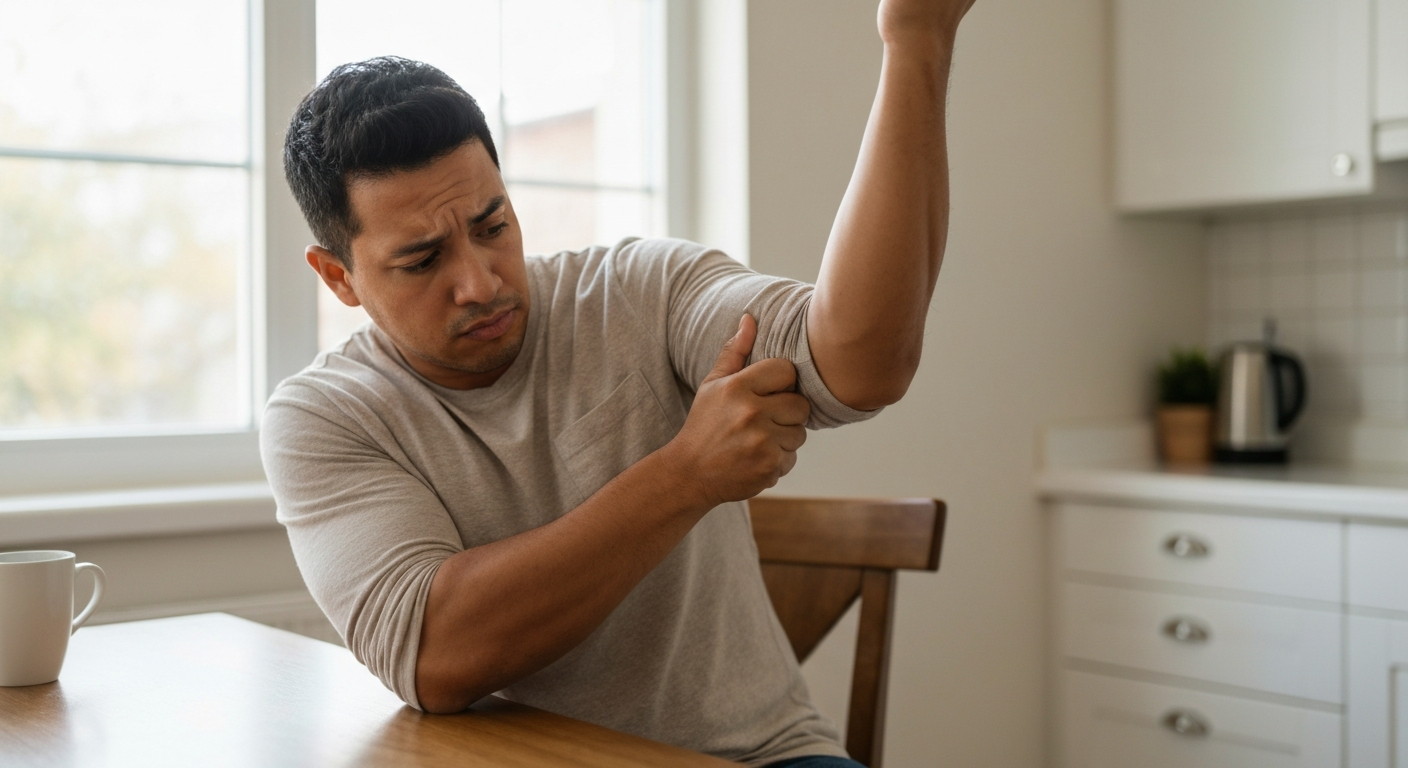

Your elbow is popping because gas bubbles are collapsing inside the joint fluid, tendons are snapping over bony ridges, or cartilage surfaces are rubbing together — all of which are usually harmless unless accompanied by pain, swelling, or loss of motion.
That cracking, clicking, or snapping sound you hear when you bend or straighten your arm can feel alarming, but in most cases it's your body's normal mechanics at work. The elbow is a hinge joint where three bones meet, surrounded by tendons, ligaments, and a lubricating fluid that can all produce noise under certain conditions. Understanding what's causing your elbow to pop helps you know when to ignore it and when to take action.
The elbow joint contains several structures that can produce popping sounds, including synovial fluid, cartilage, tendons, and ligaments — each creating noise through different mechanisms.
Your elbow is more complex than it appears. The humerus (upper arm bone), radius, and ulna (forearm bones) converge at this joint, held together by ligaments and surrounded by a capsule filled with synovial fluid. This fluid reduces friction, but it also contains dissolved gases — primarily nitrogen, carbon dioxide, and oxygen — that play a key role in many popping sounds.
When you bend or extend your arm, pressure changes inside the joint can cause these gas bubbles to form and collapse rapidly. This phenomenon, called tribonucleation, creates the classic "crack" you might hear. Research from the University of Alberta confirmed this gas-bubble mechanism using real-time MRI imaging, settling a decades-old debate about what actually causes joint cracking.
Beyond the joint capsule itself, tendons and ligaments wrap around the elbow's bony prominences. When these soft tissues slide over bone or shift position during movement, they can produce snapping or clicking sounds — especially if they're tight or if the underlying anatomy has slight variations.
Most elbow popping falls into one of six categories: gas bubble release, tendon snapping, cartilage changes, loose bodies, arthritis, or overuse injuries.
The most common and benign cause of elbow popping is cavitation — the formation and collapse of gas bubbles in your synovial fluid. When you stretch or move your elbow through its full range, you temporarily increase the joint space. This pressure drop allows dissolved gases to form bubbles, which then collapse with an audible pop.
This type of popping is painless, happens occasionally rather than with every movement, and typically requires a "refractory period" of about 20 minutes before the joint can crack again. If your elbow popping fits this pattern, it's generally nothing to worry about.
The triceps tendon and the tendons of your forearm muscles cross the elbow joint and can snap over bony ridges as you move. This snapping is more common if you have:
You might notice this type of popping more during specific movements, like fully straightening your arm after it's been bent or rotating your forearm while the elbow is flexed.
| ✓Our Pick |
Clinically backed joint support and collagen supplements Backed by strong customer feedback — the most recommended solution in forums and Q&A communities. Learn More → |
Crepitus is a grinding or crackling sensation that occurs when cartilage surfaces become rough or worn. Unlike the single pop of gas bubbles, crepitus tends to be a continuous sound or feeling during movement. Early cartilage changes might produce occasional popping, while more advanced wear creates persistent grinding.
"Crepitus in the elbow joint can indicate early degenerative changes, though it's not always associated with pain or functional limitations." — Dr. Kevin Plancher at Plancher Orthopaedics & Sports Medicine
Sometimes small fragments of cartilage or bone break off and float freely within the elbow joint. These loose bodies can cause intermittent popping, catching, or locking sensations — particularly when they get temporarily trapped between the joint surfaces. Common causes include:
| Cause | How It Happens |
|---|---|
| Osteochondritis dissecans | Blood supply loss causes bone/cartilage to separate |
| Trauma | Direct injury chips off fragments |
| Osteoarthritis | Degenerating cartilage sheds pieces |
| Synovial chondromatosis | Joint lining produces cartilage nodules |
Loose bodies often cause symptoms that come and go unpredictably, depending on where the fragment is positioned at any given moment.
Both osteoarthritis (wear-and-tear) and inflammatory arthritis can increase elbow popping. In osteoarthritis, the protective cartilage gradually breaks down, leaving roughened surfaces that click and grind against each other. Inflammatory conditions like rheumatoid arthritis cause swelling and tissue changes that alter joint mechanics.
Arthritis-related popping typically worsens over time and is often accompanied by stiffness, reduced range of motion, or aching — especially in the morning or after periods of inactivity.
Repetitive motions — whether from sports, work, or hobbies — can irritate the tendons and other soft tissues around your elbow. Conditions like tennis elbow (lateral epicondylitis) or golfer's elbow (medial epicondylitis) don't always cause popping directly, but they can change how you move your arm, leading to compensatory mechanics that produce new sounds.
"Repetitive strain injuries alter biomechanics throughout the entire kinetic chain, often resulting in secondary symptoms including joint crepitus." — American Academy of Orthopaedic Surgeons
Also Read: Why Is My Arm Sore After a Shot? Causes & Relief Tips
Elbow popping alone is rarely concerning, but when combined with pain, swelling, instability, or loss of function, it warrants professional evaluation.
Most people experience painless joint popping at some point, and the elbow is no exception. However, certain accompanying symptoms suggest an underlying problem that needs attention.
| Symptom | What It Might Indicate |
|---|---|
| Pain during or after popping | Cartilage damage, loose bodies, tendinitis |
| Swelling around the elbow | Inflammation, effusion, bursitis |
| Locking or catching | Loose bodies, mechanical obstruction |
| Reduced range of motion | Arthritis, contracture, bone spurs |
| Instability or giving way | Ligament injury, severe cartilage loss |
| Weakness in grip or arm | Nerve involvement, muscle/tendon injury |
If your elbow popping started after an injury, has progressively worsened, or interferes with daily activities, these are all signs to seek evaluation from a healthcare provider.
Gentle stretching, strengthening exercises, proper warm-ups, and staying hydrated can all help minimize harmless elbow popping.
For benign elbow popping caused by tight tendons or gas bubble release, these strategies often help:
Stretch your forearm muscles daily — Extend your arm, palm down, and gently pull your fingers back toward your body. Hold for 30 seconds, then repeat with palm facing up.
Warm up before activities — Cold, stiff tissues are more likely to snap or pop. Spend 5 minutes doing arm circles and gentle elbow bends before exercise or repetitive work.
Stay hydrated — Synovial fluid production depends on adequate hydration. Aim for at least 8 glasses of water daily.
Strengthen supporting muscles — Balanced strength in your biceps, triceps, and forearm muscles helps maintain smooth joint mechanics. Simple resistance exercises with light weights can help.
Avoid repetitive end-range movements — If certain positions consistently cause popping, try modifying how you perform those movements.
Also Read: Why Is My Face Stinging? 8 Causes & How to Fix It Fast
Seek medical evaluation if your elbow popping is accompanied by persistent pain, swelling, instability, or if it significantly limits your ability to use your arm.
A healthcare provider can perform a physical examination and order imaging if needed. Common diagnostic tools include:
Treatment depends entirely on the underlying cause. Gas bubble popping needs no treatment. Tendon issues might respond to physical therapy or activity modification. Loose bodies or advanced arthritis may require surgical intervention in some cases.
Elbow popping is usually caused by harmless gas bubbles collapsing in your joint fluid or tendons snapping over bone — neither requires treatment unless you also have pain, swelling, or functional problems. Cartilage wear, loose bodies, arthritis, and overuse injuries can also cause popping and may need professional attention. Simple measures like stretching, strengthening, and staying hydrated can reduce benign popping, but seek evaluation if symptoms worsen or interfere with daily activities.
Consistent cracking with every extension usually points to a tendon or ligament snapping over a bony prominence rather than gas bubbles, which need time to reform. This is more common in people with tight triceps tendons or naturally prominent bones at the elbow. Unless it's painful, it's generally harmless — but stretching the triceps and surrounding muscles may reduce the frequency.
Elbow popping can be associated with arthritis, but popping alone doesn't confirm the diagnosis. Arthritis-related popping usually comes with other symptoms like morning stiffness, aching, reduced range of motion, or swelling. If your popping is painless and your elbow moves freely, arthritis is less likely to be the cause.
Current research suggests that intentionally cracking your joints — including your elbow — doesn't cause arthritis or lasting damage. A well-known study followed habitual knuckle crackers for decades and found no increased rates of arthritis. However, if forcing the crack causes pain, you should stop and have the joint evaluated.
Weight training increases tension in the muscles and tendons crossing your elbow joint. This extra tension can make tendons more likely to snap over bone during movement. Additionally, lifting often takes your elbow through its full range of motion under load, which may increase gas bubble formation. Adequate warm-up and stretching between sets can help.
Children's joints often pop and crack as they grow, and this is usually completely normal. Growing bones, developing muscles, and highly flexible ligaments can all contribute to joint sounds. However, if your child complains of pain, refuses to use the arm, or you notice swelling, have them evaluated — children can experience conditions like nursemaid's elbow (radial head subluxation) that need prompt treatment.
Reviewed and Updated on June 11, 2026 by George Wright