
Health
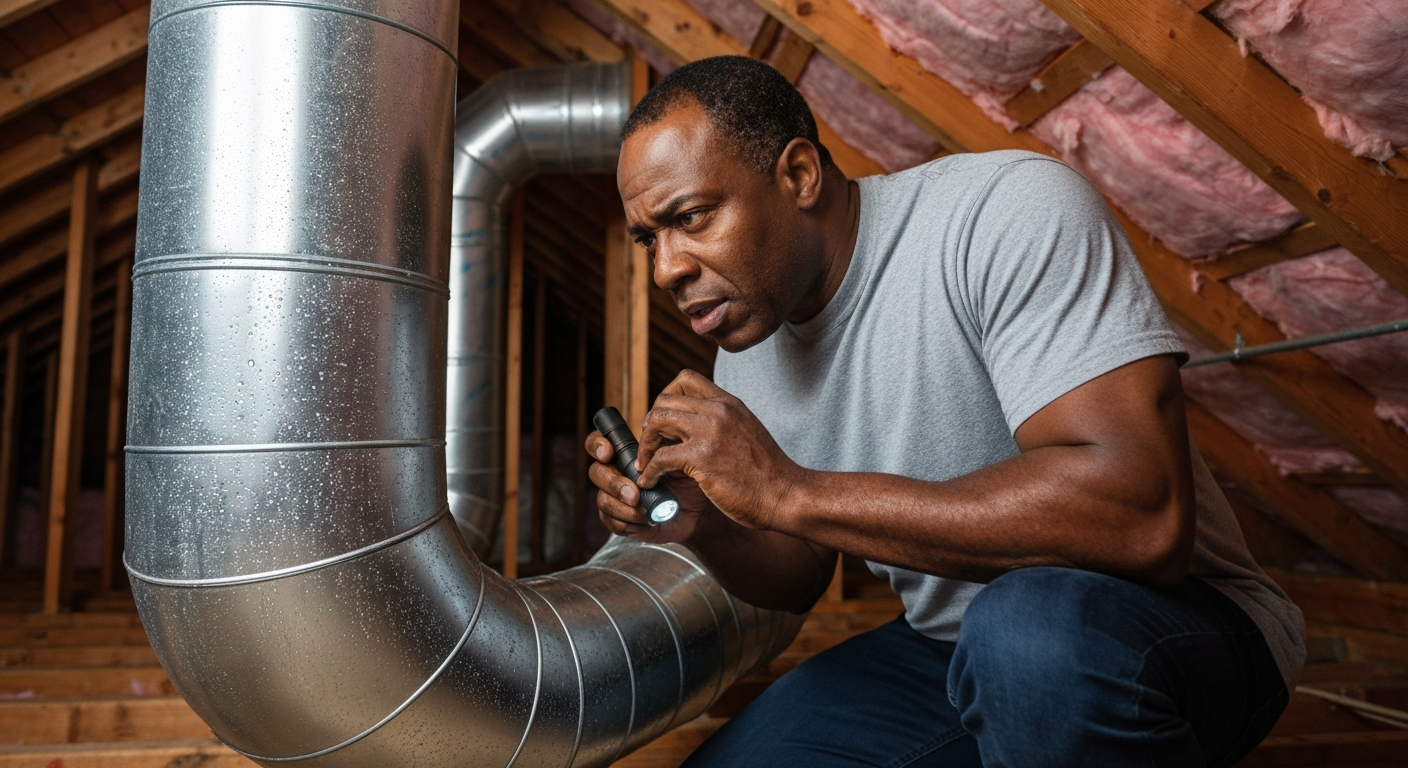

Ductwork sweats when warm, humid air contacts the cold surface of your air conditioning ducts, causing water vapor to condense into visible moisture — the same process that forms water droplets on a cold glass of iced tea in summer.
This condensation isn't just a cosmetic nuisance. Left unchecked, sweating ductwork can drip onto ceilings, soak insulation, promote mold growth, and even damage your home's structure. The good news: once you understand why it happens, most fixes are straightforward and affordable. Below, you'll find the common causes of duct condensation in 2026, how to diagnose your specific situation, and proven solutions that actually work.
Condensation forms on ductwork when the surface temperature of the duct drops below the dew point of the surrounding air — the temperature at which water vapor turns into liquid.
Your air conditioning system cools the air inside your ducts to somewhere between 50°F and 60°F. Meanwhile, the air in your attic, basement, or crawl space might be 85°F with 70% humidity. When that warm, moisture-laden air touches the cold duct surface, physics takes over: the water vapor in the air condenses into liquid droplets on the duct exterior.
Several factors determine how much condensation forms:
"Condensation on ductwork is one of the most common causes of moisture problems in homes, particularly in hot, humid climates." — U.S. Department of Energy
Also Read: Why Is My House Infested With Flies? 7 Causes & Fixes
Excessive indoor or ambient humidity is the most common culprit behind sweating ductwork — when relative humidity exceeds 60%, condensation becomes almost inevitable on cold surfaces.
Homes in the Southeast, Gulf Coast, and other humid regions face this challenge constantly during summer months. But even homes in drier climates can develop humidity problems from:
You can measure your home's humidity with an inexpensive hygrometer. Ideal indoor relative humidity falls between 30% and 50%. Anything above 60% creates favorable conditions for duct condensation.
| Humidity Level | Condensation Risk | Recommended Action |
|---|---|---|
| Below 30% | Very low | May need humidification in winter |
| 30–50% | Low | Ideal range — maintain |
| 50–60% | Moderate | Monitor and improve ventilation |
| Above 60% | High | Active dehumidification needed |
Insulation acts as a thermal barrier between cold duct surfaces and warm surrounding air — when it's missing, compressed, or water-damaged, condensation forms directly on exposed metal.
Duct insulation typically consists of fiberglass wrap, foam board, or spray-applied coatings. Over time, this insulation can:
Inspect your ductwork carefully. Look for sections where insulation has fallen away, gaps at joints and elbows, and areas where insulation appears wet, thin, or discolored. Even small exposed sections can produce significant condensation.
The minimum recommended insulation for ducts in unconditioned spaces is R-6 in mild climates and R-8 in hot, humid regions. Many older homes have R-4 insulation or less, which is inadequate by 2026 standards.
Leaky ducts create a double problem: they pull humid outside air into the duct system while also allowing conditioned air to escape, increasing the temperature differential that causes condensation.
According to the Environmental Protection Agency, typical duct systems lose 25% to 40% of the heating or cooling energy that passes through them. Those same leaks allow moisture-laden air from attics, crawl spaces, and wall cavities to contact cold duct surfaces.
Common leak locations include:
"Sealing and insulating ducts can improve the efficiency of your heating and cooling system by as much as 20 percent." — ENERGY STAR
You can detect major leaks by running your hand along duct seams while the system operates — you'll feel air escaping. For a comprehensive assessment, consider a duct blaster test performed by an HVAC professional.
An oversized air conditioner cools your home too quickly, shutting off before it can adequately dehumidify the air — leaving excess moisture that condenses on ductwork and other cold surfaces.
Air conditioners remove humidity through condensation on the evaporator coil. This process takes time. When a system is properly sized, it runs for longer cycles, allowing more moisture removal. An oversized system blasts cold air, reaches the thermostat setpoint quickly, and shuts off — leaving your home cool but humid.
Signs your AC may be oversized:
If you suspect oversizing, have an HVAC contractor perform a Manual J load calculation. This engineering assessment determines the correct system size based on your home's specific characteristics, climate, and insulation levels.
Ductwork installed in attics, crawl spaces, and garages faces extreme temperature differentials that make condensation much more likely than ducts routed through conditioned areas.
Attic temperatures in summer can exceed 130°F, while your supply ducts might be carrying 55°F air. That 75-degree differential practically guarantees condensation unless insulation is perfect. Crawl spaces present similar challenges, often with the added problem of ground moisture raising humidity levels.
If your ducts run through unconditioned spaces, your options include:
Also Read: Why Is My Defrost Not Working? 7 Causes & Fixes
The most effective approach combines improving insulation, sealing air leaks, and controlling humidity — addressing just one factor rarely solves the problem completely.
Before making repairs, document what you're dealing with. Note where condensation appears, how severe it is, and the condition of existing insulation. Use a hygrometer to measure humidity in the space where ducts are located.
Use mastic sealant (not duct tape, which degrades over time) to seal all joints, seams, and connections. Pay special attention to boot connections where ducts meet registers. For large gaps, use fiberglass mesh tape embedded in mastic.
Wrap all exposed duct surfaces with insulation rated R-6 minimum, R-8 preferred. Use insulation with an integrated vapor barrier facing outward (toward the humid air). Seal all seams in the vapor barrier with appropriate tape.
If humidity remains above 60% after sealing and insulating, add dehumidification capacity. Options include:
For ducts in crawl spaces or basements, installing a condensate collection system provides backup protection. A shallow trough beneath the duct run can catch drips and route water to a drain or sump pump.
| Fix | DIY Difficulty | Cost Range | Effectiveness |
|---|---|---|---|
| Seal duct leaks | Moderate | $50–$200 | High |
| Add/replace insulation | Moderate | $200–$800 | High |
| Portable dehumidifier | Easy | $150–$400 | Moderate |
| Whole-house dehumidifier | Professional | $1,500–$3,000 | Very high |
| Spray foam encapsulation | Professional | $2,000–$5,000 | Very high |
| ✓Our Pick |
Commercial-grade dehumidifiers for basements and crawl spaces Save yourself the frustration — a proven solution with consistently positive feedback from real buyers. Learn More → |
If condensation persists after DIY insulation and sealing efforts, or if you notice mold growth, structural damage, or water staining, bring in a qualified HVAC contractor for a comprehensive assessment.
Professional evaluation makes sense when:
A good contractor will check refrigerant levels (low refrigerant causes colder-than-normal coils), evaluate system sizing, test for duct leakage, and recommend targeted solutions based on your specific situation.
Ductwork sweats when cold duct surfaces meet warm, humid air — the solution requires insulating ducts properly, sealing air leaks, and controlling humidity in the surrounding space. Most homeowners can address mild cases with R-8 insulation and mastic sealant, but persistent condensation in humid climates often requires adding dehumidification capacity. Left untreated, sweating ducts lead to mold, water damage, and degraded indoor air quality — making this a problem worth solving sooner rather than later.
Summer brings the perfect combination of factors: your AC runs frequently, keeping ducts cold, while outdoor humidity peaks. In winter, heating systems warm ducts rather than cooling them, eliminating the temperature differential that causes condensation. Homes in humid climates notice this seasonal pattern most dramatically.
Yes. Persistent moisture on and around ductwork creates ideal conditions for mold growth. Mold can colonize wet insulation, adjacent wood framing, and drywall within days of continuous dampness. Beyond structural concerns, mold spores can enter the duct system and circulate throughout your home, affecting indoor air quality.
Condensation itself isn't dangerous, but its consequences can be. Water damage weakens building materials, mold affects respiratory health, and dripping water can damage belongings or create slip hazards. Addressing ductwork condensation promptly prevents these secondary problems.
DIY sealing and insulation typically costs $200 to $500 in materials. Professional duct sealing and insulation runs $800 to $2,000 depending on accessibility and duct length. Whole-house dehumidification adds $1,500 to $3,000, while comprehensive spray foam encapsulation of an attic or crawl space ranges from $2,000 to $5,000.
A dehumidifier reduces humidity in the surrounding space, which lowers the dew point and reduces condensation potential. However, dehumidification alone rarely solves the problem completely — you'll still need adequate insulation to prevent cold duct surfaces from triggering condensation, especially in extremely humid conditions.
Reviewed and Updated on June 2, 2026 by George Wright