

DIY
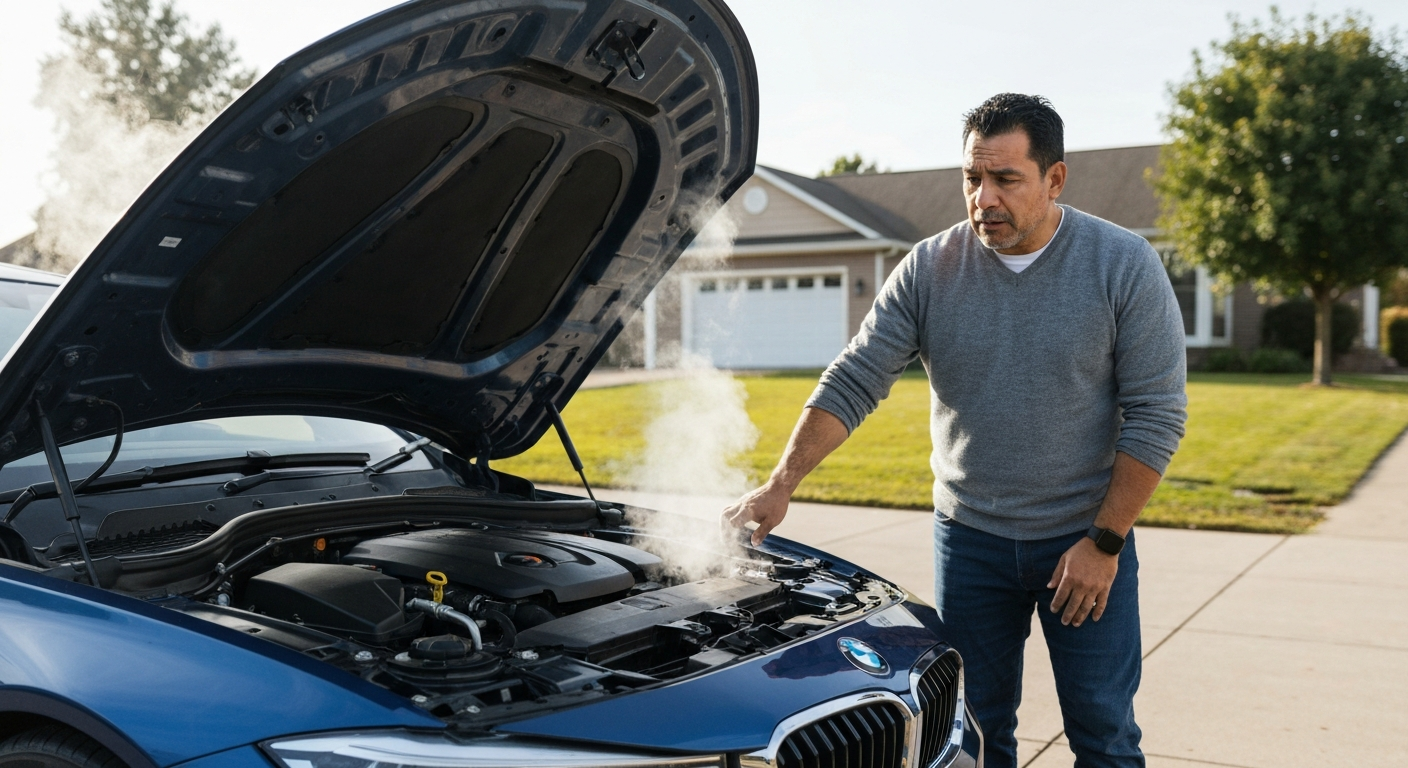

Your BMW is overheating because the cooling system has failed at one or more critical points — most commonly a faulty water pump, leaking coolant hose, stuck thermostat, or failed radiator fan. BMW engines run hotter than many competitors by design, and their cooling components are engineered to tight tolerances. When any part fails, temperatures spike fast. Identifying the specific cause quickly is essential to prevent catastrophic engine damage that can cost $5,000 to $15,000 to repair.
| ✓Our Pick |
Search BMW cooling system parts — water pumps, thermostats, radiator fans Highly rated by thousands of buyers — this is one of the most effective solutions for this issue you can try at home. Learn More → |
BMWs overheat due to specific failure points in their cooling systems — water pumps, thermostats, expansion tanks, radiator fans, coolant hoses, head gaskets, and low coolant levels are the primary culprits.
BMW cooling systems use electric water pumps (rather than belt-driven pumps) and plastic expansion tanks that degrade over time. These design choices improve efficiency but create predictable failure patterns. Understanding each cause helps you diagnose the problem accurately.
The water pump circulates coolant throughout the engine block and radiator. BMW electric water pumps typically fail between 60,000 and 100,000 miles. When the pump fails, coolant stops flowing even though the engine keeps generating heat.
Signs of water pump failure include:
- Temperature rising rapidly at idle or low speeds
- Coolant leaking from the front of the engine
- Whining or grinding noise from the pump area
- Check engine light with cooling system fault codes
Electric water pump replacement costs $800 to $1,500 at a BMW dealer, or $400 to $700 if you use an independent mechanic with aftermarket parts.
The thermostat regulates coolant flow between the engine and radiator. It stays closed when the engine is cold (allowing faster warmup) and opens when the engine reaches operating temperature. A stuck-closed thermostat traps hot coolant in the engine block.
"A stuck thermostat is one of the most common causes of engine overheating. When stuck closed, it prevents coolant from reaching the radiator, causing rapid temperature increases." — Consumer Reports automotive testing division
BMW thermostats often fail in the closed position due to the plastic housing cracking or the internal valve seizing. Replacement costs $300 to $600 for parts and labor.
BMW expansion tanks (also called coolant reservoirs) are made of plastic that becomes brittle after years of heat cycling. Cracks typically form around the seams or near the cap seal. A cracked tank allows coolant to leak and air to enter the system.
Warning signs include:
- Visible coolant puddles under the car (usually on the passenger side)
- Low coolant warnings on the dashboard
- Steam or sweet smell from the engine bay
- Coolant level dropping without obvious leaks
Expansion tank replacement is relatively affordable — $150 to $400 including parts and labor.
BMW radiator fans are electric and controlled by the engine computer based on coolant temperature. When the fan fails, air doesn't flow through the radiator at low speeds or when stopped. Your engine may stay cool on the highway but overheat in traffic or at idle.
Check whether your fan runs by:
1. Starting the engine cold
2. Letting it idle until the temperature gauge reaches normal
3. Listening for the fan to engage (it should be audible)
4. If the temperature keeps climbing without fan noise, the fan or its control module has failed
Fan replacement costs $400 to $900 depending on whether you need just the fan motor or the entire assembly.
BMW cooling systems use multiple rubber and silicone hoses that deteriorate over time. Heat, pressure, and age cause cracks, splits, and connection failures. Even a small leak reduces system pressure and allows air pockets to form, which disrupts cooling efficiency.
Common leak points include:
- Upper and lower radiator hoses
- Heater core hoses
- Expansion tank connections
- Thermostat housing connections
A visual inspection with the engine cold can reveal obvious cracks or wet spots. Hose replacement is one of the cheaper fixes — $100 to $300 per hose at most shops.
Also Read: Why Is My Passenger Side Floor Wet? 6 Causes & Fixes
Head gasket failure is the most serious cause of overheating. The head gasket seals the cylinder head to the engine block, keeping coolant and oil in their separate passages. When it fails, coolant can leak into the cylinders or oil passages, and combustion gases can enter the cooling system.
Symptoms of head gasket failure:
- White smoke from the exhaust (coolant burning in cylinders)
- Milky residue on the oil filler cap (coolant mixing with oil)
- Bubbles in the coolant reservoir (combustion gases in cooling system)
- Rapid overheating even with full coolant
Head gasket repair costs $2,000 to $4,000 for labor-intensive BMW engines. If the overheating caused additional damage, costs can exceed $10,000.
Sometimes the answer is straightforward — your BMW is overheating because there isn't enough coolant in the system. Low coolant can result from small leaks, evaporation through a failing cap seal, or coolant that was never topped off after previous service.
Check your coolant level when the engine is completely cold. The reservoir has minimum and maximum marks. BMW recommends using only BMW-approved coolant (blue or blue-green color) mixed 50/50 with distilled water.
| Cause | Typical Cost | Common Mileage |
|---|---|---|
| Water pump failure | $400–$1,500 | 60,000–100,000 |
| Stuck thermostat | $300–$600 | 50,000–80,000 |
| Cracked expansion tank | $150–$400 | 60,000–120,000 |
| Radiator fan failure | $400–$900 | 80,000–150,000 |
| Coolant hose leak | $100–$300 each | Any mileage |
| Head gasket failure | $2,000–$4,000+ | 100,000+ |
| Low coolant | $20–$50 (top-off) | Any mileage |
Diagnosing an overheating BMW requires checking coolant level first, then systematically testing the water pump, thermostat, fan, and hoses before assuming the worst-case head gasket scenario.
Follow this diagnostic sequence:
"Cooling system pressure testing is the most effective way to locate leaks. The system is pressurized to its normal operating pressure, and any leaks become immediately visible or audible." — AAA Automotive Research Center
When your BMW's temperature warning activates, pull over safely within 60 seconds, turn off the engine, and let it cool for at least 30 minutes before attempting to check coolant or restart.
Continuing to drive an overheating BMW — even for a few miles — can warp the cylinder head, crack the engine block, or seize internal components. Modern BMW engines use aluminum construction that is especially vulnerable to heat damage.
Immediate steps when overheating:
1. Turn off the air conditioning (reduces engine load)
2. Turn the heater to maximum (draws heat away from the engine)
3. Pull over to a safe location as soon as possible
4. Shift to neutral and rev the engine slightly if stuck in traffic (increases water pump flow)
5. Turn off the engine once stopped
6. Do NOT open the coolant cap while the engine is hot — pressurized coolant can cause severe burns
If the temperature drops after sitting, you may be able to drive to a nearby shop. Keep the heater on maximum and monitor the gauge closely. If it climbs again, stop immediately.
Certain BMW models have known cooling system weaknesses — the N54/N55 turbocharged engines are notorious for water pump failures, while older M54 engines commonly suffer from thermostat housing cracks.
| Engine Code | Common Models | Known Cooling Issues |
|---|---|---|
| N54/N55 | 335i, 535i, X5, X6 (2007–2016) | Electric water pump failure, thermostat issues |
| N52 | 328i, 528i, Z4 (2006–2013) | Expansion tank cracks, water pump |
| M54 | 325i, 525i, X3 (2001–2006) | Thermostat housing cracks, hose failures |
| S54 | M3 (2001–2006) | Auxiliary fan module failure |
| N63 | 550i, 650i, X5, X6 V8 | Coolant transfer pipe leaks, valve stem seals |
| B58 | 340i, 440i, X3, Supra (2016+) | Generally reliable, occasional thermostat issues |
If your vehicle is overheating and matches one of these known problem combinations, that specific failure point is the most likely culprit.
Preventing BMW overheating requires proactive coolant system maintenance — replacing the water pump, thermostat, and expansion tank together around 80,000 miles before they fail.
Many BMW specialists recommend a "cooling system refresh" at 60,000 to 80,000 miles that includes:
- New electric water pump
- New thermostat and housing
- New expansion tank
- New coolant hoses
- Fresh BMW-approved coolant
This preventive approach costs $1,200 to $2,000 but avoids roadside breakdowns and potential engine damage from a mid-drive failure.
Regular maintenance steps:
- Check coolant level monthly
- Inspect hoses for cracks or soft spots annually
- Replace coolant every 4 years or 50,000 miles
- Address any overheating episode immediately — don't assume it will "go away"
Also Read: Why Is My Dashboard Sticky? 6 Causes & How to Fix It
DIY repairs are feasible for coolant top-offs, hose replacements, and expansion tank swaps, but water pump and thermostat jobs require BMW-specific tools and expertise.
| Repair | DIY Difficulty | Special Tools Needed |
|---|---|---|
| Add coolant | Easy | None |
| Replace coolant hose | Moderate | Basic hand tools |
| Replace expansion tank | Moderate | Drain pan, basic tools |
| Replace thermostat | Difficult | Torque wrench, coolant vacuum fill tool |
| Replace water pump | Difficult | BMW-specific software for bleeding procedure |
| Diagnose head gasket | Professional only | Block tester, pressure tester |
BMW cooling systems require proper bleeding procedures to remove air pockets. Air trapped in the system creates hot spots that can cause localized overheating even when the rest of the system functions correctly. Many BMW water pumps require a dealer-level scan tool to run the bleeding procedure.
Your BMW is overheating because of a failed cooling system component — most likely the electric water pump, thermostat, expansion tank, or radiator fan. These parts have predictable failure intervals between 60,000 and 100,000 miles. Check your coolant level first, then inspect for visible leaks. If your temperature warning activates, pull over immediately — driving even a short distance while overheating can cause thousands of dollars in engine damage. For BMWs with high mileage, a preventive cooling system refresh before failures occur is the most cost-effective approach to avoiding overheating problems entirely.
If your coolant level is full but your car is still overheating, the problem is coolant circulation rather than coolant quantity. A failed water pump can't move coolant through the system, a stuck thermostat blocks flow to the radiator, and a failed radiator fan can't dissipate heat at low speeds. Air pockets trapped in the system can also cause overheating with a full reservoir because the air doesn't transfer heat like liquid coolant does.
Overheating at idle but not while driving points directly to the radiator fan. At highway speeds, air flowing through the grille cools the radiator naturally. At idle or in stop-and-go traffic, the electric fan must provide that airflow. Test your fan by idling the car until it reaches operating temperature — you should hear the fan engage. If it doesn't, check the fan motor, relay, and temperature sensor.
Overheating after a water pump replacement usually means air is trapped in the cooling system. BMW cooling systems are particularly sensitive to air pockets because of their design. Proper bleeding requires running the water pump with the heat on maximum while topping off coolant as air escapes. Some BMWs require a scan tool to activate the pump for bleeding. Return to the shop that did the work — air pockets after service are their responsibility to fix.
No — you should stop driving within 60 seconds of the temperature warning activating. BMW aluminum engines are highly vulnerable to heat damage. Continuing to drive can warp the cylinder head, damage the head gasket, or seize the engine entirely. Pull over safely, turn off the engine, and wait at least 30 minutes before checking coolant. If you must move the car, drive only to the nearest safe stopping point with the heater on maximum.
BMW cooling system repair costs range from $150 for an expansion tank to $4,000+ for head gasket repair. Water pump replacement runs $400 to $1,500 depending on whether you use a dealer or independent shop. A complete cooling system refresh (pump, thermostat, tank, hoses) costs $1,200 to $2,000 as preventive maintenance. Always get a diagnosis before approving major repairs — an overheating symptom doesn't automatically mean the most expensive repair.
Reviewed and Updated on June 10, 2026 by George Wright
