
Technology
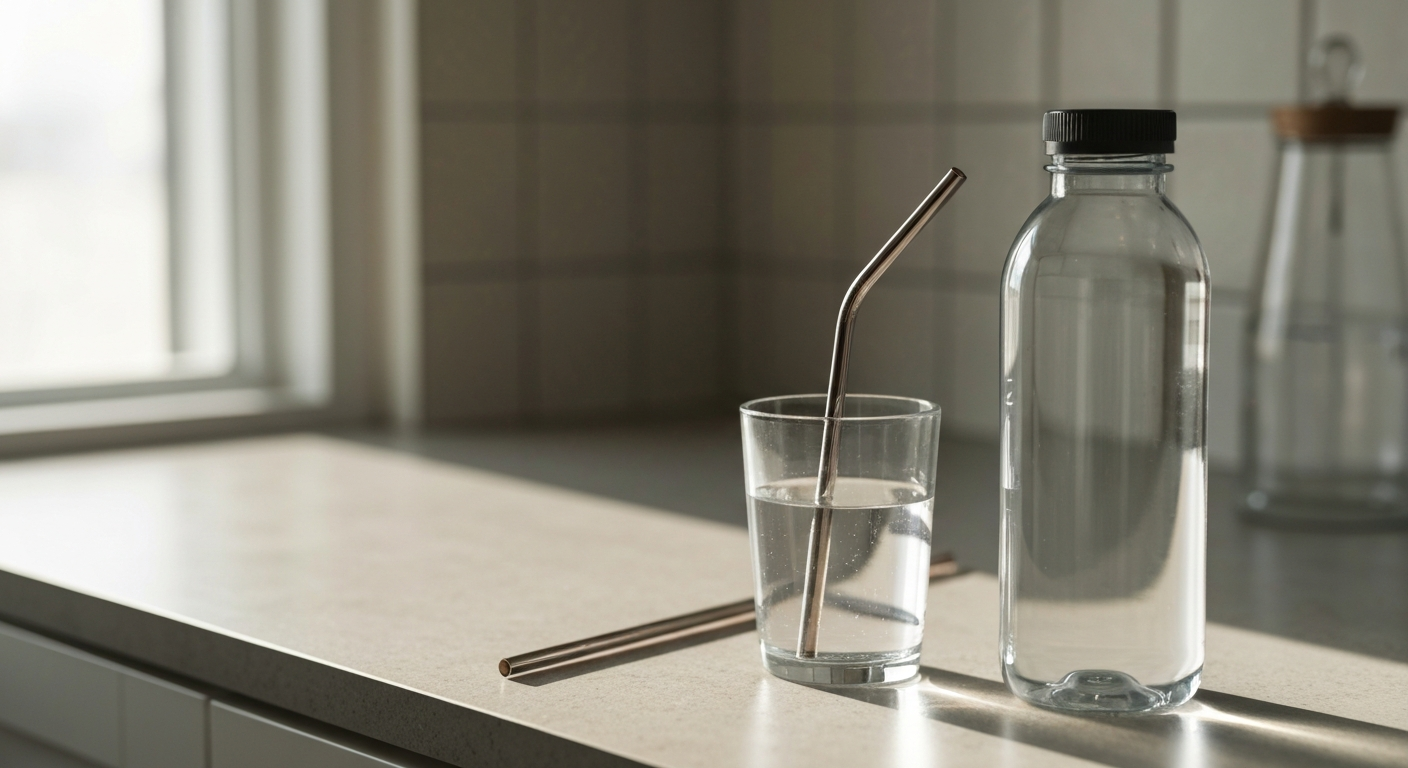

A "snore straw" — most commonly the REMplenish Myo-Nozzle — is a drinking straw-style device designed to strengthen the tongue, jaw, and throat muscles through resistance you create simply by drinking water through it.
| ✓Our Pick |
Custom-fit mouthpiece that repositions your jaw to stop snoring Great value for money — this product tackles the root cause rather than just masking the symptoms. Learn More → |
Unlike a mouthpiece that physically holds your jaw in place while you sleep, a snore straw works during the day by exercising the muscles that control your airway, similar to physical therapy for your throat.
"The Myo-Nozzle™ creates gentle, calibrated resistance with every drink." — REMplenish
Drinking through the narrow nozzle forces your tongue, jaw, and throat muscles to engage with each sip, the same way a resistance band engages a muscle during a workout. The idea is that daily repetition over weeks builds a more toned, resilient airway that's less prone to collapsing and vibrating during sleep — the actual mechanism behind snoring.
This approach belongs to a broader category called oral myofunctional therapy, which has legitimate clinical research behind the general concept — though results for any single product vary by individual.
Myofunctional therapy — exercises that strengthen the tongue and oropharyngeal muscles — has real peer-reviewed research behind the general approach.
"Polysomnography snoring decreased from 14.05 ± 4.89% to 3.87 ± 4.12% of total sleep time, P < 0.001, and snoring decreased in all three studies reporting subjective outcomes." — Camacho et al., published via the National Library of Medicine
That meta-analysis covered myofunctional therapy broadly, not this specific straw product — the manufacturer-reported usability data for this device claims a high rate of users reporting noticeable improvement after a month of consistent use, though that figure comes from the company's own study rather than independent peer-reviewed research.
As with most myofunctional approaches, the results depend heavily on consistency — drinking from it once or twice won't meaningfully strengthen anything, the same way one trip to the gym doesn't build muscle.
| You're a Good Fit If | This Probably Isn't Enough If |
|---|---|
| Your snoring is mild and tongue/muscle-tone related | Your snoring is loud, frequent, and severe |
| You're comfortable with a multi-week daily routine | You want quick or immediate snoring relief |
| You don't have significant nasal congestion | Your snoring is mainly driven by a blocked nose |
| You want a non-mechanical, exercise-based approach | You've been told you may have sleep apnea |
A snore straw is a reasonable starting point for mild snoring or as a complement to other approaches, but it's not designed to replace evaluation for moderate-to-severe snoring or suspected sleep apnea.
The Quick Fix Most People Reach for First: See what people try first for snoring relief
Most myofunctional approaches, including straw-based exercises, ask for daily consistency over at least two to four weeks before judging whether they're working.
Expect to drink one to two bottles of water through the device daily, building the habit into something you already do rather than adding a separate task. Improvement tends to be gradual rather than overnight, which is the trade-off for an approach that doesn't involve sleeping with anything in your mouth.
A snore straw is one specific commercial tool for myofunctional therapy, but the underlying muscle exercises behind it can also be done without buying anything, using simple tongue and throat exercises performed daily at home.
Common no-cost myofunctional exercises include pressing the tongue flat against the roof of the mouth and holding for several seconds, repeated tongue-to-palate clicking, and saying vowel sounds exaggeratedly to engage throat muscles, all typically done in short daily sets of ten to fifteen repetitions. These exercises target the same muscle groups a snore straw works, just without the calibrated resistance a purpose-built device provides, and they cost nothing beyond a few minutes a day. The trade-off is largely about consistency and structure: a product like a snore straw builds the exercise into something you're already doing (drinking water), which some people find easier to stick with than a separate, deliberate exercise routine.
Speech therapists and some dentists who specialize in airway health can provide a more structured, personalized myofunctional therapy program if you want guidance beyond generic exercises or a single product, particularly if snoring is significant enough that you want a more rigorous, supervised approach with measurable progress checkpoints along the way. These specialists can also assess whether your specific tongue posture, jaw alignment, or breathing pattern is contributing to snoring in a way that a generic exercise routine or off-the-shelf product wouldn't fully address on its own.
A snore straw works best as one piece of a broader approach rather than a standalone solution, especially when combined with sleep position changes and reduced evening alcohol.
| Approach | Addresses | Works Well Combined With |
|---|---|---|
| Snore straw / myofunctional exercise | Muscle tone in tongue/throat | Side sleeping, weight management |
| Side sleeping | Tongue/palate position | Snore straw, body pillow |
| Reduced evening alcohol | Throat muscle relaxation | Any other approach |
| Mandibular advancement device | Jaw position during sleep | Works independently; not usually combined with a straw |
Because a snore straw and a mandibular mouthpiece work through entirely different mechanisms — exercise versus physical positioning — combining a daytime myofunctional routine with a nighttime mouthpiece is a reasonable strategy for people who want to address snoring from multiple angles rather than betting on a single fix, and it doesn't require choosing one over the other.
A snore straw uses calibrated drinking resistance to exercise the tongue, jaw, and throat muscles involved in snoring, based on the broader concept of oral myofunctional therapy. It's best suited to mild snoring and works gradually with consistent daily use, rather than offering an immediate fix. For louder or more persistent snoring — or any suspicion of sleep apnea — a mandibular advancement device or a medical evaluation is the more appropriate next step.
Most myofunctional approaches recommend at least two to four weeks of consistent daily use before evaluating whether snoring has improved, since muscle tone changes gradually rather than overnight.
Yes — since they work through different mechanisms (muscle exercise vs. physical jaw positioning), there's no inherent conflict in using both, though it's worth tracking which change actually helps if you start both at once.
It's not a verified treatment for sleep apnea. If you have diagnosed or suspected sleep apnea, a snore straw may complement other treatments but shouldn't replace medical evaluation or prescribed therapy.
Generally yes, as it's simply a modified way of drinking water you'd consume anyway. As with any new oral exercise routine, mild jaw fatigue during the first week of use is common and typically temporary.
Reviewed and Updated on June 21, 2026 by George Wright